Strut and Shock Replacement Cost
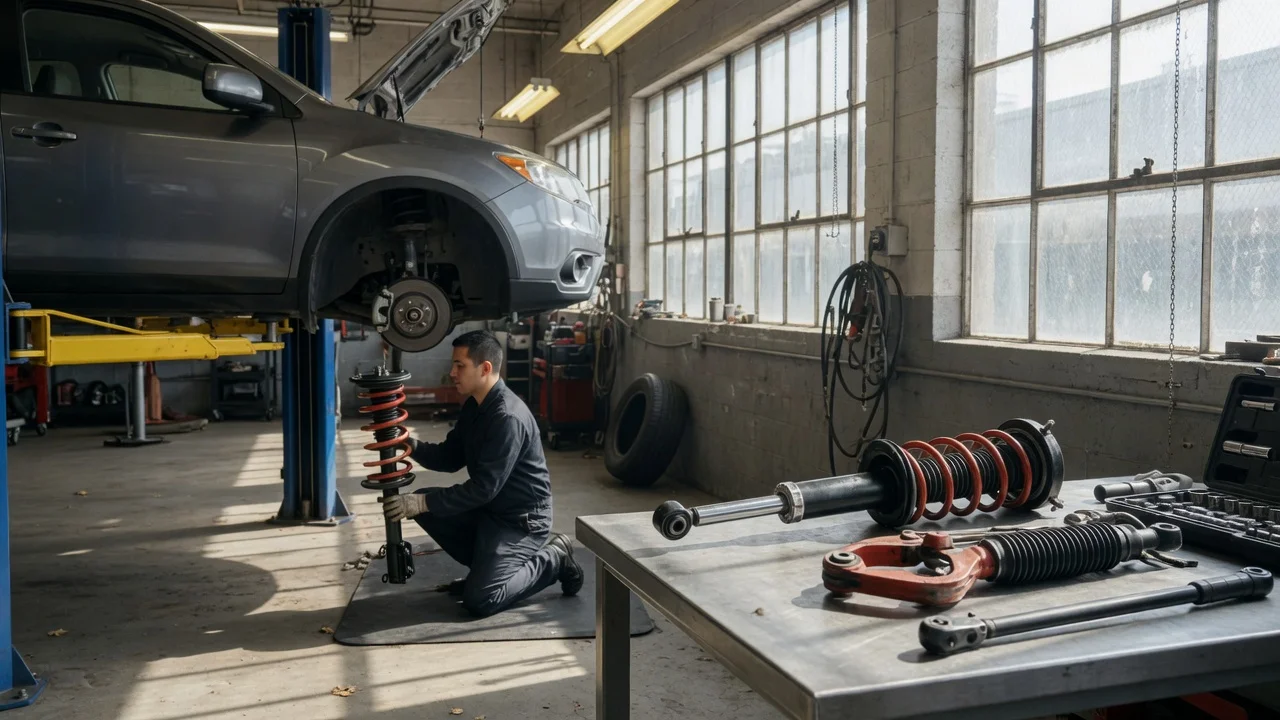
What replacement typically costs
There is no single price for replacing shocks and struts. The bill depends on the vehicle, whether the worn parts are shocks or struts, how many corners you replace, the grade of parts, and local labor. A compact car with conventional rear shocks is a different job from a crossover that uses struts at every corner. Specific dollar figures are not supplied here, so treat any quote as vehicle-specific rather than a national average.
Cost also changes when related hardware is included. Strut mounts, bearings, bump stops, dust boots, and alignment after a strut job can add to the total. Replacing only one side on an axle is usually a poor trade-off: the remaining worn unit will ride and brake differently, and many shops will quote the pair.
Shocks versus struts
A shock absorber is a damper. It controls spring bounce and is usually a separate part from the coil spring. A strut is a structural assembly: it damps motion and also locates the wheel, so it often carries the spring, a mount, and a bearing. Strut replacement is typically more labor-intensive than a shock swap because the spring must be compressed, the assembly unbolted from the steering knuckle and body, and the wheel alignment checked afterward.
Many vehicles use struts in front and shocks in the rear. Some use struts at all four corners. Confirm the layout for your model year, market, trim, and suspension package before comparing quotes. Two trims of the same nameplate can use different damper designs.
What drives the price
Vehicle and layout: size, drive type, and whether the axle uses a strut or a shock change both parts and labor time. Parts grade: economy, original-equipment-equivalent, and performance or heavy-duty units sit in different price bands. Loaded strut assemblies that include the spring and mount cost more than a bare damper. How many corners: one axle pair costs less than all four. Mixing a new unit with a worn mate on the same axle is rarely recommended. Related parts: mounts, bearings, hardware, and an alignment after strut work are often billed separately. Labor and access: rusted fasteners, seized spring seats, electronic dampers, and air-suspension modules raise time and parts cost. Electronic or adaptive dampers: magnetorheological or electronically controlled units, and the sensors or modules they use, are priced differently from passive shocks and struts. Compatibility must match the original system.
Parts and labor, itemized
A useful quote separates parts from labor and names each corner. Ask whether the price is for a bare strut or a complete assembly, and whether mounts, boots, and an alignment are included. For conventional shocks, labor is often shorter because the spring usually stays in place. For struts, labor covers removal, spring compression if the strut is not sold as a loaded assembly, reassembly, and alignment.
Loaded strut assemblies can reduce shop time because the spring and mount arrive already assembled. That can lower labor while raising the parts line. Bare struts can look cheaper on paper if you reuse a still-good spring and mount, but only if those parts are actually serviceable. Reusing a noisy mount or a tired bearing often means a second visit.
When replacement is warranted
Mileage alone is not a specification. Dampers wear gradually. Common signs include a bouncy or floaty ride, longer stopping distances on rough pavement, nose dive under braking, rear squat on acceleration, clunks over bumps, uneven tire wear, and fluid leaking from the damper body. A bounce test after a firm push on a corner is only a rough check; a leaking or physically damaged unit is clearer evidence.
If one strut or shock has failed, plan on the pair for that axle. If both axles are original and the vehicle has high miles, a four-corner quote is the comparison that matters, even if you stage the work. Alignment after strut replacement is not optional on most independent front suspensions; skipping it can undo the value of new parts through rapid tire wear.
How to get a quote you can use
Give the shop the year, make, model, market, trim, engine, and any known suspension option (sport, off-road, air, or electronic). Ask for a line-item estimate: parts brand and type, quantity per axle, labor hours, alignment, and shop supplies. If two shops differ widely, compare the parts specification, not only the total. An unresolved difference between trims or powertrains should be treated as unknown until the VIN or build sheet confirms the damper type.
DIY cost is parts plus tools and an alignment you still need to buy after a strut job. Spring compressors, torque specs, and seized hardware make this a high-risk home repair on many vehicles. If you are choosing a next step, a written estimate that names the exact units for your VIN is the reliable figure; a generic range is not.