Staked U-Joints: Identifying Them and Assessing Service Options
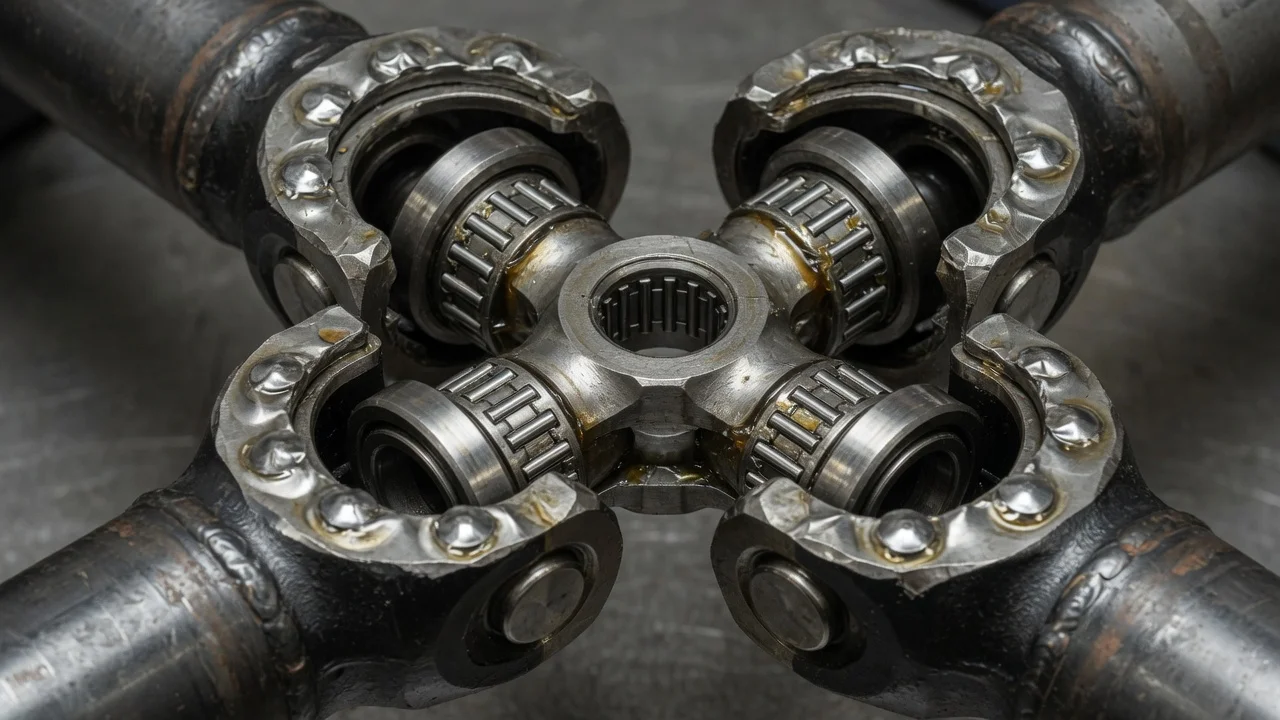
Many factory driveshafts leave the assembly plant with universal joints that are staked in place rather than held by removable snap rings. That design is quick and secure to build, but it complicates repair once a joint wears out. This guide explains how a staked U-joint is retained, how to recognize one on your vehicle, what affects the repair choice, and when replacing the whole driveshaft makes more sense than rebuilding it.
The Short Answer
A staked U-joint is a cross-and-bearing joint whose bearing caps are locked into the yoke by deforming the yoke metal around each cap. There are no external or internal snap rings to remove, and the joint is usually sealed with no grease fitting. It can often still be replaced, but not as simply as a clip-retained joint. Owners generally have two realistic paths: replace the driveshaft assembly, or have the staked joint removed and a serviceable replacement joint installed, followed by any balancing the shaft needs. Which path is appropriate depends on the yoke material, the condition of the yoke after removal, the driveshaft design and what the manufacturer specifications allow for that vehicle configuration.
How Staking Holds the Bearing Caps
A U-joint uses a cross, often called a spider, with four trunnions. Each trunnion rides on needle bearings inside a cup, and the cups sit in bores in the yoke ears. Something has to stop those cups from walking outward as the shaft rotates and the driveline angle changes. On a serviceable joint, snap rings seated in grooves do that job. On a staked joint, the factory presses the cups into position and then displaces small areas of yoke material over the edge of each cup, creating raised lips or dimples that act as a permanent stop.
Because the retention is formed from the yoke itself, removing the joint means shearing or grinding away the staked areas and pressing the cups out. Done carelessly, that process can leave the bores scored, burred or slightly out of round. A new joint relies on clean, true bores to seat its cups squarely, so the condition of the yoke after removal largely decides whether a rebuild will hold up.
How to Identify a Staked U-Joint
With the vehicle safely supported on stands and the wheels chocked, clean the area around each bearing cup and look closely at where the cup meets the yoke ear. A clip-retained joint shows a visible snap ring, either on the outer face of the cup or on the inner side of the yoke ear. A staked joint shows no ring; instead you will typically see small punch marks, peened lips or deformed metal around the rim of the bore. The absence of a grease fitting on the cross is another common, though not conclusive, sign.
Not every clipless joint is staked. Some factory joints are held by plastic injected through a small hole in the yoke ear, which leaves a visible port or plastic residue rather than peened metal. That type is usually removed by pressing the cups hard enough to shear the plastic, and the replacement joint then uses clips. Telling the two apart matters because the removal method and the risk to the yoke differ.
What Changes the Service Decision
Driveshaft construction is the first factor. Steel tubes with steel yokes are the most tolerant of joint removal. Aluminum shafts and yokes are softer and can be damaged more easily when staking is cut away, and composite shafts may have yokes bonded to the tube in ways not intended for field service. Two-piece shafts with a center support bearing, or shafts that combine U-joints with a constant-velocity joint, add components that may need attention at the same time. If the manufacturer supplies only a complete driveshaft for your vehicle, that is a strong indication joint replacement on that part is not a factory-supported repair.
Condition and history also shift the answer. Heavy corrosion around the cups makes extraction harder and raises the chance of bore damage. A shaft that has already had a joint changed may carry a previous repair of unknown quality, so check the service history if you have it. Operating conditions matter as well: towing, off-road driving or frequent heavy loads put more stress on a rebuilt yoke, and a lifted or lowered vehicle may run driveline angles that wore the original joint early. Replacing the joint without addressing a contributing cause can lead to the same failure again.
What the Owner Can Do
Start with an inspection. Typical warning signs of a worn U-joint include a clunk when shifting into drive or reverse, a vibration that changes with road speed, a rhythmic squeak at low speed and rust-colored powder around a bearing cup. With the vehicle secured, grip the driveshaft near each joint and try to twist and lift it; a healthy joint should show no noticeable free play or notchy movement. Also look for torn seals, since a sealed joint cannot be relubricated. Your maintenance schedule may call for driveline inspection, but it will not usually list a replacement interval for a sealed joint.
If a staked joint is worn, compare options before buying parts. A complete replacement driveshaft, new or remanufactured, restores factory retention and balance and is often the simplest choice for owners without a press. Converting to a serviceable joint can cost less in parts, but it requires a press or suitable joint tool, care in removing the staking without damaging the bores, a replacement joint that matches the cup size and design of your yoke, and correct orientation of any grease fitting. Mark the driveshaft and its flange or slip yoke before removal so it goes back in the same position, and follow the service information for fastener torque.
Many owners split the difference by removing the driveshaft themselves and taking it to a driveline shop. A shop can cut out the staking, inspect the bores, fit the new joint and check the shaft for balance. That last step matters because a shaft balanced at the factory can vibrate after a rebuild if weights are lost or the new joint seats unevenly.
Limitations and Next Step
This guide describes the general design and common repair practice; it cannot confirm whether your specific shaft is serviceable, which replacement joint fits it, or what torque and balance requirements apply. Those details come from the manufacturer specifications and parts information for your exact vehicle configuration, including drivetrain, transmission and shaft type. Visual identification can also be uncertain on a heavily corroded joint.
Seek professional help if the yoke bores are damaged, the shaft is aluminum or composite, you cannot safely support the vehicle, or vibration remains after a joint replacement. Persistent vibration may point to balance, driveline angle or another component rather than the joint itself. As a next step, confirm your driveshaft type, inspect each joint, then decide between a complete shaft and a shop rebuild based on the condition you find.