Spark Plugs and Wires: Should You Replace Them Together?
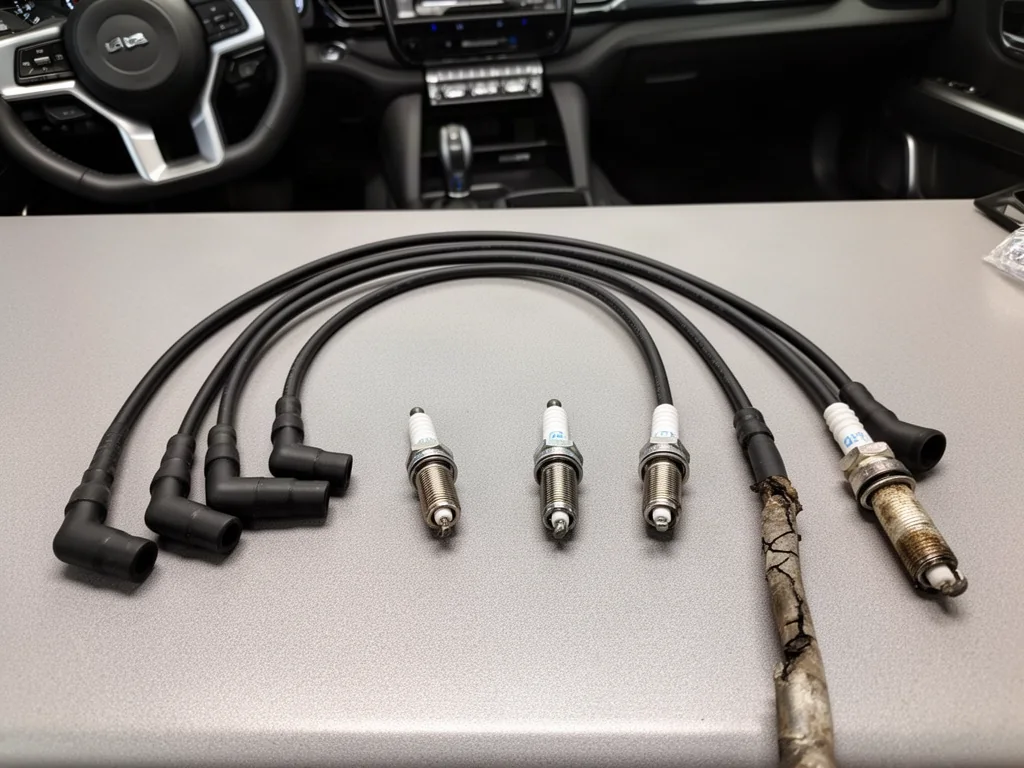
Spark plugs get most of the attention at tune-up time. On engines that use plug wires, though, the wires do part of the same job and wear in many of the same ways. If you know how wires age, what failing ones feel like from the driver's seat and how to inspect them safely, it is easier to decide whether one service visit should cover both parts.
How spark plug wires carry voltage and why they degrade over time
A plug wire carries the high-voltage pulse from the ignition coil or distributor cap to one spark plug. It only works if the whole path stays insulated, so the terminal, conductor, jacket and rubber boot at each end act as one sealed circuit. Most wire sets use either a carbon-suppression core or a spiral-wound conductor. Both are built with some resistance to limit radio interference. When that resistance climbs too high or becomes uneven between wires, less energy reaches the plug and the spark weakens.
Wires wear out in several ways at once. Heat from the exhaust manifolds bakes the insulation, oil and coolant leaks soften it, and ozone and constant engine vibration eventually crack it. Moisture that gets in corrodes the terminals. Worn plugs speed this up, because a wider gap needs more voltage to fire, which pushes old insulation closer to breaking down. Before worrying about any of this, check how your engine is set up. Many newer engines use coil-on-plug ignition and have no plug wires at all.
Spark plug boots and caps: the weak link at each end of the wire
The boot is the flexible insulating sleeve that fits over the plug at one end and over the coil or distributor cap tower at the other. People call it a cap, a boot or a plug cover, but it does the same job under any name: it seals the connection and keeps voltage from finding a shorter path to metal. Over time boots harden, crack, swell when soaked in oil or lose their grip. A loose or split boot lets spark leak to ground and lets moisture in.
Boots are also where many wires get ruined during plug service. A boot that has stuck to the plug's porcelain can tear, and pulling on the cable instead of the boot can separate the wire from its terminal. A thin film of dielectric grease inside the boot makes the next removal easier and keeps moisture out; it does not improve the electrical connection. A clean, flexible-looking boot can still hide a corroded or loose terminal, so looks alone do not prove the wire is healthy.
Symptoms that point to failing wires rather than the plugs alone
Failing wires usually show up as a rough idle, a stumble or misfire under load, hesitation when accelerating, harder starting and slowly worsening fuel economy. You may also get a check engine light with a misfire code. Timing is the clue that points to the wires. If the problems appear on damp mornings, in rain or after a car wash and then fade once the engine bay dries, voltage is probably escaping through damaged insulation, because moisture gives it an easier path to ground.
Some other clues are worth noticing from a safe distance: a faint ticking or snapping sound near the engine, a blue glow or visible spark along a wire in a dark garage, or a sharp ozone smell. Never touch the wires to investigate these. A misfire code tells you which cylinder is misfiring, not which part has failed. Plugs, wires, boots, coils, injectors and compression problems can all set the same code. Get professional testing if misfires return after new plugs, move between cylinders, or show any sign of arcing near fuel or vacuum lines.
How to check spark plug wires safely
Start with the engine off and cool. Look along each wire for cracks, chafed spots, burn marks and oil-soaked insulation, and make sure every boot seats firmly at both ends. Routing matters as much as condition. A wire that rests on an exhaust part, rubs on a bracket or is bundled tightly with its neighbors can fail early even if the jacket still looks intact. Check that the factory looms and separators still hold each wire where it belongs.
A multimeter can measure resistance on a wire removed from the engine. Compare the readings across the whole set and against the wire maker's specification, which usually depends on wire length, instead of relying on one universal number. A wire that reads much higher than the others is suspect. On a running engine, limit any check for arcing to watching in low light; never touch, pull or reroute wires. A wire can pass a meter test and still leak under load, so symptoms that persist call for a shop's scope or load test.
Should you replace the wires at the same time as the plugs?
The practical rule is simple. If the wires show any wear, are original on a high-mileage engine, or have to come off anyway to reach the plugs, replace both in one visit. That saves paying for labor twice and avoids disturbing brittle boots a second time. Keeping the existing wires makes sense if they were replaced recently, the insulation is still flexible, the boots come off cleanly and resistance readings are consistent across the set. On older engines, that combination is the exception, not the rule.
New plugs can also expose weak wires. A fresh, correctly gapped plug changes the voltage demand on the ignition system. A marginal wire that coped with the old plugs may start misfiring soon after the plug change, which makes the new plugs look defective. If boots tear or stick during removal, the decision has been made for you, so have a wire set on hand before you start. For timing, follow the vehicle maker's guidance. Many manuals call for inspecting the wires at plug service rather than replacing them on a fixed schedule.
Choosing a plug and wire set: OEM-style, performance, and matching the engine
A matched wire set gives you the correct length for each cylinder, boots shaped to fit the engine's plug wells, and terminals that fit either a coil pack or a distributor cap. Brands that supply automakers, such as AC Delco, are a common choice for factory-style replacement on the vehicles they cover. Still, confirm fitment by engine and model year rather than assuming it from the brand name. Performance wires usually offer lower-resistance spiral cores, thicker silicone jackets and higher heat tolerance.
Those upgrades help most on modified or high-heat engines and make little noticeable difference on a stock daily driver. Whatever you choose, do not mix wire types or resistance values on one engine. Also avoid moving old boots or terminals onto new wires, since that brings back the weak points you were trying to get rid of. When buying a combined plug and wire kit, check the plug type, heat range and gap against your vehicle's specification. Kits are sometimes listed by broad application rather than for an exact engine.