Spare Tire Pressure: Find the Right PSI and Know When to Check
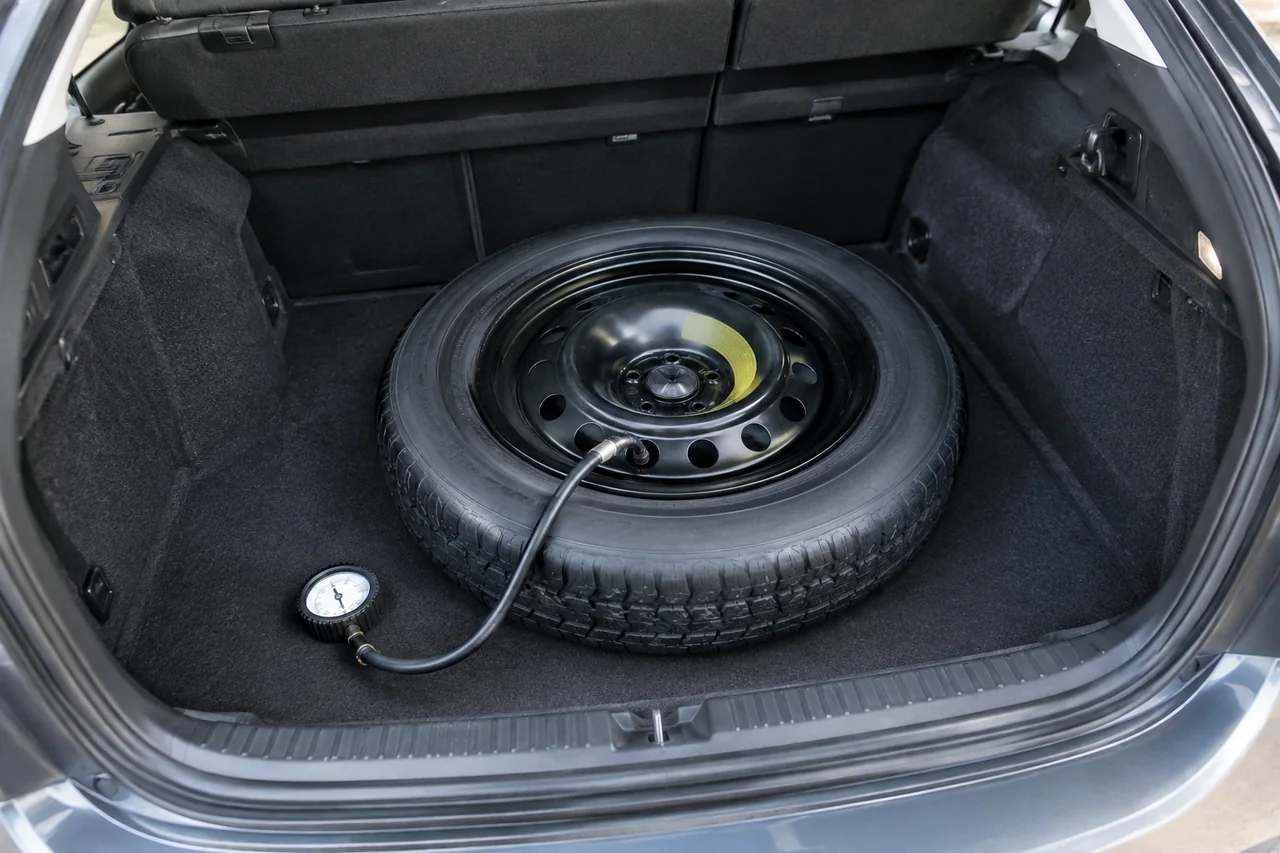
The correct spare tire pressure is not a guess and is not the same on every vehicle. How much air should be in a spare tire depends on whether you carry a compact temporary spare or a full-size spare, and on the cold inflation figure the manufacturer published for that tire. Check stored tire pressure with a gauge before you need it, because a spare that looks ready can still be low or already flat.
Find the Specified Cold Pressure for Your Spare
The psi a spare tire should carry is the specified cold inflation pressure for the spare actually fitted, not a single figure for every car. How much air goes in a spare tire differs between a compact spare tire and a full-size spare because they are sized and loaded differently. Find spare tire air pressure in the owner's manual and on the tire information placard, often on a driver's door jamb, glove-box lid, or fuel-filler door. When the placard lists a separate spare-tire entry, use that cold tire pressure as the target.
The number molded on the sidewall is a maximum inflation marking, not automatically the vehicle's recommended spare tire psi. Inflating to that ceiling can over-pressure a tire relative to the load and speed the manufacturer intended for spare use. If the spare has been replaced with a different size or brand, or the placard and manual do not clearly match the tire on the carrier, have a tire professional confirm both suitability and the correct air pressure for the spare before you rely on it.
Why Many Compact Spares Specify 60 PSI
Many compact temporary spares specify 60 psi because a small-diameter, narrow tire must carry a large share of the vehicle's weight on a limited contact patch. That higher setting is common on donut-style units, yet it is not a universal setting for every spare. Construction, overall diameter, section width, and rated load all influence how much air should be in a spare of this type. A stiffer, higher-pressure carcass helps the compact spare support load without the air volume of a full-size tire.
Confirm the exact cold-pressure specification before adding air. Some compact spare tires list a figure other than 60, and a mismatched full-size unit in the same well must not be pumped to a donut's pressure. Matching that spare tire pressure to the published cold value also does not lift the temporary spare's operating limits. Speed, distance, and other restrictions printed in the owner's manual or on the tire itself still apply, because the compact spare is a short-term substitute, not a fourth matching road tire.
Confirm the Pressure for a Full-Size Spare
A full-size spare still needs the vehicle manufacturer's applicable pressure guidance; matching the diameter of the road tires does not, by itself, establish the target. Tire pressure for a spare of the same size often follows the placard figure for the axle that spare will support, but that is not something to assume from appearance. When front and rear cold pressures differ, the owner's manual spare-use instructions tell you which value applies after a roadside change. Using the wrong axle figure can leave the replacement over- or under-inflated for the corner it occupies.
Even a full-size spare can carry use restrictions, particularly if its wheel, load rating, speed rating, or tire construction differs from the vehicle's fitted equipment. A steel wheel under alloy road wheels, a different brand, or an older stored tire may change handling, braking, or clearance in ways the manufacturer already flagged. Follow those limits until a matching tire is installed. If the stored unit's markings do not line up with the placard size, treat the pressure question as unsettled and have a professional confirm both fitment and inflation before you drive on it.
Measure Spare Tire Pressure Safely
Judge spare tire pressure with a suitable tire pressure gauge on a cold spare, not by appearance or a squeeze of the sidewall. A compact spare can look firm while still sitting well below its specified cold pressure, and a full-size spare can look slightly low when it is actually at the placard value. Follow the vehicle's spare-access instructions to reach an accessible valve stem. Take a stable reading after the hose or chuck is fully seated, then compare that number with the verified specification rather than a remembered round figure.
If the reading is low, add air with suitable equipment to the verified specification, recheck with the same gauge, and replace the valve cap so dirt and moisture stay out of the valve stem. Stop if the carrier will not release, the spare is trapped under the vehicle, or you would have to crawl beneath an unsupported vehicle to reach it. Do not improvise on a stuck underbody spare carrier. Those access problems belong to a shop or roadside assistance, not to a roadside workaround that puts you under the chassis.
Include the Stored Spare in Routine Pressure Checks
Stored tire pressure falls even when the spare never leaves the well. Air can slowly permeate through rubber and liners, and a leaking valve stem or a poor bead seal will drop the reading faster. That is why a spare that was correct last season can sit well below spec when a road tire goes flat. Ambient temperature also moves the gauge number: a cold morning reading is lower than the same tire after a hot afternoon in a closed trunk or cargo area, even though no air was used on the road.
Include the spare in routine tire-pressure checks and in pre-trip preparation, following any schedule the manufacturer specifies for the stored tire. Many vehicles do not monitor the spare the same way they monitor the four road wheels, so a dashboard warning may never show low spare pressure. Direct sensors, if fitted, can also miss a tire that lives in the cargo area or underbody carrier. Repeated loss after inflation points to a valve, bead, or casing problem and needs professional inspection rather than another top-off.
What to Do When the Spare Is Flat
Do not drive on a flat spare tire. If the stored unit is already down when you need it after a puncture, move the vehicle to a safe location away from traffic before you do anything else. A low gauge reading is not proof the spare is serviceable. Visible cuts, bulges, cracking, dry weathering, or wheel damage call for professional assessment, because a damaged casing or bent rim can fail even after air is added to the specified cold pressure.
An apparently intact spare may be inflated to its verified specification when access is safe and suitable equipment is available, then rechecked on the same gauge. Holding air for a few minutes does not establish the tire's condition; a slow leak can still leave you stranded a short distance later. Call roadside assistance when the spare will not hold pressure, shows damage, or cannot be accessed and checked without crawling under an unsupported vehicle or forcing a stuck carrier. That is the safer choice whenever both the road tire and the spare are out of service.