Signs Your Tires Need Balancing and Why Vibration Can Persist After Balancing
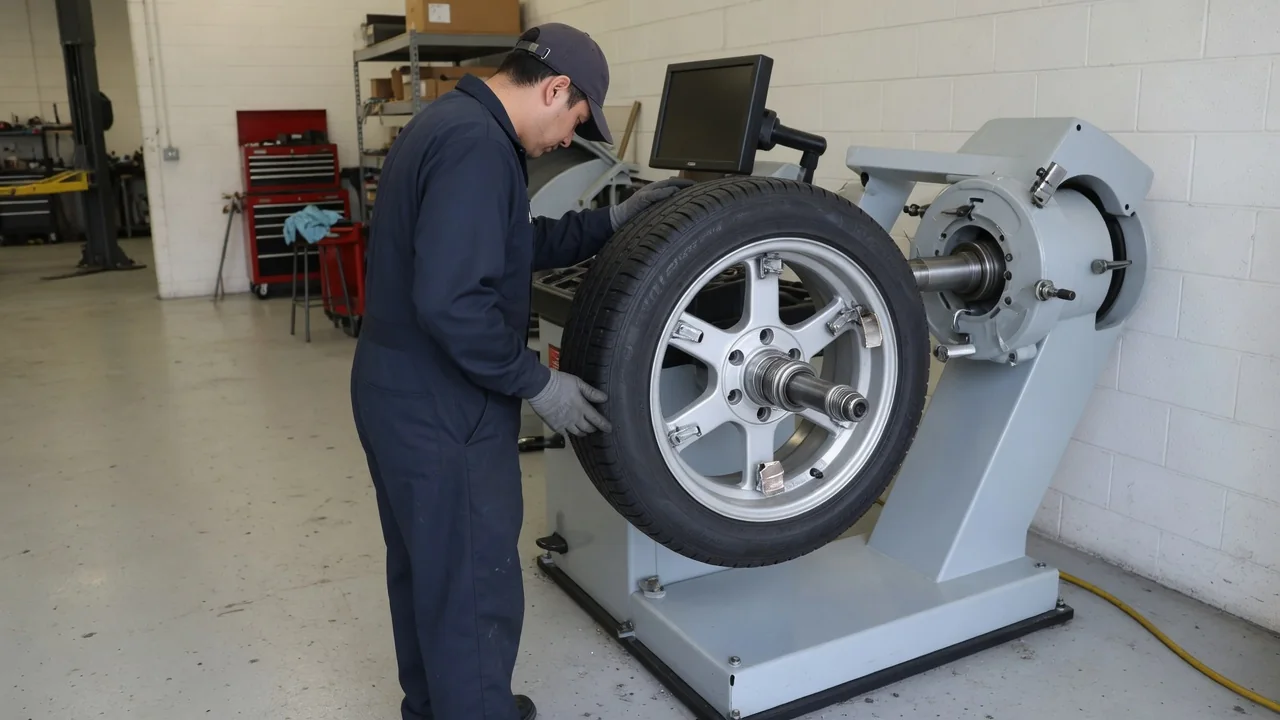
Tire balancing issues often show up as vibration, steering-wheel shake, or uneven tread wear, but those signs can also come from mounting, pressure, or other chassis problems. Common tire balancing symptoms, the meaning of tire balancing dots during installation, and tire vibration after balancing all need careful interpretation rather than a single assumed cause. Recent tire work, impacts, and speed-related shake help a shop decide what to inspect next.
Symptoms That Can Point to Tire Imbalance
Tire and wheel imbalance can produce a rhythmic vibration that often becomes noticeable in a particular speed range and may fade or change as speed continues to rise. Steering-wheel shake may be felt at the rim, while vibration through the seat or floor can appear at the same time or instead of a shaking wheel. Sensation alone cannot reliably identify the affected corner, because road input and chassis paths mix the feel. Tire balancing problems of this kind still deserve a structured check rather than guessing which assembly is heavy.
Irregular or uneven tread wear can travel with vibration, yet wear does not establish imbalance as the cause. Cupping, feathering, or a flat spot can come from inflation, alignment, or a dragging brake as readily as from a heavy spot. Useful history includes whether tire balancing symptoms began after tire installation, a rotation, a curb or pothole impact, or the loss of a wheel weight. A change that appeared immediately after service points toward mounting or balance, while a delayed onset after an impact points toward damage that still needs inspection.
Safe Observations Before Scheduling Tire Service
Before scheduling service, record when vibration occurs during ordinary driving, including the speed range and whether braking or acceleration changes it. Do not deliberately provoke a shake or hunt for a worst-case speed. Cold tire pressure should be compared with the vehicle placard, because underinflation or overinflation can mimic tire balancing issues. While parked in a safe place, look at accessible tread and sidewalls for cuts, bulges, and obvious uneven wear. Those notes help a technician separate inflation and damage from a balance complaint.
Visible clues can include adhesive marks where a wheel weight once sat, packed stones or mud in the tread, or a missing clip-on weight on a steel wheel. None of those findings confirms a diagnosis, because debris, wear, and a lost weight can coexist with a bent rim or a seating problem. Stop in a safe location and arrange assistance for sudden severe vibration, a bulge, exposed cords, or suspected wheel looseness. A bulge or exposed cords can precede rapid air loss, and looseness is a fastening concern rather than leftover imbalance.
How Balance or Wheel Mounting Problems Can Leave a Shake
Balancing corrects uneven mass distribution in the tire and wheel assembly by placing wheel weights so the rotating mass is closer to even. That process has limits when the tire has physical damage or built-in nonuniformity, because adding mass cannot flatten a high spot or restore a damaged belt. Inaccurate wheel centering on the balancing machine, a cone or collet that does not match the hub bore, incorrect weight placement, or a weight that later detaches can leave residual imbalance. The machine reading then no longer matches what the vehicle feels.
Even after a balancer reports an acceptable result, improper wheel seating or centering on the vehicle can still produce vibration. A rim that is not fully seated on the hub, corrosion on the mating face, or a centering ring that does not locate the wheel can recreate a shake that looks like leftover tire balancing problems. Mounting, seating, and printed balance results belong in a professional inspection. Do not lift the vehicle or adjust wheel fasteners as a home experiment; incorrect fastener work is a safety risk, and a shop can confirm how the assembly sits on the hub.
What Tire Mounting Dots Actually Indicate
Colored tire mounting dots, sometimes discussed as tire balancing dots, are manufacturing reference marks used during tire mounting. They are not wheel weights and do not themselves correct imbalance. A mark may indicate a high or low point in radial force or a uniformity reference, but meanings and alignment procedures depend on the tire manufacturer and any applicable wheel guidance. There is no universal color rule that applies to every brand. Treating every paint mark as a weight location or as proof of a bad job misreads what the mark is for.
Aligning a dot with a valve stem is appropriate only when the relevant mounting instructions specify that match. Some procedures pair a uniformity mark with the valve, a painted wheel mark, or another stated reference; others use a different scheme. Dot position alone cannot prove a poor installation, because the mark can be covered, faded, or unused on a given tire. After correct reference-mark alignment, the assembly may still need balancing, since matching a manufacturing point does not remove leftover mass variation around the rim.
Why Vibration Can Persist After Balancing
Tire vibration after balancing can still occur, and it does not automatically mean the balance job failed. Radial runout in the tire or wheel, a bent rim, belt damage, or tire nonuniformity can produce a once-per-revolution force that wheel weights cannot cancel. Balancing only redistributes mass; it does not straighten a high spot or restore a damaged structure. Irregular wear that already exists can keep creating a shake after the heavy spot has been corrected, because the remaining tread still contacts the road unevenly.
Other systems can imitate leftover imbalance. Vibration that appears mainly under braking can point toward rotors or related hardware, while a shake that changes with load or over rough pavement may involve worn steering or suspension parts. A growling or speed-related rumble can support a wheel-bearing concern, and a vibration that tracks with engine or driveline speed rather than road speed needs a different path. Persistent shake after a recent balance warrants reassessment of the whole complaint, not an assumption that either the tire is defective or the shop simply failed.
What to Ask the Shop to Check Next
Give the shop a clear history: when the shake started, the speed range, whether braking or acceleration changes it, recent tire installation or rotation, any curb or pothole impact, and whether the feel changed immediately after balancing. Ask them to verify remaining balance, machine centering of the assembly, how the wheel seats on the hub, tire condition, and any vehicle-specified mounting requirements. That request keeps the next visit focused on tire balancing issues that a first pass may have missed, including a weight that fell off or a rim that was not centered.
Professional radial runout measurement and road-force testing can help investigate a remaining shake by showing whether a high-force location or geometric variation is present, but neither test is a guaranteed diagnosis by itself. Results still need comparison with the driving complaint and with the matching tire. Ask for findings that support any recommended repair, such as a bent wheel, a damaged tire, or a seating problem, and confirmation that the original vibration was reassessed after the work. Balance numbers on a printout do not replace a road check of the same shake.