Saab ignition
A Saab ignition concern usually appears as a slow crank, a click without rotation, or a start that catches and dies. The phrase “Saab ignition” can describe the key and switch pathway, the coil and spark side, or the full vehicle starting sequence on a turbocharged four-cylinder with a floor-mounted key and other Scandinavian packaging quirks. Because the starter circuit, battery state of charge, cranking speed, fuel delivery, and diagnostic checks overlap at the moment of starting, the useful first step is to treat the symptom, not assume one failed part. Verifying what happens during crank separates a switch or immobilizer issue from weak spark or pressure loss.
Essential answer
The essential answer is that “Saab ignition” refers to the entire chain that wakes and starts the engine, not only the ignition switch beside the shifter or a single coil. On a no-start, the faint repeated clicking usually points toward the starter circuit and battery state of charge, because the solenoid cannot hold and the cranking speed stays too low. A crisp crank with no fire shifts attention to ignition triggering, fuel delivery, or a security interruption. Observing whether the dash stays dark, the tachometer moves, or the engine kicks briefly gives a better direction than swapping parts immediately.
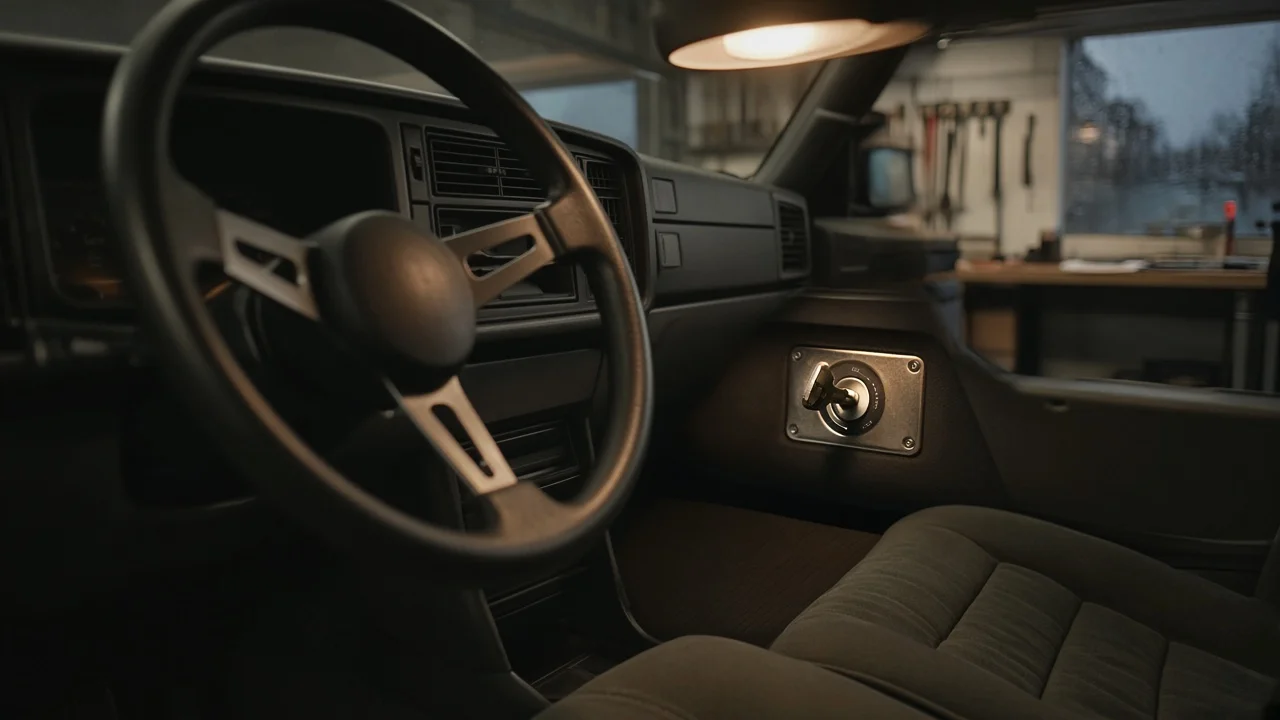
Saab’s layout adds useful clues. The key is often mounted near the transmission tunnel, and the ignition switch operates through a linkage that can develop wear, making the electrical position differ from the mechanical key position. If a key reaches the start position but nothing clicks, the ignition switch pathway or starter circuit is more likely than the battery. If the engine rotates normally but will not run, checking for consistent spark and fuel pressure against diagnostic checks matters more than cranking speed. Manufacturer-dependent codes may identify a path, yet the code is a symptom to interpret, not proof that one component must be replaced.