Running an EV Charging Cable Under or Through a Garage Door
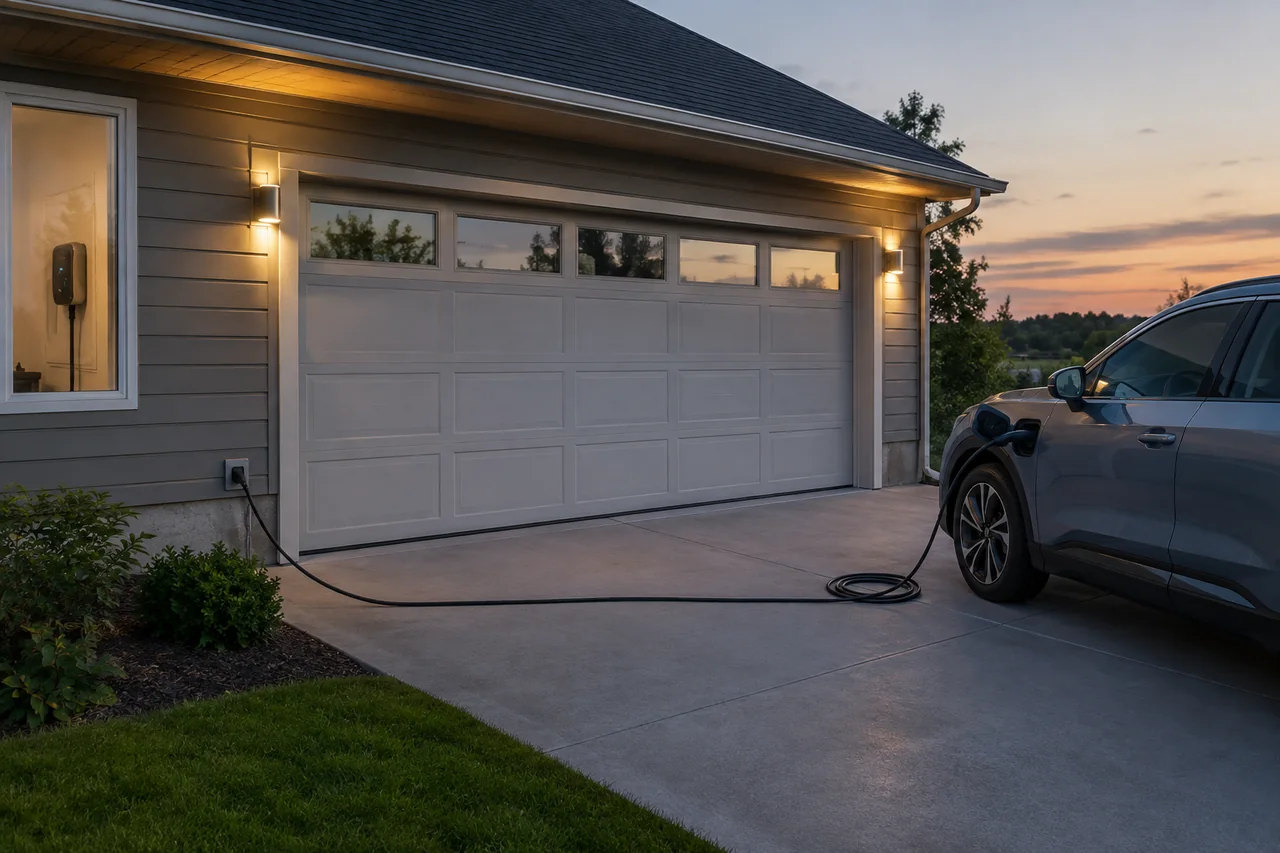
Running an EV charging cable under a closed garage door seems like a quick fix, but it can crush insulation, defeat weather sealing, and leave high-voltage conductors exposed. A pass-through through the wall or a modified door seal is safer, though each option has limits. This article explains the risks, the available pass-through approaches, and how to protect both the cable and your home when the charger must stay inside.
Why Running the Cable Under a Closed Garage Door Is Risky
A garage door can weigh over 100 pounds, and when it closes on a charging cable, that force concentrates on a small contact patch. The bottom seal compresses the jacket against the floor, which can flatten the insulation, nick the outer sheath, or cut through to the conductors over repeated cycles. Even if the cable appears to survive, internal copper strands may be damaged. A compromised jacket exposes live wires to moisture and creates a shock risk, while damaged conductors can overheat and potentially start a fire during high-current charging.
Garage door auto-reverse systems rely on optical sensors or motor force sensing, but a thin cable often slips between the sensor beam or fails to generate enough resistance to trigger reversal. Many openers are calibrated to reverse only for solid objects like a child or bicycle. The door may continue closing and press on the cable with its full closing force. Assuming the opener will detect the cable is unsafe; the cable can be pinched repeatedly, and the opener's force limit may be adjusted too high to stop in time.
Garage Door Pass-Through Options and Their Limits
Products sold as garage door pass-throughs typically include a low-profile channel that replaces a section of the bottom weather seal or a notched insert that lets the cable sit below the door edge. Some channels are designed to be installed beneath the door's existing seal, creating a small tunnel. Others require cutting a notch in the rubber seal itself. Before buying any kit, verify the connector end of your cable can physically fit through the channel, and that the door fully seals against the ground with the cable in place. A channel that pinches the cable when the door is closed eliminates the safety benefit.
Any modification to the door's bottom edge can affect its weather tightness, insulation value, and even the factory warranty. A channel that raises the door slightly may let in rain, snow, and pests. After installing a pass-through, the opener's limit switches and force settings often need adjustment so the door closes fully but does not press excessively on the channel and cable. Watch for flattening of the cable, scuff marks on the jacket, water pooling at the threshold, or a door that begins to close unevenly—these are signs the pass-through is not working correctly.
Considerations for Tesla Owners Charging Through a Garage Door
Tesla charging equipment, like any other brand, is subject to the same mechanical hazards when a cable is routed under a garage door. The wall connector and mobile connector manuals provide specific guidance about cable handling, bending radii, and outdoor exposure. The mobile connector's control box is not fully weatherproof and should not be left outside permanently, while the wall connector is designed for either indoor or outdoor mounting. Read the documentation for your specific unit before choosing a door pass-through solution. Tesla does not endorse any third-party under-door channel products.
Cable length is a frequent constraint. The Gen 3 wall connector ships with a 24-foot cable, and the mobile connector with a 20-foot cable, but the usable reach depends on the charge port location—driver's side rear on most models—and the distance from the charger to the door. The connector handle and its bulky strain relief often determine whether a pass-through is possible at all, since it must fit through any channel or notch. Do not use an extension cord or a non-approved adapter to gain extra length; the charger's ground-fault and temperature monitoring may not work correctly, and many extension cords are not rated for continuous high-current charging.
Wall Pass-Throughs as a Permanent Alternative
A permanent wall pass-through can be a cleaner solution. The concept involves drilling a hole through an exterior wall and installing a sealed conduit or weatherproof grommet through which the charging cable can pass. Alternatively, an exterior-rated outlet or a dedicated outdoor charger can be installed so the cable no longer has to cross the door opening at all. This eliminates the pinch risk entirely and preserves the garage door's weather seal. However, cutting through a wall is a more invasive project that may require permits and professional help.
It is important to distinguish between passing a finished charging cable through a wall and relocating the charger's supply wiring. Most building and electrical codes prohibit running flexible appliance cords or charging cables through walls. The correct method for a permanent installation is to install a new circuit or extend the existing supply wiring to a junction box or charger location on the outside. This work must be done by a licensed electrician, and the charger's installation manual will specify whether the unit is rated for outdoor exposure, how it must be mounted, and what clearances are required.
Protecting the Charging Cable Outdoors and on the Driveway
Outdoor routing should keep the cable away from vehicle traffic, foot paths, and standing water. Plan a route along a wall or fence, and use hooks or cable hangers to keep the cable elevated. Coiling and hanging the cable after each session prevents kinks and tangles, and keeps the connector away from dirt and moisture. Many chargers include a wall mount or holster for the connector; use it whenever the car is not charging. Never leave the cable lying on a driveway where it can be driven over, even with a protector in place.
Cable ramps can protect against crushing by vehicle tires and reduce trip hazards across walkways. Choose a ramp with an internal channel diameter that matches your cable without compressing it, and inspect the ramp for cracks that could pinch the cable. In cold climates, snow and ice can freeze the cable to the ground and make it brittle; in summer, direct sun can degrade the outer jacket over time. Keep the connector capped or holstered when not in use to prevent corrosion in wet weather. A simple visual check for cracks, cuts, discoloration, warm spots during charging, or a loose strain relief at either end can catch problems before they become dangerous.
When to Rethink the Setup or Call a Professional
If you find yourself running the cable under the door every day, the charger is probably in the wrong place. Repeated manual routing increases wear on the cable and the door seal, and it becomes a chore that invites shortcuts. A permanent solution, such as relocating the charger to the wall nearest the parking spot, installing an exterior-rated outlet, or adding a dedicated outdoor charger, removes the daily friction and the pinch hazard together. Consider the long-term convenience and safety rather than trying to make a temporary fix work indefinitely.
Stop using the equipment immediately if you see damaged insulation, exposed wires, repeated charging faults, burning smells, or the breaker trips during charging. These indicate a serious electrical fault that requires professional inspection. A licensed electrician can evaluate the existing installation, relocate a charger, or install an exterior-rated circuit and outlet. Before making permanent changes to a wall or garage door, check with your local building department about permits and inspections, and with any landlord or HOA about restrictions. Permanent electrical work should always comply with local codes to protect both the equipment and your home.