Rough Idle in Toyota Corolla, Camry, Yaris, Echo and Pontiac Vibe: Causes and Checks
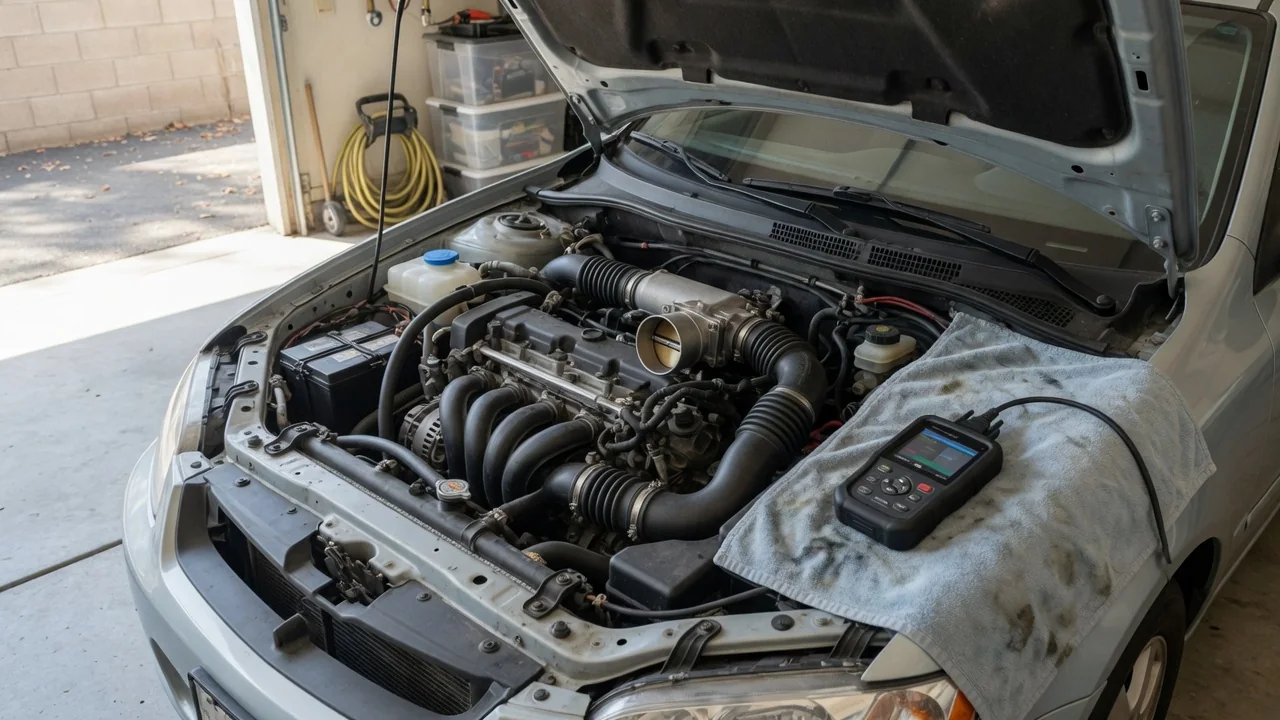
A rough idle in a Toyota Corolla, Camry, Yaris, Echo, or Pontiac Vibe often appears as a shake at stoplights, a wandering tachometer needle, or a stumble when the A/C kicks on. Owners of models like the 2003 or 2005 Corolla, 2007 Yaris, 2009 Vibe, or 2010 Corolla may notice the condition worsens in Drive or after warm-up. Pinpointing whether the cause is a dirty throttle body, vacuum leak, failing ignition coil, or stuck PCV valve starts with careful observation of symptoms and triggering conditions.
How a Rough Idle Shows Up in a Toyota Corolla and What to Note First
A rough idle typically shows up as noticeable vibration through the steering wheel, seat, or shifter while sitting at a red light. On a Toyota Corolla or Camry, the tachometer needle may rise and fall by 100 to 300 rpm without driver input, and the car can stumble when the air conditioning compressor engages. In some cases, like on a 2005 Corolla or 2009 Pontiac Vibe, the engine may dip so low that it stalls as the vehicle rolls to a stop or when shifting from Park into Drive.
Before chasing parts, note exactly when the roughness occurs. A cold start idle problem often points to a rich mixture or a sticking idle air control circuit, while a fully warm stumble suggests a vacuum leak or weak ignition coil. Compare Park versus Drive with the A/C on and off, and record whether the issue began after refueling, a battery disconnect, or recent service. If the check engine light is on steady, a stored misfire code can help; if flashing, stop driving. A simple log with mileage, frequency, and freeze-frame data gives a technician a head start.
Main Causes to Consider: Throttle Body, PCV, Ignition Coils and Vacuum Leaks
Carbon buildup on the throttle body is a common contributor to idle fluctuation because it restricts the small amount of airflow the engine needs at closed throttle. On electronic throttle control Toyotas, the ECU learns a baseline opening; once deposits form, actual airflow no longer matches the learned value. Cleaning the throttle plate can restore smooth operation, but forcing the blade open by hand can damage the drive motor or gears. After cleaning, an idle relearn procedure is usually required so the computer can adapt to clean surfaces.
A failing PCV valve or cracked hose can also cause a rough idle by allowing unmetered air into the intake or by pressurizing the crankcase. On a Toyota Echo or 2007 Yaris, the PCV valve is often tucked under the intake manifold, so a visual check for oil residue and brittle rubber is first. Ignition problems produce a rhythmic misfire that feels like a steady thump rather than an erratic lope. A cylinder-specific P0301 through P0304 code tells you which cylinder is misfiring, but not whether the coil, plug, or injector is at fault. Listen for hissing near the intake; do not spray flammable fluids on a hot engine. A professional smoke test is the safe way to find a vacuum leak. Worn engine mounts can make a normal idle feel rough, especially in Drive.
Diagnosing Rough Idle on a 2003 or 2005 Toyota Corolla
For a 2003 or 2005 Toyota Corolla, start by confirming the exact engine from the under-hood emissions label or VIN, because 1ZZ-FE and 2ZZ-GE engines can have different idle control systems. With age and high mileage, rubber vacuum and PCV hoses become hard and crack, the intake manifold gasket can shrink, and the throttle body accumulates more deposits. A 2003 model may also have a cable-operated throttle, whereas later cars use electronic control, so cleaning and relearn procedures differ.
A basic OBD-II scanner can read pending and stored codes, but cannot confirm a vacuum leak or weak coil. If the idle improves when the A/C or headlights are turned on, the ECU is adding load compensation and base idle may be too low. Try wiggling intake hoses gently with the engine idling; a change in rpm suggests a crack. If the scanner shows a lean code such as P0171, a smoke test is next. Likewise, a fuel pressure test or ignition coil stress test should be performed by a technician when a misfire code persists after spark plug replacement.
Rough Idle on a 2010 Toyota Corolla and a 2009 Pontiac Vibe
The 2009 Pontiac Vibe shares its platform and many drivetrain components with the Toyota Corolla, but owners should confirm which engine their Vibe has before applying Corolla advice. The base 1.8-liter 2ZR-FE is common, but a 2.4-liter 2AZ-FE was also offered, and some Vibe models use different throttle body part numbers. Even when engines are identical, GM and Toyota parts catalogs may list the same component under different names, so checking fitment with the VIN is essential.
On this generation, a rough idle often stems from throttle body coking, a torn PCV hose, or a failing coil-on-plug unit. Because the throttle body is shared with the Corolla, the same cleaning and idle relearn cautions apply. Engine mounts on both the 2010 Corolla and Vibe can collapse with age and transmit normal engine vibration more harshly, especially in Drive. If the idle is intermittent or only appears under load, a professional road test with a scan tool recording live data is better than guessing with parts. A misfire code with a freeze-frame showing a specific rpm and load can point to a coil breaking down only at idle.
Rough Idle Clues for the 2007 Toyota Yaris and the Toyota Echo
Small-displacement engines like those in the 2007 Toyota Yaris and the Toyota Echo idle at a lower rpm and have less rotational inertia, so idle speed will dip noticeably when the A/C compressor or alternator load increases. If the engine recovers quickly and smoothly, that is normal compensation. However, if the idle drops below 600 rpm, the car shakes, or the engine stalls, then a vacuum leak, dirty throttle body, or weak spark should be suspected. Turn off the A/C and watch the tachometer: a slow, wandering idle with no load points away from the compressor.
Always confirm the exact model year and engine from owner documents, because the Echo was sold in different markets with 1.5-liter and 1.3-liter engines, and the Yaris changed engine families over time. For these cars, start with a visual inspection of the PCV hose and intake boot for cracks; rubber becomes brittle after ten years. Spark plugs and coils should be replaced together if a misfire code is present. The throttle body on the Yaris is electronic and requires a relearn after cleaning. Finally, inspect engine mounts by shifting between Park and Drive with the brake held; excessive movement suggests the mounts are no longer isolating the engine.
Toyota Camry Rough Idle: Engine Variations and What to Check
Toyota Camry models came with either a four-cylinder or a V6 depending on the year and trim. The diagnostic approach changes with engine layout because a V6 has two banks, and a misfire on one bank can point to a vacuum leak near that intake runner or a specific coil. On a four-cylinder Camry, the same idle factors as the Corolla apply: throttle body deposits, PCV system leaks, and aging engine mounts. On a V6, the rear bank spark plugs and coils are difficult to reach, so professional work may be warranted for simple ignition service.
A code like P0301 on a V6 Camry tells you cylinder one is misfiring, which is on the bank near the radiator; a P0302 is the cylinder next to it. Switching the coil to the other bank and seeing the misfire move is a useful test, but if the misfire stays on the same cylinder, the spark plug, injector, or mechanical compression is suspect. Because Camrys span many years, owners should check the VIN with a Toyota dealer for any open service campaigns for idle control, PCV valve, or throttle body software updates before assuming a known fix exists.
Reading Trouble Codes Safely and Knowing When to See a Technician
Generic OBD-II codes such as P0300 (random misfire) or P0171 (system too lean) indicate a system-level problem, not a specific failed component. For example, a lean condition can be caused by a vacuum leak, a dirty MAF sensor, low fuel pressure, or an exhaust leak before the oxygen sensor. Manufacturer-specific codes, especially those beginning with P1, must be checked against Toyota or GM service information for the exact model and year, because the same code can have different definitions on different vehicles.
DIY work should respect safety limits: never disconnect ignition coils or spark plug wires while the engine is running, because high voltage can cause severe shock or damage the computer. Do not spray flammable carburetor cleaner around a hot engine to find a vacuum leak; use a smoke machine or have a shop perform the test. If the check engine light is flashing, the misfire is severe enough to damage the catalytic converter, so stop driving. Professional testing with live fuel-trim data, a cylinder balance test, compression check, or ignition scope can provide clear evidence. Replace one part at a time only when data supports it, and keep written records so a repeat problem can be traced to a pattern.