Roots Supercharger Bypass Valve: How It Regulates Airflow
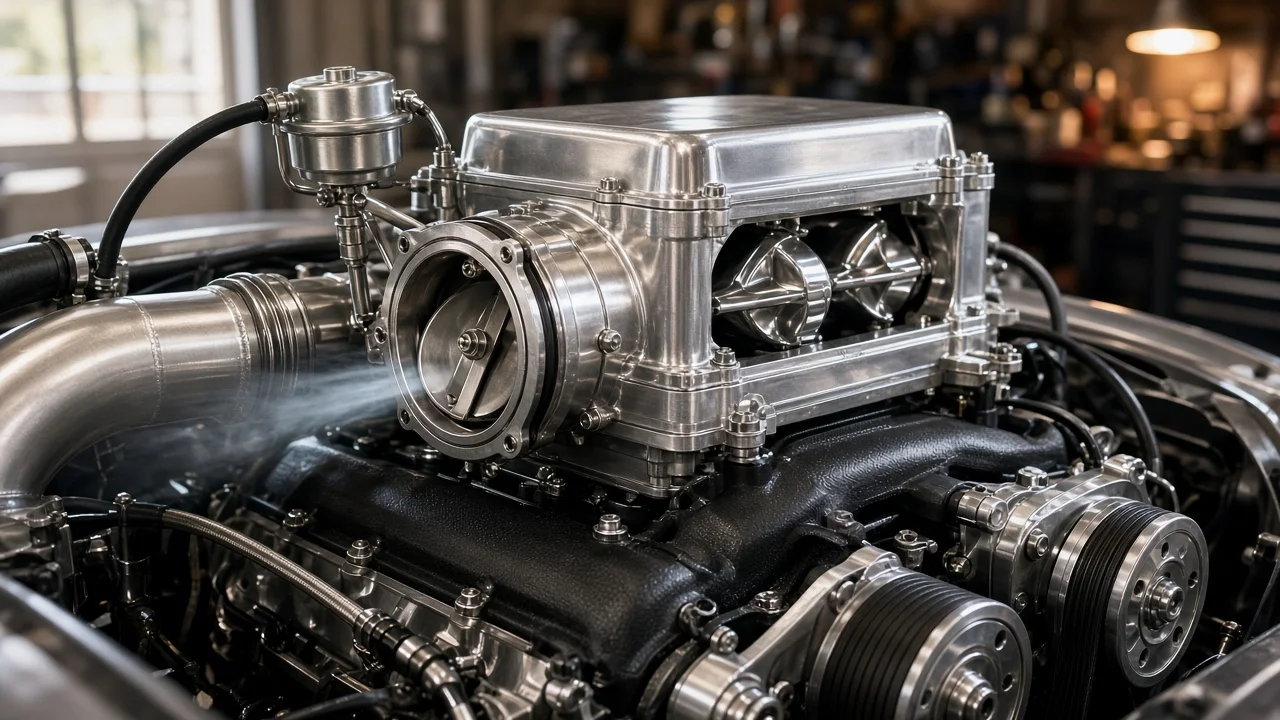
A Roots-type supercharger is belt-driven, so it spins and moves air whenever the engine runs, whether or not the driver wants boost. The bypass valve keeps that constant pumping from working against the engine at idle and cruise. This guide explains what the valve does, how it decides when to open and close, how designs differ between vehicles, and what an owner can reasonably check before a shop gets involved.
The short answer
A Roots supercharger bypass valve is a flap or butterfly in a passage that connects the blower's outlet back to its inlet. When the engine needs little air, such as at idle, light cruise or deceleration, the valve opens and lets the blower recirculate air instead of forcing it into the intake manifold. When the driver opens the throttle hard, the valve closes. That shuts the recirculation path, and the blower's output goes to the engine as boost. On most factory systems the valve does not set how much boost the engine makes at full throttle. Blower size, pulley ratio and engine speed mainly determine that. The valve's job is to switch the blower between an unloaded state and a working state, and to blend smoothly between the two in the middle of the throttle range. The exact behavior depends on the specific vehicle configuration, so treat this as the general principle rather than a description of any one model.
How the bypass valve works
A Roots blower is a positive-displacement pump: each revolution of the rotors moves a fixed volume of air. Because the belt ties it to the crankshaft, that volume rises with engine speed. On many factory installations the throttle body sits upstream of the blower. At part throttle the nearly closed throttle restricts what can reach the rotors. Without a relief path, the blower would keep churning air against a pressure difference. That would consume engine power, add heat to the intake charge and increase noise.
The bypass valve gives that air somewhere to go. With the valve open, pressure on both sides of the rotors is close to equal, so the blower spins with relatively little load. On many designs a spring holds the valve closed and a vacuum diaphragm actuator connected to intake manifold vacuum opens it. High vacuum at idle and cruise pulls the diaphragm and opens the valve. As the throttle opens and manifold vacuum falls, the spring wins, the valve swings shut and pressure builds in the manifold. Because vacuum changes gradually, the valve can sit partly open, so boost comes in smoothly rather than in an abrupt step. Some newer engines replace the diaphragm with an electronically controlled actuator. The engine computer commands it using inputs such as throttle position and manifold pressure.
What changes the answer
Not every Roots supercharger uses a bypass valve in the same way, and the position of the throttle matters. With the throttle ahead of the blower, the valve mainly reduces pumping losses at light load. In a blow-through arrangement, the throttle sits downstream of the blower, and closing it traps pressurized air between the two. In that layout the bypass also relieves pressure when the driver lifts off. Some systems have no bypass at all. Others use an electromagnetic clutch to disengage the blower drive at light load, sometimes combined with a bypass.
The control method also changes what an owner can test. You can check a vacuum-operated valve mechanically. An electronically actuated valve is usually monitored by the engine computer, which may set diagnostic trouble codes when the valve's position does not match what was commanded. Aftermarket kits and tuned engines add more variation: a different pulley, a modified actuator spring or a revised calibration can change when the valve closes and how the car feels. Operating conditions matter too. Altitude, intake temperature and engine load all affect manifold vacuum, so a vacuum-controlled valve does not start closing at one fixed number that applies to every car.
Signs the bypass valve may not be working
Faults generally fall into two patterns. A valve stuck open, or one that cannot close fully, lets boost leak back to the blower inlet. The engine feels flat under hard acceleration, and a boost gauge, if fitted, shows less pressure than usual. A valve stuck closed keeps the blower loaded at light throttle. On spring-closed designs this is a common result of a torn diaphragm or a disconnected or split vacuum hose. Owners may notice louder blower whine at idle or cruise, positive pressure where there should be vacuum, rougher part-throttle behavior or worse fuel economy.
A leaking vacuum line can also upset idle quality and fuel trims. The symptom may then show up as a lean condition or a related trouble code rather than as an obvious boost complaint. None of these signs is unique to the bypass valve. Low boost can also come from a slipping belt, a leak in the intercooler plumbing or a fault elsewhere in the intake. That is why an inspection should confirm the cause before any parts are replaced.
What the owner can check
Start with a visual inspection with the engine off and cool. Trace the vacuum hose from the actuator to its manifold source and look for cracks, softening, splits at the ends or a fitting that has popped off. Check that the actuator rod is attached to the valve arm and that the linkage is not bent. On many vacuum-operated designs you can move the arm by hand and feel whether it travels freely and returns under spring pressure. Binding or sticking suggests carbon, oil residue or wear in the shaft. Do this only if the parts are easy to reach and you are sure which component you are handling.
A hand vacuum pump is a useful next step. When you apply vacuum to the actuator, the rod should move smoothly and the diaphragm should hold vacuum rather than slowly bleeding down. A leaking diaphragm or a rod that does not move means the actuator needs attention. If the car has a boost or vacuum gauge, note the readings at idle, steady cruise and brief full throttle. Compare them with how the car behaved before the problem started. For an electronically controlled valve, a scan tool that reads codes, and live actuator position data where supported, tells you more than mechanical checks.
Record what you find alongside the car's service history. If a valve problem appears right after other intake or blower work, a hose or connector may not have been refitted correctly.
Limitations and when to get help
Bypass valve layouts, actuator types and control strategies vary between engines, so the checks above are general. The correct opening behavior, actuator part number and any test values should come from the manufacturer specifications or service information for your exact vehicle, not from another model. The bypass valve does not usually have its own replacement interval. Checking it is not a substitute for following the vehicle's maintenance schedule for the drive belt and any supercharger or intercooler fluids the manufacturer lists.
Get professional help if the valve is hard to reach or intake parts must come off. The same applies if the car sets trouble codes you cannot interpret, or if symptoms persist after the vacuum supply and actuator check out. A technician with the right service information can confirm whether the valve, the blower, the control system or something unrelated is responsible. They can then replace or calibrate parts to the factory configuration. Unexpected boost at light throttle or a sudden loss of power should be diagnosed rather than ignored.