Repair a convertible soft top
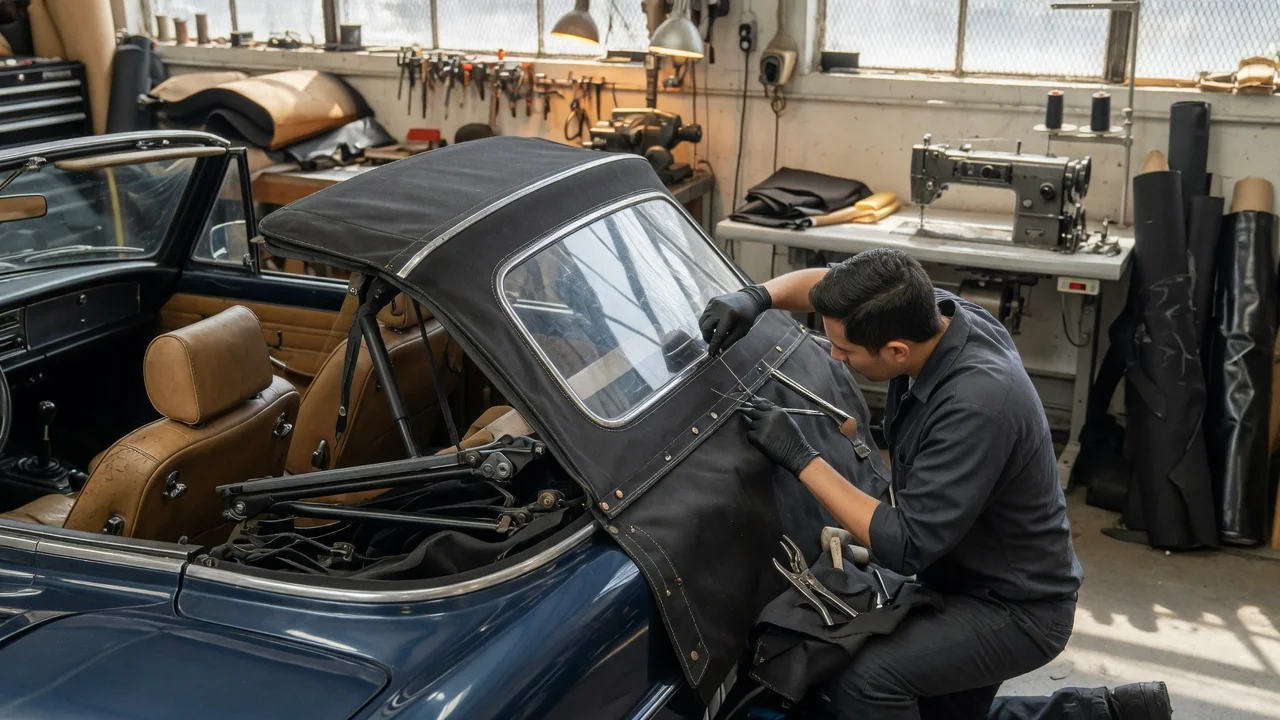
For a BMW soft-top repair, start by identifying what needs attention: the flexible roof covering, its window, the seals or the equipment that moves and secures the roof. These are separate repair questions. A request for a replacement hood should not substitute for an assessment of the actual damage.
What belongs in a soft-top repair assessment?
The following selection covers the main areas to discuss with a repairer, ordered from the roof covering to its operating equipment. It is a practical assessment list, not an exhaustive parts inventory or a ranking of likely faults. Here, “cabriolet hood” means the convertible roof covering; “bonnet” refers to the engine cover.
1) Roof covering
Identify the location and extent of any damage to the flexible covering. Ask the repairer to distinguish a proposed local repair from replacement of the covering and explain why that option suits its condition. No roof material, damage description or BMW model has been supplied, so a particular patch, adhesive or repair procedure cannot be recommended here.
2) Seams and attached edges
Include stitching, seams and the edges where the covering attaches to the roof assembly in the assessment. Ask the repairer to identify whether the proposed work concerns the fabric itself or an attachment. The available information does not establish which attachment methods apply to your roof.
3) Rear window and its connection to the hood
Treat the rear window and its connection to the surrounding covering as a separate item in the quotation. Confirm whether the proposed work replaces the window, repairs its connection or includes a larger roof assembly. Separate window replacement should not be assumed possible without checking the particular roof.
4) Seals and roof contact areas
Ask for any work on seals—the flexible strips at closing joints—to be identified separately from work on the hood covering. A quotation should name the affected area and explain the evidence for repair or replacement. No water-entry location or inspection findings have been supplied, so there is no basis for identifying a leak source.
5) Frame, catches and operating equipment
Keep repairs to the supporting frame, securing catches and roof operating equipment distinct from repairs to the covering. Where the vehicle has powered operation, request a model-specific assessment before authorising component replacement. No operating symptoms, diagnostic results or confirmed faults are available here.
What to establish before authorising the repair
Give the repairer the exact BMW model and model year, and state whether the roof is original or has been replaced or modified. Request a written scope identifying the affected parts, the proposed method, any unresolved findings and the checks included after the work. The information supplied does not support a repair price, completion time, service-life estimate or decision between repair and replacement.