Renting Chassis Ears for Wheel Bearing Noise Diagnosis
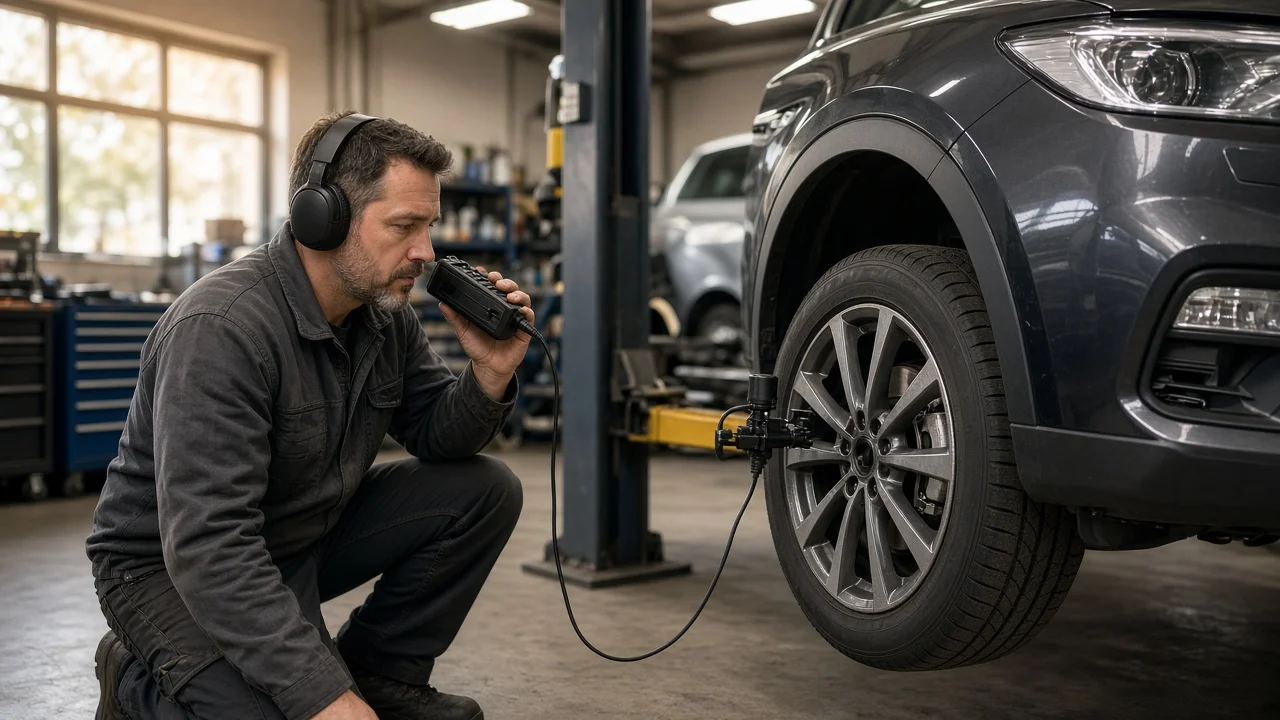
A hum or growl that rises with road speed often points owners toward a worn wheel bearing, but tires, CV joints, brakes and driveline parts can sound very similar. Renting chassis ears lets you clamp small microphones to several suspension points and listen to each one during a road test, narrowing the source before you spend money on parts. This guide covers how to describe the noise, which causes compete with a bearing, a safe order of checks and how to read what the channels tell you.
Establish the symptoms
Start with a written record of when the noise appears. Note the speed at which it begins and whether it follows road speed rather than engine speed; a sound that stays the same when the transmission changes gear at a steady speed is tied to the wheels or driveline rather than the engine. Note whether it changes during gentle sweeping curves to the left and right, whether it differs on smooth and coarse pavement, and whether it is present from a cold start or only after driving. Record associated signs such as vibration in the steering wheel, seat or floor, a pull to one side, or an ABS or traction control warning. Finally, list recent changes: new or rotated tires, a pothole or curb strike, brake service, or any suspension or hub work.
This record does more than describe the problem. It tells you which corners deserve a microphone, the speed range to hold during testing and which competing causes to keep in mind. A clear picture before you collect the kit shortens the rental and makes each test drive count.
Distinguish plausible causes
A failing wheel bearing typically produces a steady hum, drone or growl that increases with speed. Its pitch or volume often changes when load shifts during a curve, because the bearing on the outside of the turn carries more weight. A bearing is supported when the noise tracks road speed, changes with cornering load and, with the wheel off the ground, the hub feels rough or gritty when turned. It is weakened when the noise changes with engine speed, moves to a different corner after a tire rotation, or is identical on every surface regardless of load.
Tires are the most common impostor. Cupped, feathered or unevenly worn tread, and aggressive tread patterns, create a drone that is easy to mistake for a bearing; a noise that follows the tire after rotation points strongly to the tire. A worn outer CV joint usually clicks in tight turns under power, while inner joint wear tends to show as vibration during acceleration. Brake problems such as a dragging caliper or a bent dust shield touching the rotor can scrape or hum and may change when the brakes are applied. Differential or transfer case wear on some drivetrains produces a whine that changes between acceleration and coasting rather than with cornering.
Checks in a useful order
Begin with observations that need no tools. Check tire pressures against the placard on the vehicle, then run a hand across each tread looking for scalloped or saw-tooth wear and inspect sidewalls for bulges. Look for fresh grease or a torn boot near the CV joints and for anything rubbing near the brakes. If tire wear is obvious, keep it on the list as a strong alternative to the bearing.
Some parts retailers run tool loaner programs and some rental outlets stock electronic chassis ears, but availability and terms vary, so ask ahead. Before leaving, confirm the number of channels, that every clamp and lead is present, and whether the unit is wired or wireless. Tap each clamp while listening to confirm all channels work. Attach clamps with the engine off and the vehicle secure; if you raise it, use stands at the approved lift points and never rely on a jack alone. Clip each clamp to a solid mounting point close to the suspect bearing, such as the steering knuckle or the outer end of the lower control arm. Route and tie leads away from the tires, axles, steering linkage, brake hoses and exhaust, then turn the steering lock to lock to check clearance. On the road, the driver concentrates on driving while a passenger switches channels.
Tests that need the wheel off the ground come next: spinning the wheel by hand to feel for roughness, and rocking the tire at the top and bottom to check for joint play. Movement can come from the bearing, a ball joint or other worn parts, so watch where it originates. Acceptable bearing play, axle nut tightness and every fastener specification are model-specific and must come from the service information for your vehicle. If you are unsure how to support the vehicle or interpret play, have a qualified technician perform these checks.
Interpret the findings
The loudest channel suggests the corner, but vibration travels through the subframe and body, so a single loud reading is not proof on its own. Compare the same position on the left and right sides and listen for the pattern you recorded: a sound that rises with speed and changes as cornering load shifts. A channel that is clearly louder than its counterpart and follows that load pattern strongly supports a bearing at that corner. A noise that is loud on every channel, or louder on the side with obviously worn tires, points back toward tires or the driveline.
Before buying parts, confirm the chassis ears result with the hand-spin and play checks at the indicated corner. If tires remain a suspect, rotating them where the tire type allows and repeating the road test can separate the two causes. Then identify the bearing design: some vehicles use a bolt-on hub assembly, others a pressed-in bearing, and some integrate the wheel speed sensor. Where the repair disturbs the knuckle or strut connection, the service procedure may call for a wheel alignment check afterward, and some alignment procedures require verifying ride height first.
Urgency and next action
Stop driving and arrange inspection or towing if the noise turns into grinding or scraping, worsens quickly, or is accompanied by a wobble, a clunk, a pull or looseness in the steering, play you can feel by hand, a burning smell, or a new ABS warning. A worn bearing can deteriorate unpredictably, so no safe remaining mileage can be promised from noise alone; base the decision on confirmed findings and professional inspection.
When booking the repair, provide the year, make, model, VIN and drivetrain, the suspected corner, the speed range and turning behavior of the noise, the channel readings from the chassis ears, any tire wear you found and recent work on the vehicle. This lets the shop order the correct hub or bearing and plan the job. Before returning the rental kit, remove every clamp and tie, confirm nothing is left near moving parts and check that all components are accounted for.