Rear Axle Shaft Won't Go Back In: How to Find the Cause
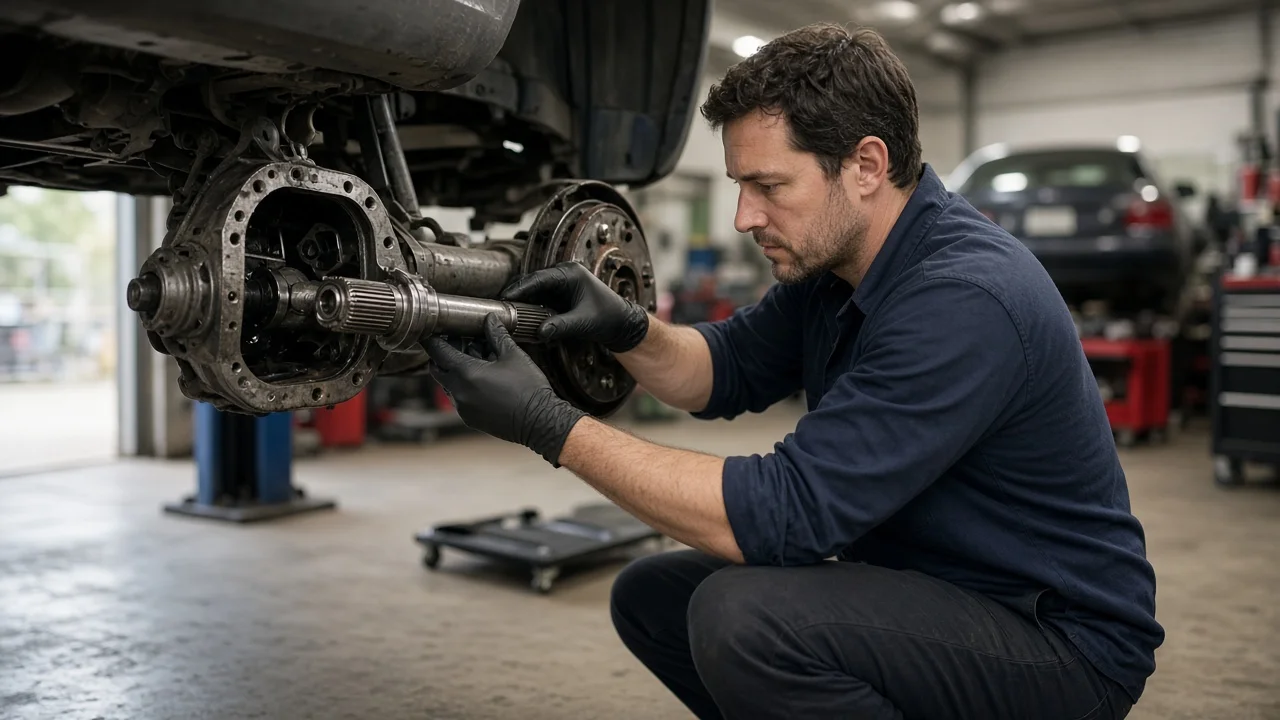
When a rear axle shaft won't go back in after a seal, bearing or brake job, the obstacle is usually inside the housing, not a faulty part. The shaft has to pass the seal, center in the bearing bore and engage the differential side gear splines, and any of those points can stop it. This guide helps you find where the shaft is binding and what to check before you force anything or order parts.
Establish the symptoms
Start by noting exactly where the shaft stops. Mark the shaft at the housing face and measure how far short of fully seated it is. A shaft that slides most of the way and then stops near the differential points to the splines or the internal parts. A shaft that stops with the flange close to the housing points to the bearing, the bore or the seal. Also note whether the stop feels hard and metallic or slightly springy, and whether the shaft still turns freely by hand at that point.
Then record what happened while the axle was out. Was the differential cover removed? Was the cross shaft, also called the pinion shaft, reinstalled? Did anyone turn the opposite wheel, the driveshaft or the other axle? Were a new bearing, seal or replacement axle installed? Note the vehicle configuration as well: whether the axle is retained by C-clips inside the differential, by a bearing retainer plate at the outer end, or is a full-floating design, and whether the differential is open or limited slip. Earlier repairs in the service history, such as a previously replaced axle or differential work, are also worth noting.
Distinguish plausible causes
The most common cause is spline misalignment. The shaft passes the bearing and stops hard against the side gear because the splines are not lined up. Slowly rotating the shaft while applying light inward pressure usually lets it drop in. If the differential was turned while the axle was out, the side gear may also have shifted slightly off center, which makes the splines harder to find. Limited-slip units add preload springs or clutch packs that hold the side gear in position, so aligning them may take more patience and help from the opposite wheel.
On C-clip axles, sequence matters. The shaft has to travel slightly farther inward than its final position so the clip can be fitted into the groove at the inner end. If the cross shaft was reinstalled first, the axle end hits it and cannot go far enough. This is likely if the cover is off and the cross shaft is already bolted in. On bearing-retained axles, the bearing outer race has to enter the housing bore squarely. Rust, a burr, debris or a slightly cocked bearing will stop the shaft near the end of its travel, often with the flange just short of the backing plate.
Less common causes: a seal lip that rolled over or was pushed out of place, an ABS tone ring touching its sensor, a bent shaft that wobbles when rotated, and a replacement axle that does not match the original in length, spline count or flange design. A wrong part is more likely when a new shaft stops while the old one went back in without trouble.
Checks in a useful order
Begin with safe observations that need no special tools. Make sure the vehicle is secured on jack stands on level ground with the front wheels chocked. Pull the shaft back out and inspect the splined end for burrs, missing material or debris. Shine a light into the housing bore to check for rust, grit or a damaged seal lip. If you have the old shaft, lay it next to the new one and compare length, spline count and flange. Roll the shaft on a flat surface, or spin it, and look for obvious wobble.
Next, reinstall with control. Support the shaft so it stays level, because a sagging shaft can catch on the seal or miss the side gear. Rotate it slowly while pushing gently, and have a helper turn the opposite wheel slightly if needed. If that fails, removing the differential cover lets you see the side gear and the cross shaft position directly. That means draining the gear oil and resealing the cover afterward with the correct gasket or sealant and the specified lubricant. Avoid hammering on the shaft end, which can damage the side gear, the bearing or the shaft itself.
Some checks need tools, specifications or a qualified technician. These include measuring shaft runout with a dial indicator against the manufacturer specifications, pressing a bearing and its retaining ring on or off a shaft, and diagnosing internal damage in a limited-slip unit. Torque values for retainer nuts and the cross shaft bolt should come from the service information for your exact vehicle, not from a general figure.
Interpret the findings
If the shaft drops in after you rotate it, the cause was spline alignment and nothing needs replacing. If it only seats after you remove the cross shaft, the problem was assembly order: insert the axle, fit the C-clip, pull the shaft outward so the clip sits in the side gear recess, then install the cross shaft and its retaining bolt. If the shaft stops at the outer end and seats only after the bore is cleaned, corrosion or debris was the cause. If the parts comparison shows different spline counts or lengths, the replacement axle is wrong for that housing and should be exchanged rather than forced.
Even a successful installation leaves some items to confirm. If force was used, inspect the seal for damage and watch for gear oil at the backing plate after a short test. Check that the retention is complete: C-clips seated, cross shaft secured, or retainer plate nuts tightened to specification. Look for metal fragments in the drained fluid, refill to the correct level, and spin the wheel to listen for grinding. Do not replace a side gear or an axle on suspicion alone. Replace it only when inspection shows chipped splines, a bent shaft or a damaged bearing.
Urgency and next action
Do not drive the vehicle, or even lower it onto that wheel and roll it, until the shaft is fully engaged and retained. A C-clip axle without its clip can slide out of the housing with the wheel still attached, and a partially engaged shaft can strip its splines. After reassembly, stop using the vehicle if you notice grinding, clunking when moving off, wheel wobble, gear oil on the brake parts, or a new ABS or traction warning light. Oil on the brakes affects stopping ability and needs attention before further driving.
If you hand the job to a shop, give them the information that saves diagnostic time: year, make, model and axle or differential type if known; whether the differential is limited slip; what work was done and which parts were installed, with part numbers; how far short the shaft stops and where; and what you have already tried. That lets the technician go straight to the likely cause instead of repeating your inspection.