Range Rover Sport Parking Brake Shoes: Fitment and Selection
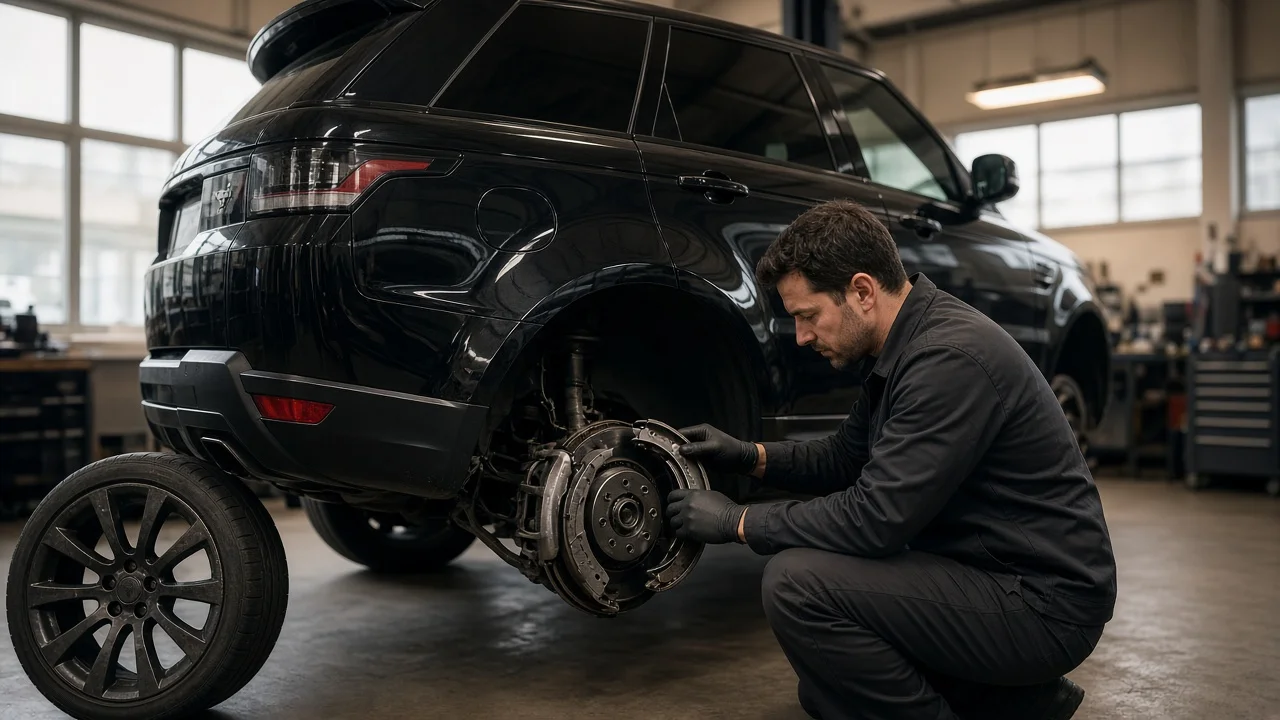
Parking brake shoes on a Range Rover Sport have one job: holding a heavy SUV still on a slope, at a trailhead or with a trailer attached. Choosing them depends less on brand claims than on matching the brake design fitted to your vehicle, the condition of the drum surface inside the rear rotor and the hardware around the shoes. This guide covers how to confirm fitment, which features matter and what ownership costs to expect.
Define the job the product must do
Many Range Rover Sport models use a drum-in-hat parking brake. A small pair of shoes sits inside the hub section, or hat, of each rear brake rotor. These shoes are separate from the brake pads and caliper that do the everyday stopping. They are applied mechanically, usually through cables pulled by an electronic actuator, and they are designed to hold a stationary vehicle rather than slow a moving one. Because of this they wear slowly. Replacement is usually triggered by something else: contamination, corrosion, a parking brake that no longer holds, or a rotor job that reveals worn linings.
Before you shop, be clear about why the shoes are coming out. If you tow, park on steep driveways or regularly leave the vehicle on grades, you need full holding force. Several conditions mean the cause must be fixed as well as the shoes replaced: a parking brake that was applied while the vehicle was moving, glazed linings, or linings soaked with oil or grease from a leaking seal. If the parking brake will not hold, a warning message appears or the vehicle creeps when parked, stop relying on it. Chock the wheels, use Park and have the system inspected before normal use.
Check compatibility
Fitment starts with the generation and build date, not just the model name. The Range Rover Sport has been produced over several generations, and the parking brake design has not stayed the same. Some versions use shoes inside the rear rotor hat. Others use an electric motor on the rear caliper that clamps the brake pads, and those vehicles have no parking brake shoes to buy. Look the part up by VIN in the manufacturer's parts catalog or with a supplier that searches by VIN. A year range in a listing is not enough, because running changes and market differences can sit inside the same model year.
Once the design is confirmed, compare the details that decide physical fit. The shoe diameter and lining width must match the drum section of your rear rotors. The anchor and adjuster points and the cable attachment must match your hardware layout. Rear brake specifications can vary with engine, trim and brake package, so check that the listing's part number cross-references to your exact configuration. Also check whether the listing covers one wheel or the whole rear axle. If you are fitting new rotors at the same time, make sure the replacement rotors are specified for a drum-in-hat parking brake and match the shoe size.
Features that affect the choice
The friction material on parking brake shoes is usually an organic or low-metallic compound bonded or riveted to a steel shoe. For this application, words like premium, ceramic or heavy duty tell you little. Better signs of quality are physical: • even, secure bonding of the lining; • chamfered lining edges; • an accurate arc, so the lining contacts the drum across its full width; • a corrosion-resistant finish on the steel shoe; Useful evidence includes a published part number cross-reference, clear fitment data, applicable regulatory markings and a stated warranty. Unverified claims of better performance than original equipment are not evidence.
The second choice is shoes only or a full kit. Return springs lose tension with heat and age, and adjusters and retaining pins corrode, especially on vehicles driven on salted roads or through water. A kit with new springs, pins and adjusters costs more up front. In exchange, you avoid fitting fresh linings to tired hardware that may stop them from retracting or adjusting properly. Genuine parts generally cost more than aftermarket equivalents, while aftermarket quality varies widely between manufacturers. A reputable supplier with a clear return policy reduces the risk of ordering a near-miss part.
Limitations and ownership costs
Replacing the shoes is more involved than replacing brake pads. To reach the shoes, the caliper and rotor must come off. On electronically actuated systems, the actuator usually has to be put into a service or release mode before the cables can be slackened. Depending on the vehicle, this may require a diagnostic tool or a specific procedure from the service information. After fitting, the shoes are adjusted to the drum and bedded in following the specified sequence. Skipping these steps can leave weak holding force or cause dragging. The hydraulic system is normally left closed. If a brake hose or line is disconnected, the system must be bled with the specified brake fluid.
New shoes cannot correct worn parts around them. A scored, rusted or oversize drum surface will reduce holding force no matter what lining you fit. Measure the drum's internal diameter against the maximum value given for your rotors, and judge lining thickness against the wear limits in the service information. Shoes also will not fix a failing actuator, stretched or seized cables, or a software fault. Ownership costs therefore often include more than the shoes: • labor or diagnostic tool access; • rear rotors, if the drum section is beyond limits; • a hardware kit; • possibly cables or the actuator; In most cases the shoes are a small share of the total job.
Build a practical shortlist
Use this checklist to narrow the options: • Confirm by VIN that your Range Rover Sport uses parking brake shoes and not a caliper-integrated electric parking brake. • Match the part number cross-reference to your build and rear brake configuration. • Check whether the listing covers one wheel or the full axle. • Decide whether you need a hardware kit. • Inspect or measure the drum surface inside the rotors before ordering, so you know whether new rotors belong on the same order. • Confirm you have the procedure and, where required, the diagnostic tool to release and recalibrate the actuator. • Compare warranty terms and return conditions, especially if fitment information is incomplete.
If any of these points can't be confirmed, choose the conservative path. Order by VIN from a source that guarantees fitment, and have a brake specialist do the work if you lack the tooling or service information. A parking brake that holds weakly may seem fine on level ground and then fail on a slope, so a test on a grade after the job, carried out safely, matters more than any label on the box.