Ram 1500 Rear Axle Shafts: Check Year and Axle Fitment Before Buying
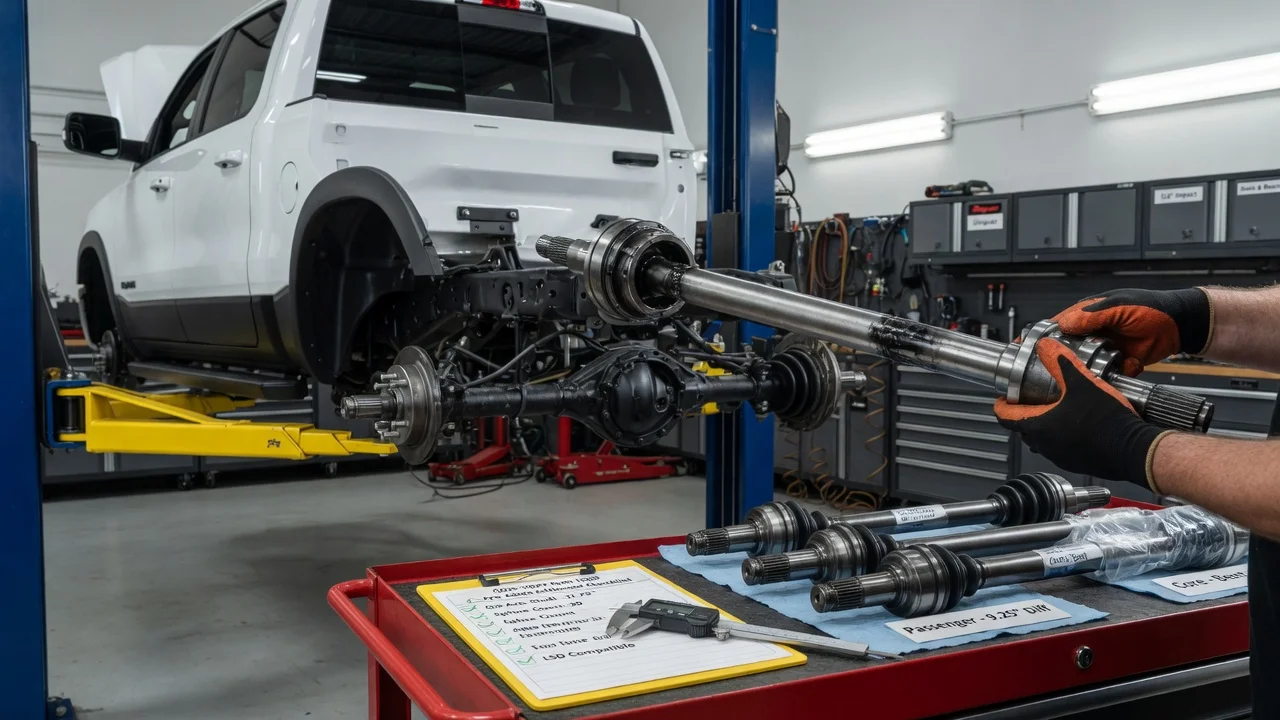
Ordering a Ram 1500 rear axle shaft by model year alone often gets you a part that does not fit. Rear axles on these trucks vary by generation, axle assembly, differential type and other build options, so the correct shaft depends on your exact vehicle configuration. Before you order, confirm that the shaft is actually the failed part. Then match the replacement to the axle your truck has, not to a listing title.
Establish the symptoms
Write down what you notice before anything is taken apart. Record what you hear or feel and exactly when it happens. Examples include a hum or growl that rises with road speed, grinding from one rear corner, a clunk when shifting between drive and reverse, or a vibration at a particular speed. Note whether the symptom changes when coasting, accelerating, braking or turning in each direction, and whether it gets worse with a load or a trailer. If the noise changes during gentle left and right sweeping turns, the problem is often on one side of the truck, which narrows the inspection.
Look for related signs as well. Gear oil on the inside of a rear wheel, on the brake backing plate or drum, or a strong gear-oil smell near one wheel suggests fluid is getting past an axle seal. An ABS or traction control warning light can come on when a wheel speed sensor signal is disturbed. Also list recent changes from the service history, such as differential fluid service, brake work, a new tire, hitting a curb or pothole, or heavy towing. Pay particular attention to a symptom that started right after the differential cover was removed. On many designs, that job involves the parts that hold the axle in place and the axle seals.
Distinguish plausible causes
Several faults look like a damaged axle shaft. A worn rear wheel bearing makes a hum or growl that changes with speed. On semi-floating axles, the bearing rollers may run directly on a machined surface of the shaft, so a failed bearing and a damaged shaft can occur together. A leaking axle seal causes wet brakes and a falling fluid level, but it does not by itself mean the shaft is bad. Worn differential gears or pinion bearings usually change their noise between acceleration and deceleration rather than with steering, which helps separate them from a wheel-end problem. Tire wear, an unbalanced wheel or driveline faults can cause vibration that gets mistaken for a bent shaft.
A bent shaft is more likely after an impact, or when a wheel still wobbles after the tire and wheel have been checked. A broken shaft or a failed or missing retaining clip can let the shaft and wheel move outward. Signs include a wheel sitting at an odd angle, rubbing noises from the brake area, or a sudden loss of drive. A leaking brake wheel cylinder or caliper can also wet the inside of a wheel, so identify the fluid. Gear oil has a distinct smell and feels heavier than brake fluid.
Checks in a useful order
Start with checks that need no disassembly. Park on level ground and look at both rear wheels from behind and from the side for tilt or uneven position in the wheel arch. Check the inside of each rear tire and wheel for fluid. Also check the differential cover and pinion area for leaks, so you do not blame an axle seal for oil coming from somewhere else. Inspect tire wear and pressure, because an unevenly worn tire can sound like a bad bearing. A short road test on a safe, empty road can show when the noise appears, but do not drive the truck if any of the stop-use signs described below are present.
The next checks require the truck to be raised and supported on rated jack stands, never on a jack alone. With the rear wheels off the ground and the vehicle secured as the service procedure directs, turn each rear wheel by hand to feel for roughness or grinding. Rock the wheel at the top and bottom to check for excessive play. Then check the differential fluid level and condition, and note any metal particles. Measuring axle flange runout, inspecting the bearing journal and removing a shaft all require service information, a dial indicator and torque values. On many Ram 1500 rear axles, the job also means removing the differential cover and a retaining clip. If you do not have the manufacturer specifications and tools, this is the point to involve a qualified technician.
Confirming fitment is a separate check. The 2007 Dodge Ram 1500 is from an earlier generation than the 2012, 2014, 2016 and 2017 Ram 1500, so do not assume parts from one generation fit the other. Even within one model year, rear axle shafts can differ by axle assembly, differential type (open, limited-slip or electronic locking), drivetrain, wheel and brake setup, and ABS sensor arrangement. Read the identification tag on the axle housing or differential cover if there is one, and use the VIN or build information to confirm the axle code. Before installation, compare the old shaft's length, spline count, flange and stud pattern with the replacement.
Interpret the findings
Each result tells you less than it may seem. Gear oil on the brakes confirms a leak at the wheel end, not a failed shaft. The seal surface and bearing journal still need inspection. A rough or noisy wheel bearing confirms a bearing problem. Once the shaft is out, the condition of the journal shows whether a new bearing and seal are enough or the shaft itself must be replaced. Compare pitting, scoring, heat discoloration or a groove where the bearing runs against the service information instead of judging by eye alone.
Flange runout outside the manufacturer specification, visible bending, twisted splines or cracks support replacing the shaft. Differential noise with no wheel-end findings points away from the axle shaft. A missing or damaged retaining clip explains outward movement, but it may also have damaged the shaft, the differential side gear or the housing, so inspect those parts too. Order a shaft only after the faulty part is confirmed and the exact axle is identified. A replacement that matches the year but not the axle assembly will not fix the problem.
Urgency and next action
Stop driving and arrange an inspection or a tow in any of these cases: • A rear wheel moves in and out, tilts or wobbles noticeably. • There is loud grinding or metal-on-metal noise. • Gear oil has reached the brake shoes, pads or rotor. Contaminated friction material can reduce braking. A broken shaft or failed retention can let a wheel come off the truck. No safe remaining mileage can be promised for a wheel-end fault. A minor seep with no noise and no brake contamination is less urgent. Still, have it inspected before the fluid level drops and before towing or carrying heavy loads.
For the repair or parts purchase, gather the VIN, model year, cab and bed configuration, 2WD or 4WD, the axle tag information, the differential type, and whether the truck has drum or disc rear brakes. Bring your symptom notes, the service history for recent axle or brake work, and photos of any leaks. Ask the shop or parts supplier to confirm fit using your VIN, not just the model year. Plan for the related parts the service procedure calls for, such as seals, bearings, a cover gasket or sealant, and the correct gear oil plus any friction modifier specified for your differential. For later fluid changes, follow the maintenance schedule and fluid specification for your truck and operating conditions rather than generic intervals.