Precision Wheel Bearing and Hub Assembly: Reviews
What the Precision name usually means in wheel bearing and hub assemblies
Precision is a brand name used in automotive replacement parts, commonly associated with hub bearings, hub assemblies, seals and related drivetrain components. The name does not by itself tell you where the part was made, which factory produced the internal bearing, or whether the metallurgy matches the original equipment specification. When shoppers look at Precision wheel bearing and hub assembly reviews, the useful question is usually whether the part fits a specific vehicle and holds up under normal driving, not whether Precision is a premium or economy brand overall.
Common reasons a wheel bearing or hub assembly is replaced
A wheel bearing and hub assembly is replaced when there is noise, looseness, roughness, or damage around the driven or non-driven wheel. There is no single mileage interval that triggers replacement. A failing hub bearing often produces a growl, hum, or rumble that changes with vehicle speed and can become more noticeable during light cornering. A worn assembly can also create wheel play, uneven brake pad wear, or an illuminated ABS or traction-control warning where the wheel speed sensor is integrated into the bearing or hub.
What reviews tend to highlight, conditionally
Owner and installer comments about Precision hub assemblies tend to be mixed and vehicle-dependent. Some reviews report acceptable fit and quiet operation, while others report a shorter service life than the original part, premature play, or an ABS sensor problem after installation. A review that is positive for one application does not reliably predict performance on a different vehicle, axle position, or road environment. Where the assembly includes an integrated wheel speed sensor, electronic compatibility matters as much as mechanical fit.
Fitment and specification checks to make before buying
The material and dimensional claim that fits one model year may not fit another trim, build date, drive type, or axle load. Check the part number against the vehicle registration or VIN, confirm the drive type, axle position, hub pilot diameter, bolt pattern, flange offset, tone ring or encoder ring type, and whether the replacement is a bolt-on hub assembly or a press-in bearing. When supplied evidence does not show a match for a specific market or powertrain, treat that as an unresolved compatibility point.
Installation and ownership trade-offs
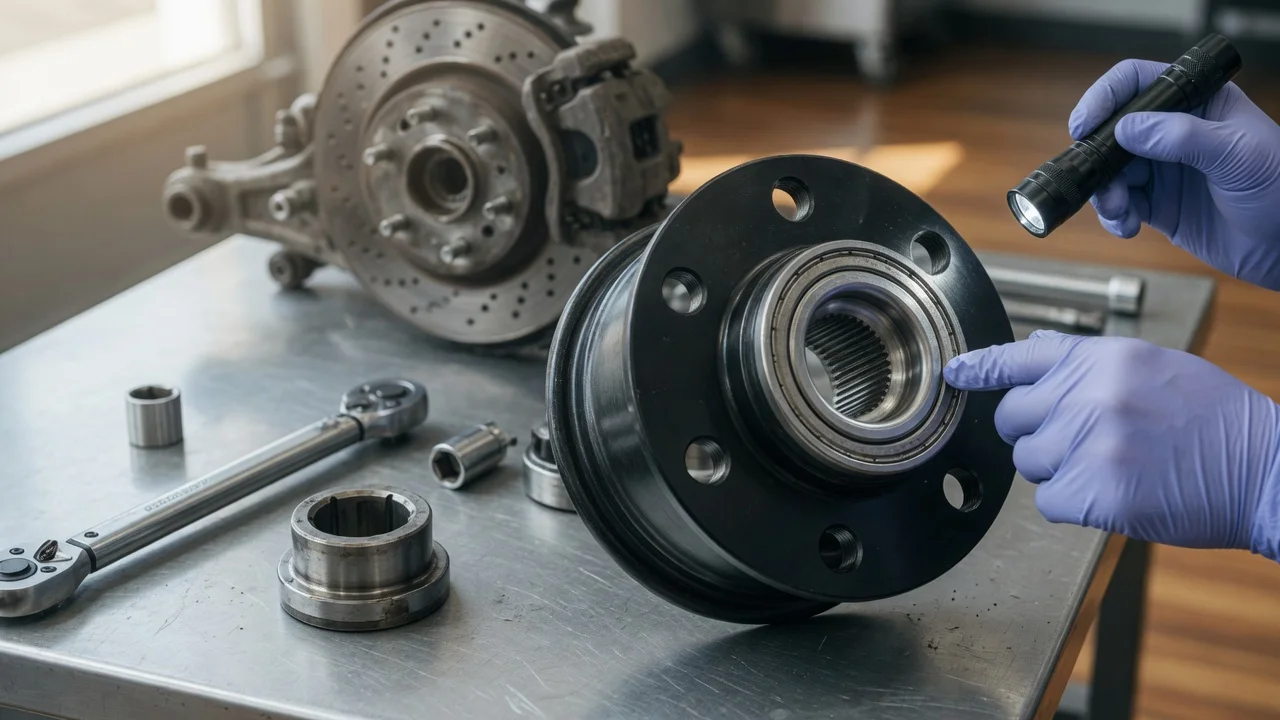
A hub assembly is usually replaced as a complete unit, but the spindle, snap ring, axle nut, and surrounding parts still need to be clean and undamaged. The axle nut torque is a specification, not a guess, and a torque wrench is required. Reusing a damaged axle nut or undertorquing the nut can shorten the new bearing life. In corrosion-prone areas, rust between the hub and knuckle can make removal difficult even when the replacement part is dimensionally correct.
What the supplied information does and does not settle
The request asks for Precision wheel bearing and hub assembly reviews, but no specific vehicle, part number, test data, price, or reviewer sample is supplied here. That means no claim can be made that Precision is generally better or worse than another brand, or that a particular assembly lasts a stated number of miles. The measured answer is that Precision may be a workable replacement when it matches the vehicle and when installation follows torque and sensor-related specifications, but the condition that changes the outcome is exact application fit.
A practical next step
Before choosing a Precision wheel bearing and hub assembly, identify the original part number or OE cross-reference for the vehicle instead of shopping by brand name alone. Then compare the replacement against the axle position, drive type, build date, integrated sensor requirement, and flange detail. If the fitment cannot be confirmed for the specific vehicle, the safer next step is to pause the purchase rather than rely on a generic review.