Power Brake Booster: What It Does and How It Works
The short answer
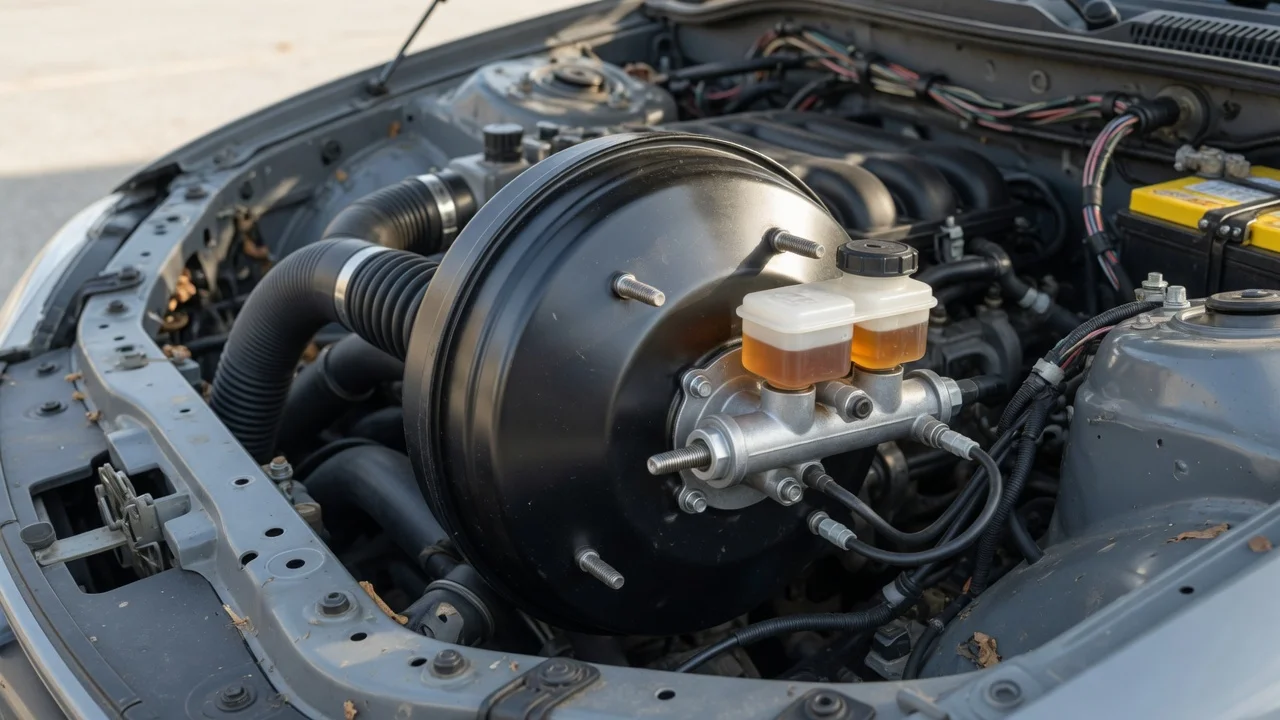
A power brake booster is the component that multiplies the force you apply to the brake pedal before that force reaches the master cylinder. The master cylinder converts pedal movement into hydraulic pressure in the brake lines. The booster's job is to reduce the effort needed to stop the vehicle. It does not create braking on its own, and it does not replace the hydraulic brake system. It assists it.
One qualification matters more than any other. If the booster stops working, the brakes still function, but the pedal becomes much harder to press and stopping distances can grow if the driver cannot apply enough force. A failed booster is a safety problem even though the car can still brake.
Where it sits and what it connects to
In most conventional layouts, the booster is mounted on the driver's side of the firewall, between the brake pedal pushrod and the master cylinder. On vacuum-type units it is usually a round, drum-shaped housing with the master cylinder bolted to its front face. Exact placement and appearance vary by vehicle, so the owner's or service manual for the specific model year and powertrain is the reliable reference.
The main types of brake booster
The phrase "power brake booster" covers several designs. Which one a vehicle uses depends on its engine, powertrain and generation, so no single description applies to every car.
Vacuum booster: the most common type in gasoline-engined cars. It uses engine vacuum, typically drawn from the intake manifold through a hose and a one-way check valve, to create a pressure difference across an internal diaphragm. Vacuum booster with a separate vacuum pump: used where the engine does not produce enough manifold vacuum. Diesel engines and some turbocharged or direct-injection gasoline engines commonly fall into this group. The pump may be mechanical or electric depending on the design. Hydraulic booster (often called hydro-boost): uses pressurized fluid, commonly from the power steering pump, instead of vacuum. It tends to appear on some diesel trucks and heavier vehicles. Electric or electromechanical booster: uses an electric motor to provide assist. This design is used on many hybrids and electric vehicles, which may have no engine vacuum available, and it can integrate with regenerative braking and driver-assistance systems.
How a vacuum booster works
Inside a vacuum booster, a flexible diaphragm divides the housing into two chambers. With the pedal released, vacuum is present on both sides, so the diaphragm stays balanced. When the driver presses the pedal, a valve opens that lets outside air at atmospheric pressure into the chamber behind the diaphragm while vacuum remains on the front side. That pressure difference pushes the diaphragm forward, adding force to the pushrod that drives the master cylinder. Releasing the pedal closes the air valve and restores vacuum on both sides.
The check valve keeps stored vacuum in the booster when the engine is off or manifold vacuum drops. This is why a vacuum-assisted car usually provides one or a few assisted pedal presses after the engine is switched off before the pedal goes firm.
Why it matters for an owner
Because the booster controls how hard the pedal feels, booster problems usually show up as pedal-feel changes rather than as a complete loss of braking. A hard or high pedal is the classic sign of lost assist. On vacuum units, a vacuum leak at the hose, check valve or diaphragm is a common cause, and some leaks produce a hissing sound near the pedal. On vehicles with a vacuum pump, hydraulic booster or electric booster, the pump, power steering system or electrical components can also be the cause. Diagnosis differs by type, so the vehicle's booster design should be confirmed first.
Any change in brake pedal feel is worth having inspected promptly. The booster is a safety-critical part, and replacement procedures, part numbers and any required calibration, which is especially relevant for electric boosters tied to stability and driver-assistance systems, are specific to each vehicle.
What this guide does not cover
No model-specific specifications, assist ratios, replacement costs or test data were available for this article, so none are given here. For figures or fitment details for a particular car, check the manufacturer's service information for the exact model year, engine and market.