Portable and Mobile EV Charging: Help When You Can't Reach a Station
Running low on charge far from a working station is stressful, but you usually still have options. Portable electric car charging covers several different things, from cord sets that plug into an outlet to battery-based units and mobile services that come to you. If you know what each one can deliver, what it may cost and how to plan around it, a low battery is less likely to leave you stranded.
What Portable EV Charging Equipment Actually Provides
The phrase portable charging is used for two very different kinds of equipment. The most common is a charging cord set, the cable and control box many owners keep in the trunk, which lets the car draw power from a suitable outlet. It holds no energy of its own. The other kind is a battery-based charging unit that stores electricity and transfers it to the car on site. The two are easy to confuse when shopping, but only the second can add range where there is no electricity supply.
A product sold as a portable power station is not automatically an EV charger. Many are built for tools, camping gear or home backup. Their output type, sustained power and stored energy may not match what a car's onboard charger expects, or may be too small to add meaningful range. Before relying on any unit, check four things: your vehicle's charging requirements, whether it fits your charge port, whether the manufacturer approves it for vehicle charging, and whether the power source can run it safely for the whole session.
How Mobile EV Charging Reaches a Stranded Vehicle
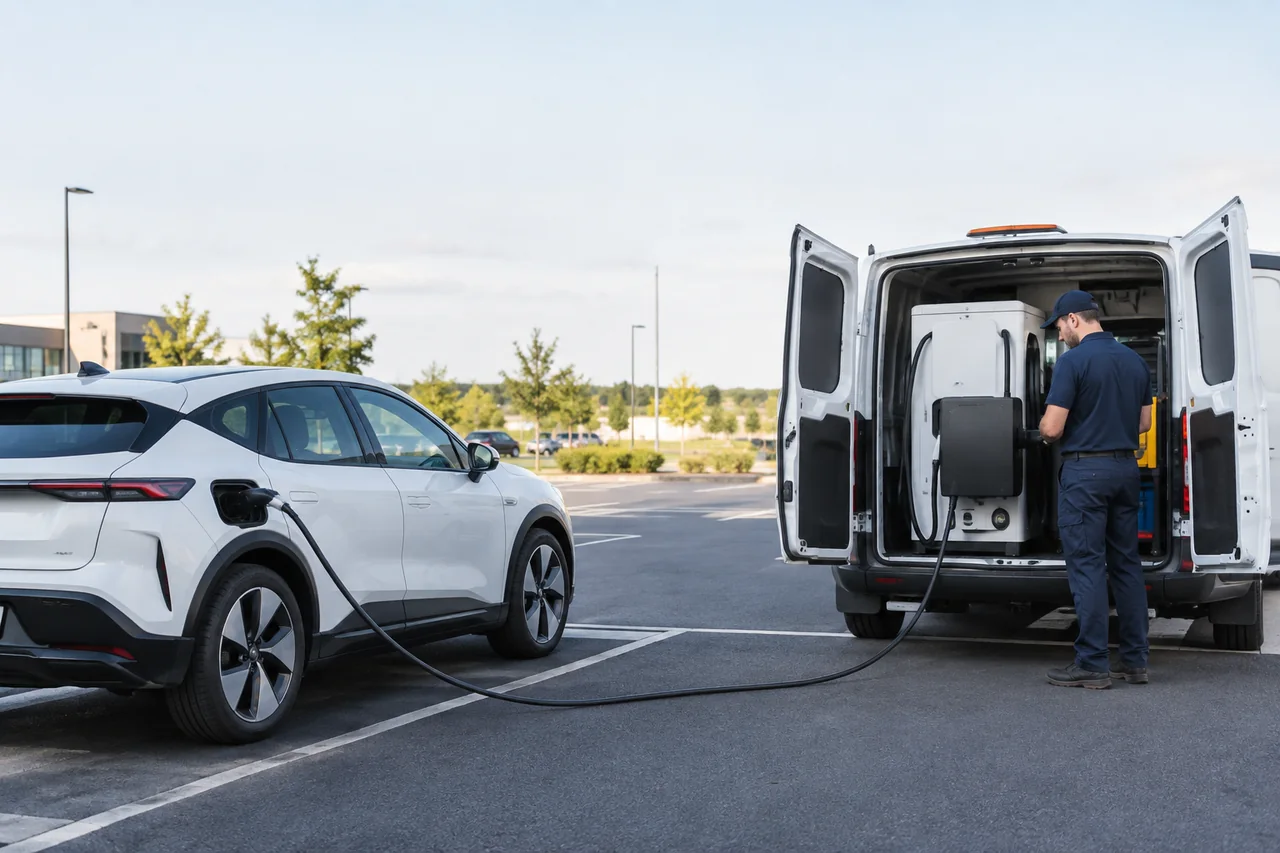
A mobile charging visit usually starts with a call or an app request where you share your location and vehicle details. The dispatcher confirms where you are, checks that their equipment can connect to and communicate with your car, and sends a technician. When the technician arrives, they check that the spot is safe to work in, inspect the charge port, connect and monitor the session. Some service vehicles carry stored battery energy, while others generate or convert power onboard, so capabilities vary from one provider to another.
How much range you gain depends on several limits at once. The service can only deliver the energy it carries or produces, and its equipment has a maximum output. Your vehicle will also accept only so much charging power through a given connector. Battery temperature and charge level matter too, since a very cold or nearly empty pack may charge more slowly. For these reasons, roadside help is usually meant to get you to a nearby backup charging stop, not to fill the battery completely.
What to Confirm Before Booking a Charging Service
Dispatch can only send the right equipment if it knows exactly what it is dealing with. Have your precise location ready, ideally with a nearby landmark, mile marker or map pin. Also have your vehicle's make, model and year. Describe the charge port and connector type, the battery level on the display and any warning messages on the dash. A photo of the message can help. Ask the provider to confirm its service area, operating hours, estimated arrival time and support for your connector.
Many businesses that advertise an electric car charging service focus on scheduled appointments at homes, offices or parked fleets rather than breakdowns, so ask directly whether they respond to roadside emergencies. Say whether the car is on a shoulder, in a garage or somewhere a service vehicle may struggle to reach. Transport may be the better choice if no compatible equipment is available, if the stopping spot is too dangerous for a technician, or if a vehicle fault stops the car from accepting charge.
Safe Steps When the Battery Is Too Low to Reach a Station
When a low-battery warning appears, treat the range estimate as a guide rather than a promise, because it can drop quickly with speed, cold or climbing. Find the nearest charging location you can actually reach and use. If it is out of reach, pick a safe place to stop. Slowing down and using less heating or cooling may stretch the remaining energy. If the car stops, get yourself and any passengers to safety and follow your vehicle's guidance and local roadside rules. Call emergency services if anyone is in immediate danger.
Once you are safe, contact your assistance plan, insurer or a local service and ask specifically for roadside charging or transport, since charging is not always covered. A car that loses propulsion has not necessarily run its traction battery empty. Warning messages may point to a system fault, and a weak low-voltage battery can also stop the car from running; either needs a professional to check it. Never try improvised electrical connections or high-voltage work, and don't try to charge a car that shows visible damage.
What Goes Into a Roadside Charging Bill
Roadside charging bills vary widely, and providers don't all charge the same way. A bill might include a dispatch fee for sending a unit, a travel or mileage charge, labor or time on site, a charge for the energy delivered, a minimum service amount, and higher rates for nights, weekends or holidays. Roadside coverage may pay for some of these items and not others. It may also cap the number of calls or the amount covered, or apply only if you request help through an approved dispatch channel.
Before a technician sets out, ask for an itemized estimate. Find out what you owe if you cancel, if the charging attempt fails, or if the car still needs towing, since transport may be billed separately. A small amount of added range can come with a surprisingly large bill, because the energy itself may be a minor part of the cost. Mostly you are paying for specialized equipment, a trained person and the time it takes to reach you.
Planning Ahead to Avoid Running Out of Charge
Good trip planning starts with choosing a main charging stop and a backup you can reach if the first one is busy or out of service. Check each site for access restrictions such as gated lots, membership requirements or customer-only parking, and confirm its operating hours. If a network or app shows live status, check it before you commit, but keep in mind that the information can be out of date. Keep enough charge in reserve to cover hot or cold weather, highway speed, hills, heavy cargo and possible detours.
A portable cord set in the trunk only helps if you can reach a suitable outlet you are allowed to use, such as at a hotel or a friend's home. Damaged outlets, improvised adapters and extension cords are not emergency solutions and can cause fire or shock. Before a trip through remote areas, save your roadside assistance number and coverage terms so you can reach them even with weak cell service. Also confirm whether charging or transport is included where you plan to drive.