Porsche 996 Fuel Filter Replacement: What Owners Need to Know
The Short Answer
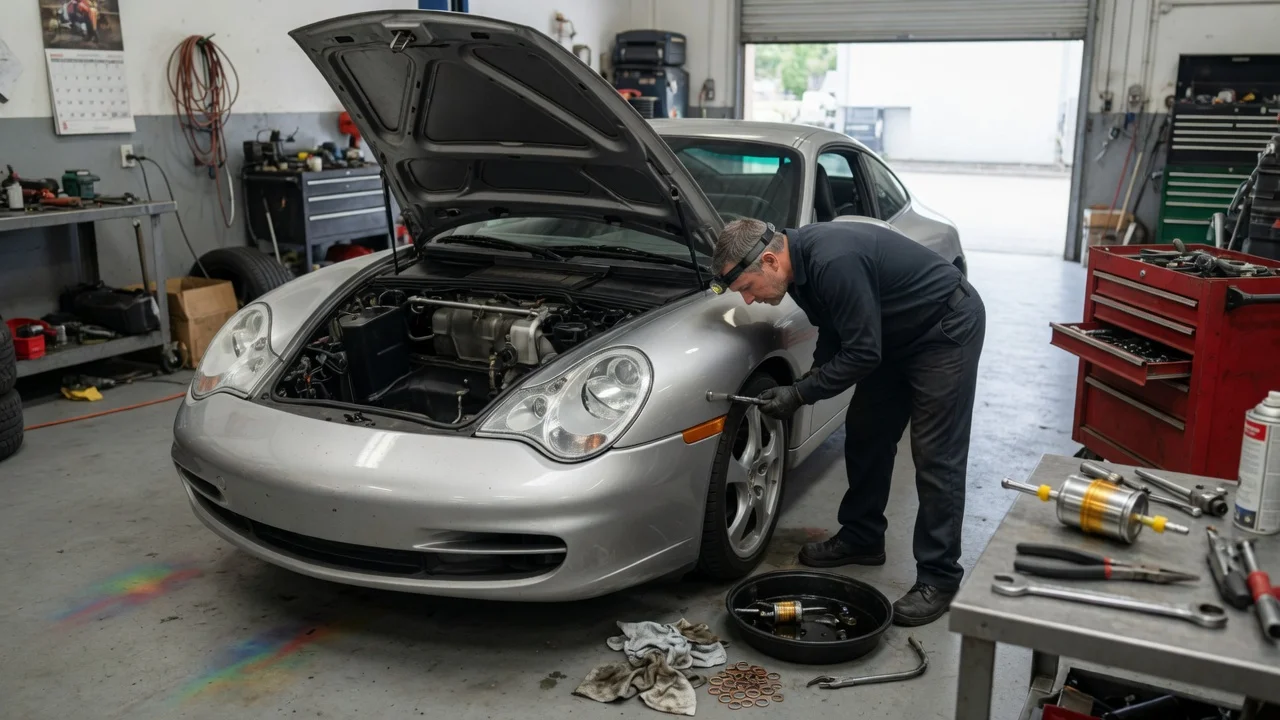
The Porsche 996 fuel filter is a serviceable component located underneath the car, forward of the left rear wheel on most models. Replacement involves relieving fuel system pressure, removing the protective cover and mounting clamp, disconnecting the supply and return lines, and fitting a new filter in the correct flow direction. The exact procedure and filter position vary by model year and powertrain, so the repair must be matched to the specific 996 variant.
Where the Fuel Filter Is Located
On Porsche 996 models that use an external filter, the unit is positioned in the fuel line routing beneath the vehicle. It is typically near the left side of the chassis, ahead of the rear wheel, protected by a plastic or composite shield. The filter is held in place with a mounting bracket or clamp and connected by fuel lines secured with quick-disconnect fittings or hose clamps, depending on the production version.
Access requires safely raising and supporting the car. Working beneath a lowered vehicle demands proper jack stands or a lift, because fuel line work near the suspension and chassis leaves little margin for error.
Why Model Year and Variant Matter
The 996 generation spanned multiple engines and revisions, and the fuel system changed over time. Early cars may use a conventional in-line filter, while later build revisions can integrate filtration differently within the system. Owners should confirm the configuration for their specific model year, engine and market before ordering parts, because a filter listed generically for the 996 may not match every production variation.
This qualification is important: the replacement task is not identical across all 996s. A repair guide written for one version can mislead an owner with a car that uses different line connections or filter placement.
When to Replace the Fuel Filter
A fuel filter does not have a driver-visible wear indicator, so replacement is usually scheduled by mileage or time. The supplied reference does not state a factory replacement interval for the 996, and the interval can differ by market and service documentation. Owners should treat an unspecified mileage figure as unverified rather than assuming a universal schedule.
Symptoms of a Restricted Filter
A clogged fuel filter can restrict flow before the failure becomes obvious. Symptoms consistent with a fuel delivery restriction include hard starting, hesitation under acceleration, reduced power at higher engine load, and occasional stalling. These symptoms overlap with other fuel system problems, so the filter is only one diagnostic possibility rather than a guaranteed cause.
Safety Before Starting
Fuel is flammable and remains pressurized in the lines even when the engine is off. Before disconnecting any fitting, the fuel system pressure must be relieved according to the workshop procedure for the car. Common precautions include removing the fuel pump fuse and briefly cranking or running the engine until it stalls, but the correct method varies, and the car's specific procedure should be followed.
Work should be performed in a ventilated area away from ignition sources. Have a suitable container ready for the small amount of fuel that drains when the lines are separated, and wear eye protection.
Replacement Steps in Overview
Raise and support the vehicle safely, leaving enough access near the left rear area. Locate the filter and remove the protective cover or shield if fitted. Relieve fuel system pressure before opening any line. Disconnect the fuel supply and return lines from the old filter, catching any fuel. Release the mounting clamp or bracket and remove the old filter. Note the flow direction marked on the old filter before installation. Install the new filter in the correct orientation and secure the mounting clamp. Reconnect the fuel lines and confirm the fittings are fully seated. Restore the system, start the engine, and check for leaks at the connections.
Flow Direction and Fittings
Fuel filters are directional. The housing is marked with an arrow or inlet and outlet labels, and the new filter must match the orientation of the removed unit. Reversing the filter can restrict flow or defeat its internal filtration, so orientation should be confirmed before the old part is taken out.
The line connections may be push-type quick connectors or clamped hoses. Quick connectors require the correct release technique to avoid breaking the retaining clip. Reused seals or clips should be inspected, and any damaged component should be replaced rather than reinstalled.
Post-Replacement Checks
After installation, the fuel pump must re-pressurize the system. The ignition can be cycled to run the pump briefly before starting, depending on the vehicle's behavior. Once started, the engine should be checked at idle and the fittings inspected for dampness or fuel odor. A leak at a connection is a reason to stop the engine and correct the fitting immediately.
Documented Facts and Gaps
This guide relies on general Porsche 996 fuel system characteristics and does not reproduce a factory workshop procedure. Specific torque values for the mounting clamp, the exact pressure-relief method, and the official replacement interval are not supplied in the available coverage. Those details should be confirmed from the correct service information for the car's model year and market before beginning the job.