Polestar coolant system service required
Direct answer
A Polestar coolant system service required warning means the vehicle has detected a condition in the thermal management system that needs attention. In most cases it should not be ignored, because coolant is used to regulate the temperature of the high-voltage battery, electric motors and power electronics, not just a combustion engine. The warning can point to low coolant level, a sensor fault, air in the circuit, a failing pump, a leak or a software calibration issue. The exact meaning depends on the model, model year and whether the car is a Polestar 1 plug-in hybrid or a Polestar 2, Polestar 3 or Polestar 4 battery-electric vehicle.
What the warning covers
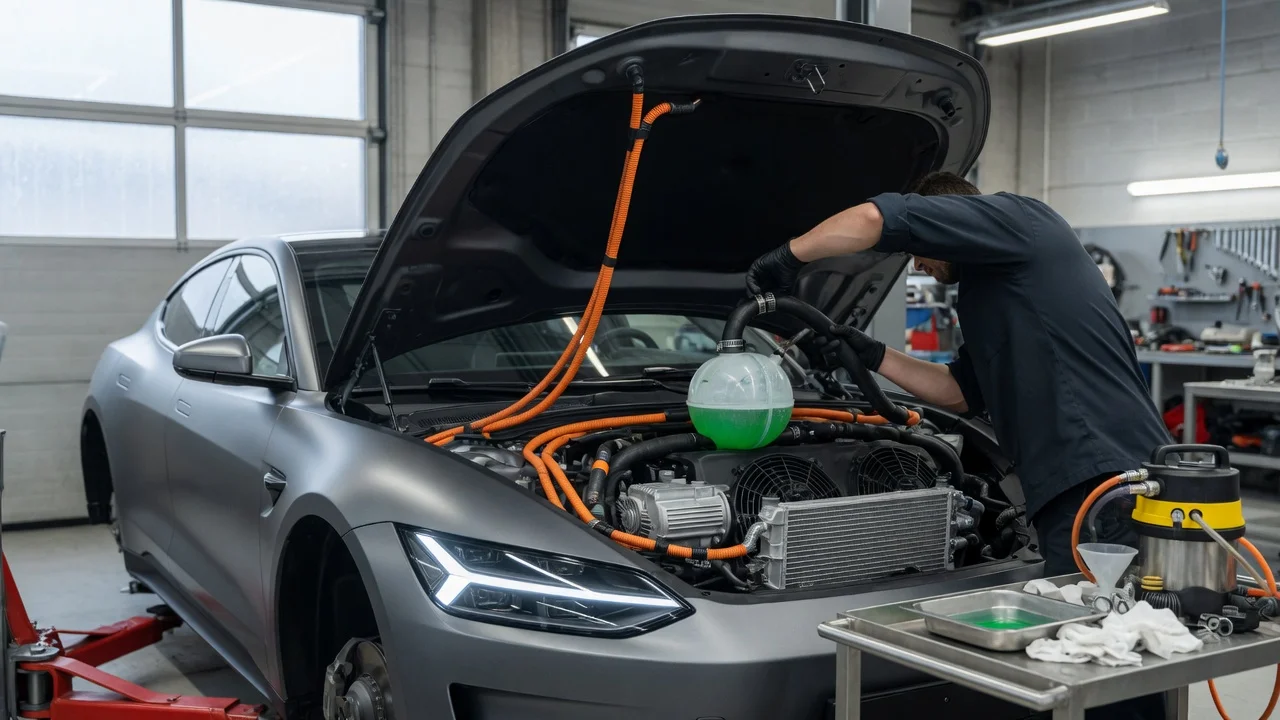
Polestar uses liquid cooling circuits for several vehicle systems. On a battery-electric Polestar, the main circuits normally serve the high-voltage battery, the drive units and onboard charging components. Some variants also use coolant for cabin heating or battery preconditioning. The service warning is therefore not limited to a traditional engine radiator and water pump. It can be triggered by a measured value falling outside the expected range, including temperature, pressure or level.
Because this is a warning generated by diagnostic logic rather than a single mechanical failure, the correct response is to have the stored diagnostic trouble codes read. The code narrows the problem to a specific circuit, sensor or component. Without that code, checking the visible coolant reservoir is only a basic first step and does not rule out internal or electrical faults.
Common causes
Low coolant level from a small leak or evaporation loss; Faulty coolant level sensor; Air trapped in a circuit after a coolant change or component replacement; Electric coolant pump malfunction or reduced flow; Temperature sensor reading outside the expected range; Stuck or incorrectly positioned control valve; Software error or outdated thermal management calibration
Model and variant notes
The Polestar 1 is a plug-in hybrid and has both an internal combustion engine cooling system and hybrid-specific thermal management. A coolant warning on that model can still relate to conventional engine cooling components, but it may also involve the hybrid battery circuit.
The Polestar 2, Polestar 3 and Polestar 4 are fully electric. On these vehicles there is no engine radiator loop in the traditional sense. A coolant warning is more likely to relate to the battery, drive unit or power electronics circuit. Exact coolant specifications, fill procedures and bleeding sequences vary by model and model year, so the required service is not always interchangeable across the range.
Immediate steps for the owner
If the message appears while driving and no other warning such as overheating or reduced performance is present, the vehicle can often be driven cautiously to a safe place. If the message is accompanied by a power limit, a high-temperature warning or visible coolant under the car, stop driving and arrange recovery.
The basic owner check is to look at the coolant expansion tank, but Polestar vehicles may have more than one reservoir. Do not open a hot or pressurized cap. If the level is visibly below the minimum mark, topping up can be a temporary step only if the correct Polestar-specified coolant is available. Adding the wrong coolant type can damage seals, reduce corrosion protection or affect the thermal properties of the system.
Why professional diagnosis matters
Many coolant warnings on Polestar models are resolved with a software update or a sensor replacement rather than a mechanical repair. However, the same message can indicate a genuine leak or pump failure. A workshop with Polestar diagnostic access can read the fault memory, inspect the relevant circuit and perform a pressure test or vacuum fill if needed. This is more reliable than replacing components based on the warning text alone.
Cost and repair expectations
Repair cost varies widely. A sensor replacement or software update is usually less expensive than a coolant pump, valve, radiator or battery-circuit component replacement. If a leak is found in a high-voltage component, the repair may require specialist handling and longer workshop time. Vehicles still under warranty should have the issue assessed by an authorized Polestar service point before any independent repair is attempted.
Known limitations in this guidance
This article is based on general Polestar system behavior and common diagnostic outcomes. It does not identify a single dominant cause, because the supplied evidence does not include model-specific fault data, service bulletin details or a confirmed repair history for a particular vehicle. The safest conclusion is that the warning requires diagnostic confirmation rather than a universal owner fix.