Polaris RZR Turbo Boost Control Valve: Identification and Checks
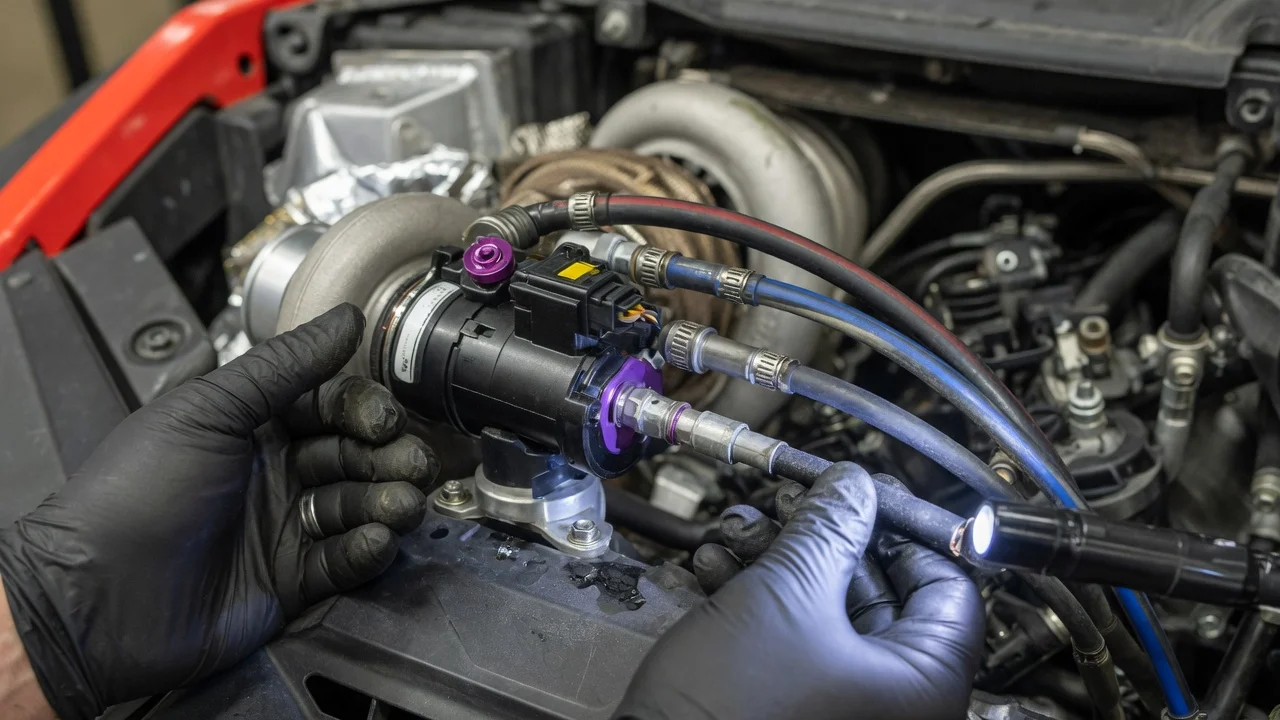
On turbocharged Polaris RZR models, the boost control valve, usually called the boost control solenoid or wastegate solenoid, is an electrically operated valve the engine control unit uses to regulate how much pressure reaches the wastegate actuator. When it misbehaves, boost can fall short, spike or swing unpredictably. This guide explains how to find the valve on your machine, record symptoms accurately, separate it from other common faults and decide which checks are safe to do yourself.
Establish the symptoms
Start by confirming which part you are dealing with. The wastegate actuator is the canister mounted on the turbocharger with a rod that opens the wastegate. Small hoses run from it, and one path leads to a compact valve with an electrical connector, typically mounted near the charge tubing. That valve is the boost control solenoid. Exact location, hose count and routing vary by model year and vehicle configuration, so confirm what you see against the service manual diagram for your machine rather than relying on photos of another model.
Next, write down exactly when the problem appears. Note whether it happens cold or fully warm, at light throttle or only under heavy load, at a particular engine speed, at altitude, or after long runs in high heat. Record associated signs such as a warning light, stored fault codes, reduced-power operation, surging, a sudden hard pull followed by a cut in power, hissing, a changed turbo whistle or smoke. Finally, list recent changes: a tune or aftermarket boost controller, intake or exhaust work, clutch service, pressure washing, a rock strike or anything that may have disturbed hoses and wiring. This record often narrows the cause more than any single test.
Distinguish plausible causes
A failed solenoid is only one explanation for boost trouble. The valve can fail electrically, with an open or shorted coil, or mechanically by sticking open or closed. A fault code pointing to the solenoid circuit, together with symptoms that stay the same regardless of temperature or load and hoses that are intact and correctly routed, supports this cause. Codes that point to sensors or other systems, or symptoms that come and go with vibration, weaken it.
Hose problems are common and cheaper to fix. A cracked, swollen, collapsed, disconnected or swapped control hose can send the wrong signal to the actuator, giving low boost, overboost or fluctuation. Recent work near the turbo and audible hissing make this more likely. A boost leak elsewhere, such as a loose charge tube coupler or a damaged intercooler connection, usually causes low boost and sluggish response rather than spikes. A sticking wastegate or a damaged actuator can mimic a bad solenoid, since the actuator may fail to respond even when the solenoid works. A faulty pressure sensor can make the ECU misjudge boost and command the wrong correction. Lastly, aftermarket tunes and controllers change the targets, so boost that seems low may be intended for that calibration.
Checks in a useful order
Begin with safe observations, engine off and cooled down. Inspect every small hose between the compressor side, the solenoid and the wastegate actuator for cracks, heat damage, kinks and loose ends, and compare routing with the manual diagram. Check the solenoid connector for mud, water, corrosion, bent pins and a secure latch, and follow the harness for chafing or melted insulation near the exhaust. Confirm charge tube couplers and clamps are tight, look for oil film around joints that may indicate a leak, and check the air filter condition. Review the service history for recent work that could have disturbed this area.
The next checks need tools and manufacturer specifications. Read stored and active fault codes with a diagnostic tool compatible with your model. If live data is available, compare commanded solenoid duty cycle with measured boost and note whether boost follows commands. Measure solenoid coil resistance and check supply and control signals at the connector, comparing results with the values in the service manual rather than figures from forums or other vehicles. A pressure or smoke test of the intake tract finds boost leaks, and a hand pressure pump can show whether the wastegate actuator moves smoothly at the pressure the manual specifies.
Leave dealer-level software work, ECU updates, wastegate adjustment and any work requiring turbo removal to a qualified technician. Do not shorten actuator rods, cap hoses or bypass the solenoid to restore power, because these changes remove the ECU's control over boost.
Interpret the findings
A damaged or misrouted hose is a clear finding, but repair it and retest before buying anything else. A solenoid circuit code combined with coil resistance outside the specified range points to the solenoid, though the connector and harness still deserve a check before replacement. If resistance is within specification and the code returns, suspect wiring, the connector or the ECU side of the circuit instead. If the actuator does not move when correct pressure is applied by hand, the problem lies with the actuator or wastegate, not the solenoid. A confirmed boost leak explains low boost on its own and should be fixed before judging the control system.
Clearing codes proves nothing by itself. After any repair, reproduce the original operating conditions recorded earlier and confirm that boost behaviour and codes stay normal. If a new boost control solenoid does not change the symptom, the evidence points elsewhere, so return to the remaining causes rather than replacing more parts on guesswork.
Urgency and next action
Stop riding if you see signs of overboost, such as a sudden violent surge, readings above normal on a boost display or repeated reduced-power events, or if you hear pinging or knocking under load. Also stop for rising engine temperature, smoke, a burning smell, oil pooling in the charge tubes or a hot hose resting against the exhaust. Uncontrolled boost can damage the engine quickly, and there is no safe distance to continue under those conditions. Low boost without other warnings is less urgent, but it still signals a fault that should be diagnosed before hard use.
When booking a repair, provide the model, model year and VIN, a list of modifications including any tune or boost controller, all fault codes with any freeze frame data, a description of when the symptom occurs and what you have already checked. Include recent service history and items completed on the maintenance schedule. Clear, specific information helps the technician confirm the cause rather than starting from scratch.