Pintle Trailer Hitches: How the Coupling Works
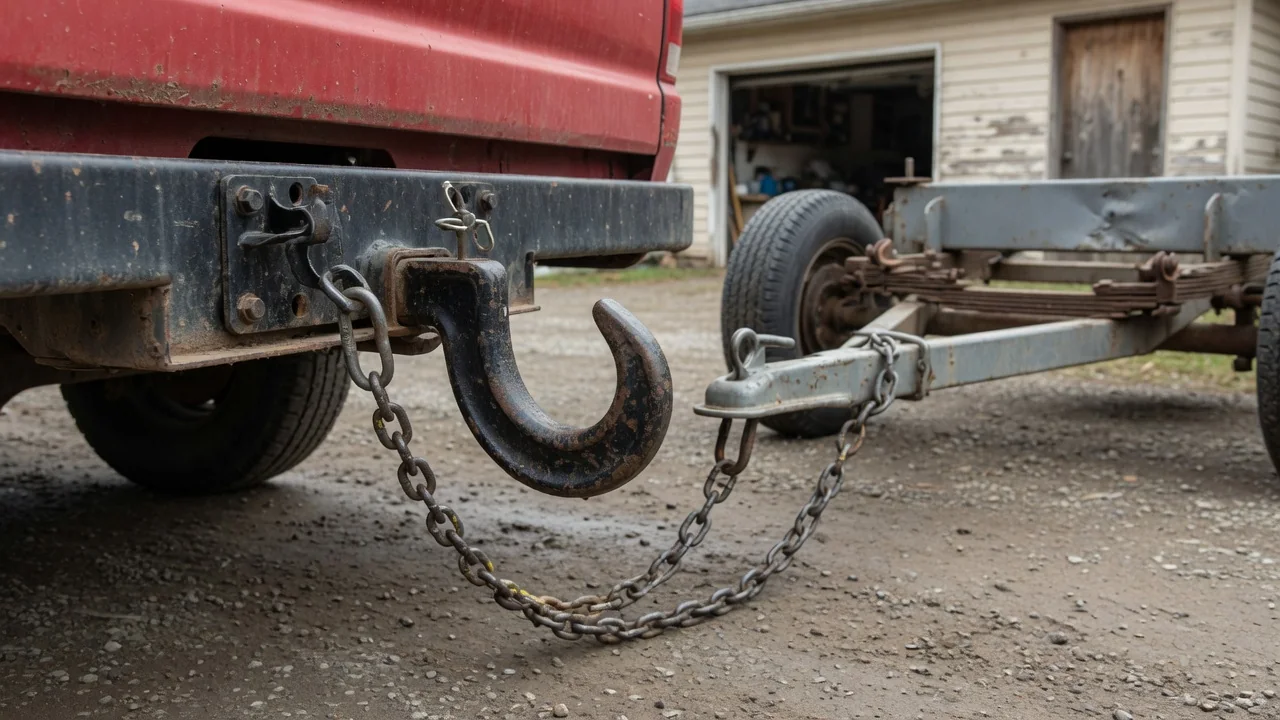
A pintle trailer hitch joins a tow vehicle and trailer with a hook and a ring instead of a ball and socket. The design is common on work trucks, equipment trailers, and military-style rigs because it tolerates rough ground and heavy articulation. Understanding how the two halves meet, lock, and move makes it easier to judge whether the coupling suits a given towing job.
What This Topic Covers
The coupling has two parts. The pintle is a hook, usually with a hinged upper jaw or latch, mounted on the tow vehicle. The lunette is a thick steel ring fixed to the trailer tongue. When the ring drops over the hook and the jaw closes, the trailer is captured. A trailer hitch pintle hook therefore does the job a ball does on a conventional setup, while the lunette ring replaces the ball coupler on the trailer side.
Readers looking at a truck can usually identify the system quickly: a horn-shaped hook with a latch on top, bolted to a plate, a bumper, or a shank that slides into a receiver. On the trailer, the ring may be bolted, welded, or carried on an adjustable channel. Mounting style, hook shape, and ring dimensions differ between manufacturers, so the markings stamped on each component and the vehicle documentation matter more than appearance when identifying what is actually installed.
How It Works in a Vehicle
In operation, the lunette ring rests in the saddle of the hook, and the closed latch prevents it from lifting out. Most latches are held shut by a secondary pin or clip so that vibration cannot open them. Pulling force passes from the ring into the horn of the hook, then through the mount into the vehicle frame or receiver. Braking loads push the ring against the opposite side of the hook, so the connection works in both directions.
The ring is deliberately larger than the hook section it sits on, and that clearance is what gives the coupling its character. The trailer can pitch, roll, and swing through wide angles without binding, which helps on uneven job sites, steep driveway transitions, and off-road tracks. The same clearance allows a small amount of fore-and-aft movement, so drivers often feel or hear a slight knock when accelerating or slowing. That behavior is inherent to the design rather than a sign of a fault.
Common Variations
Several forms exist. A rigid pintle hook bolts directly to a reinforced plate or crossmember on a truck. Receiver-mounted versions use a shank that slides into a standard hitch receiver, which lets the owner remove the hook when it is not needed. Combination units add a tow ball to the top of the hook, allowing the same mount to pull either a lunette-equipped trailer or one with a ball coupler, though each mode carries its own stamped limits.
Other variations aim to reduce the slack between ring and hook. Cushioned or spring-loaded mounts absorb some of the shock, and certain designs use a plunger or air-assisted mechanism that presses against the ring to take up clearance. Lunette rings also come in different inside diameters and section thicknesses, and some swivel on their mounts. Because hooks and rings are not universally interchangeable, the two halves need to be matched according to the manufacturers' specifications for both parts.
Everyday Use and Observations
Day to day, hooking up is straightforward: the latch is opened, the ring is lowered onto the hook, the latch is closed, and the retaining pin is inserted. The large target makes alignment more forgiving than centering a coupler over a ball, which is one reason the system is popular with crews that hitch and unhitch often. Safety chains, electrical connections, and any breakaway equipment are still attached separately, just as they would be with any other trailer coupling.
On the road, an unloaded or lightly loaded trailer tends to produce more clunking than a loaded one, because less weight holds the ring down in the saddle. Over time, the contact surfaces of both hook and ring polish and wear. Owners can watch for a latch that no longer closes firmly, a missing retaining pin, visible grooves, cracks, or distortion, and loose mounting hardware. Lubrication practices vary by product, so the manufacturer's guidance for that particular hook is the reference to follow.
Limits and Next Steps
A pintle arrangement is not automatically stronger or more capable than another hitch type. The usable limit of any setup is governed by its lowest-rated element, which may be the hook, the ring, the receiver, the mounting structure, the trailer, or the tow vehicle itself. Those figures come from the stamped ratings and the vehicle documentation, not from the size or look of the hardware. The slack that helps articulation can also make the ride noisier and less refined for light trailers on smooth roads.
Before buying or using a pintle trailer hitch, it is worth confirming the ratings on every component, checking that the ring and hook are intended to work together, and verifying that the mounting location on the vehicle is approved for this kind of load. Worn, bent, or cracked parts are generally replaced rather than repaired, since welding or heating can affect the steel. When there is any doubt about fitment or condition, a qualified hitch installer or the equipment manufacturer can assess the specific vehicle and trailer.