Pickup Truck Tire Maintenance: Pressure, Wear and Inspection
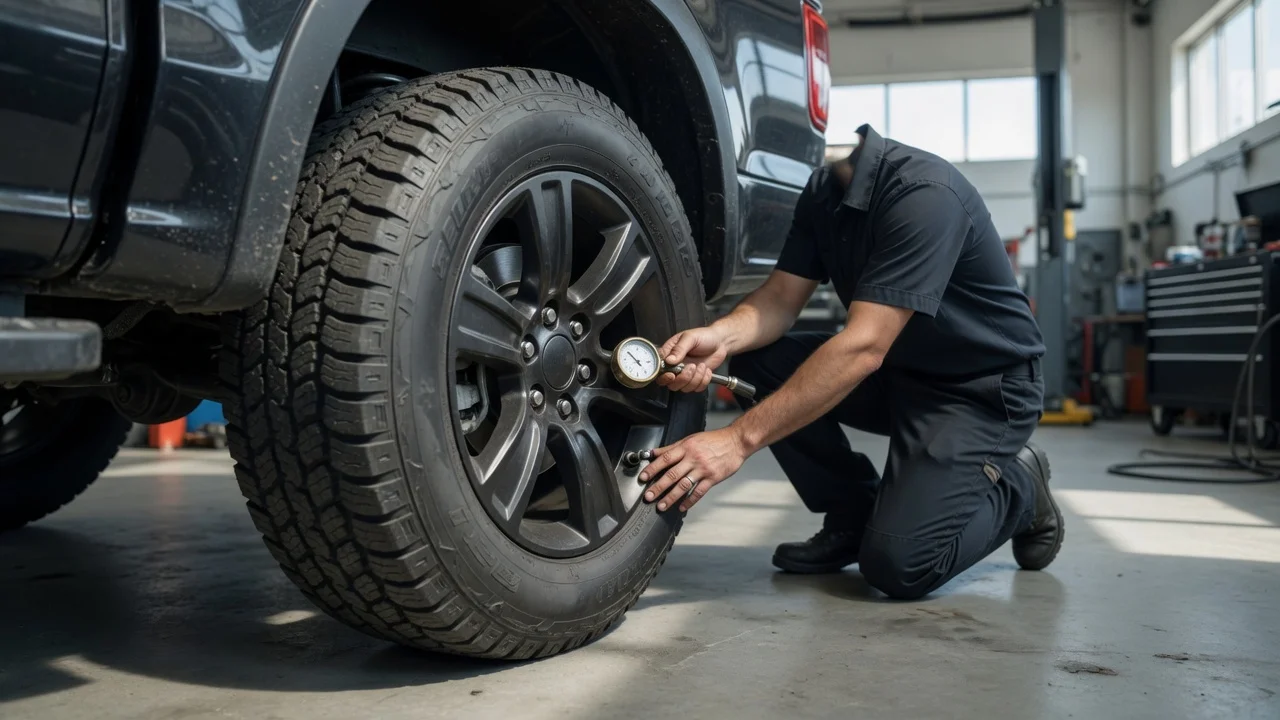
What pickup truck tire maintenance actually covers
Tire maintenance on a pickup is the regular work of keeping air pressure correct for the load, watching how the tread is wearing, and inspecting the tires and wheels for damage before a failure. The subject is the complete rolling set on the truck—typically four tires, or six on dual-rear-wheel models—plus the spare. The answer changes with the truck’s GVWR and payload, whether you tow, whether the tires are all-terrain, highway, or winter-rated, and with the pressures printed on that specific vehicle’s tire-information placard. Those placard values, the tire’s load index and speed rating, and any separate towing or camper-loading guidance from the truck maker are the controlling specifications; sidewall “max press” is a limit, not a daily target.
Pressure: set it cold, and set it for the load
Check pressure when the tires are cold—before a long drive, or after the truck has sat for several hours out of direct sun. Heat from running and from pavement raises pressure; a reading taken on a hot tire will overstate the cold fill. Use a calibrated gauge at the valve stem. If the truck has a tire-pressure monitoring system (TPMS), treat the dash warning as a prompt to measure with a gauge, not as a substitute for one. TPMS thresholds and sensor locations vary by model year and whether the truck has dual rears; some systems do not monitor the spare.
The correct cold pressure is the figure on the driver’s-door placard or in the owner’s manual for that truck, trim, and tire size, not a generic “pickup” number. Many pickups list more than one pressure: a light-load or everyday figure and a higher figure for full payload or towing. If you regularly haul, carry a slide-in camper, or tow, use the loaded or towing pressure the manufacturer specifies for that condition. Underinflation on a loaded truck overheats the sidewall and the shoulder of the tread; overinflation on an empty truck reduces the contact patch and can accelerate center wear. When you add or remove a large load, recheck pressure rather than leaving a towing fill in place for empty highway miles, or an empty fill in place under a trailer.
Match pressure across a dual pair. On dual-rear-wheel pickups, a soft inner dual can hide until heat or a blowout makes it obvious; both tires in a dual set should be at the specified cold pressure and of matching size, load range, and tread type. After any pressure change, recap the valve and confirm the stem is not leaking. Nitrogen fills, where used, still need the same cold-pressure target; the gas does not replace load-based inflation.
Wear: what the tread is telling you
Pickup tires wear according to load, inflation, alignment, rotation habits, and how much of the work is highway versus dirt, gravel, or jobsite use. Even wear across the tread, with remaining depth above the wear bars, is the goal. Wear bars sit in the grooves; when the tread is flush with those bars, remaining depth is at the indicator height (commonly 2/32 inch in U.S. passenger and light-truck service), and replacement is due. Legal minimums and inspection standards differ by market; follow the rule that applies where the truck is registered and operated.
Center wear with a rounded, high middle often points to chronic overinflation or a light truck run at a heavy-load pressure. Shoulder wear on both outer edges often points to underinflation or repeated running under load at too-low pressure. Wear on one shoulder of one axle often points to camber or alignment issues, or to a bent wheel or worn suspension part. Cupping, scalloping, or diagonal chop can point to unbalanced tires, worn shocks or control-arm bushings, or a rotation interval that was skipped. Faster wear on the rear of a two-wheel-drive pickup, or on the drive axle of a 4x4 used in low range, is common if rotations are overdue. Feathered tread edges can point to toe misalignment.
All-terrain and mud-terrain treads can look “worn” at the void while still having usable lug depth; judge remaining depth in the grooves, not only the look of the voids. Highway tires on a truck that now lives on gravel will show faster chunking and cutting. Winter tires have their own remaining-depth guidance from the tire maker; do not mix winter and all-season tires on the same axle. Load range, ply rating, and whether the tire is LT-metric, flotation, or P-metric with a load-inflation table all change how much weight a given pressure can carry. If the truck was re-tired onto a different size than the placard lists, pressure and load capacity must be recalculated from the tire maker’s load-inflation table for that size and load range, not copied from the old placard blindly.
Inspection: what to look at, and how often
A useful inspection is visual and tactile, done with the truck on level ground, and repeated more often when you tow, haul, or run unpaved roads. Walk around the truck. Look at each tire from the tread and from both sidewalls, including the inner sidewall on duals. Run a gloved hand over the tread to find nails, screws, and cuts that a glance misses. Check the spare the same way, and confirm it holds pressure.
Tread: remaining depth, evenness, embedded objects, cuts that reach the cord, and chunks missing from lugs. Sidewalls: bulges, bubbles, cracks, weather checking, abrasions from rubbing a fender or dual partner, and damage from curbs or rocks. Bead and wheel: corrosion at the rim flange, bent rims, missing balance weights, and seepage at the bead. Valve stems: cracks, leaks, missing caps, and TPMS sensors that are damaged or overdue for service when tires are replaced. Fasteners: wheel-nut condition and, after a tire service, torque to the truck maker’s specification once the truck has been driven a short distance. Age: the DOT week/year code on the sidewall. Rubber ages even with tread left; replacement timing for age is a tire-maker and fleet-practice question, not a single universal year count in this guide.
Replace a tire that has a bulge, a cut to the cord, a repair outside the tread’s repairable zone, or a previous repair that is leaking. Puncture repair limits—hole size, location in the tread, and whether a plug-only repair is acceptable—are set by industry repair standards and by the tire manufacturer; a sidewall injury is not a candidate for a simple plug. After a hard pothole, curb strike, or off-road rim hit, inspect for inner-liner damage and have the wheel checked for runout even if the tire still holds air.
Rotation, balance, and alignment
Rotation equalizes wear between steer, drive, and (on 4x4s) the axle that is used more. Follow the pattern in the owner’s manual for that drivetrain: many four-wheel pickups use a modified X or rearward-cross pattern; dual-rear-wheel trucks have their own pattern and may not rotate the same way as a single-rear-wheel truck. Directional tires must stay in their rolling direction unless they are dismounted and remounted. Staggered sizes, which are uncommon on pickups but appear on some sport-truck trims, may not rotate front to rear.
A typical owner’s-manual interval is tied to oil-change or mileage service; the exact mileage is model-year specific. If you see early shoulder or cupping wear, shorten the interval and check alignment rather than waiting for the next scheduled rotation. Balance the assembly when you feel vibration in the seat or steering wheel at speed, after a repair, or when a wheel weight has been lost. Alignment belongs in the same conversation as tire life: a pickup that tows, sits with a loaded bed, or has lifted or leveled suspension may need alignment specs that match that configuration. Aftermarket lift, leveling kits, and wheel offset can move the tire relative to the fender and change wear; those setups need their own alignment targets and periodic re-checks.
Load, towing, and when the tires are no longer enough
Pickup tires are a load-rated component. Gross vehicle weight rating (GVWR), gross axle weight ratings (GAWR), and tire load index must all clear the actual weight on the axle, including passengers, bed cargo, hitch tongue weight, and any camper. Weighing the truck loaded, at a scale, is the way to know whether the current tires and pressures are in range; guessing from a half-empty bed is not. If axle weight exceeds the tires’ capacity at the pressure you can legally run, the next action is a higher load-range tire in a size the truck maker allows, not simply adding more air past the rim and tire limits.
Towing adds tongue weight to the rear axle on a conventional hitch and changes front-axle load as well. Use the truck’s towing supplement for any special tire or pressure notes. Trailer tires are a separate maintenance subject; they do not substitute for keeping the tow vehicle’s tires at the loaded specification. Temperature swings of tens of degrees will move cold pressure by a few psi; recheck at the start of a trip and when the weather changes sharply.
A practical maintenance rhythm
Before a loaded trip: confirm cold pressures at the placard or towing figure, inspect tread and sidewalls, and check the spare. Monthly in ordinary use: gauge all tires, including the spare, and look for new cuts or uneven wear. At each rotation: depth check, visual inspection, and a decision on remaining life. At tire replacement: match size, load index, speed rating, and winter or all-terrain designation across the axle at minimum; many truck makers prefer a matched set of four. Reset TPMS if the procedure for that model year requires it, and torque the wheels to spec.
What this guide does not replace is the door-placard pressure, the tire’s load-inflation table, and the inspection or remaining-depth rule in your market. Those documents, plus a scale ticket when you haul or tow heavy, are the next action when you need a number rather than a method.