Pickup Truck Maintenance Checklist: What to Inspect and Service
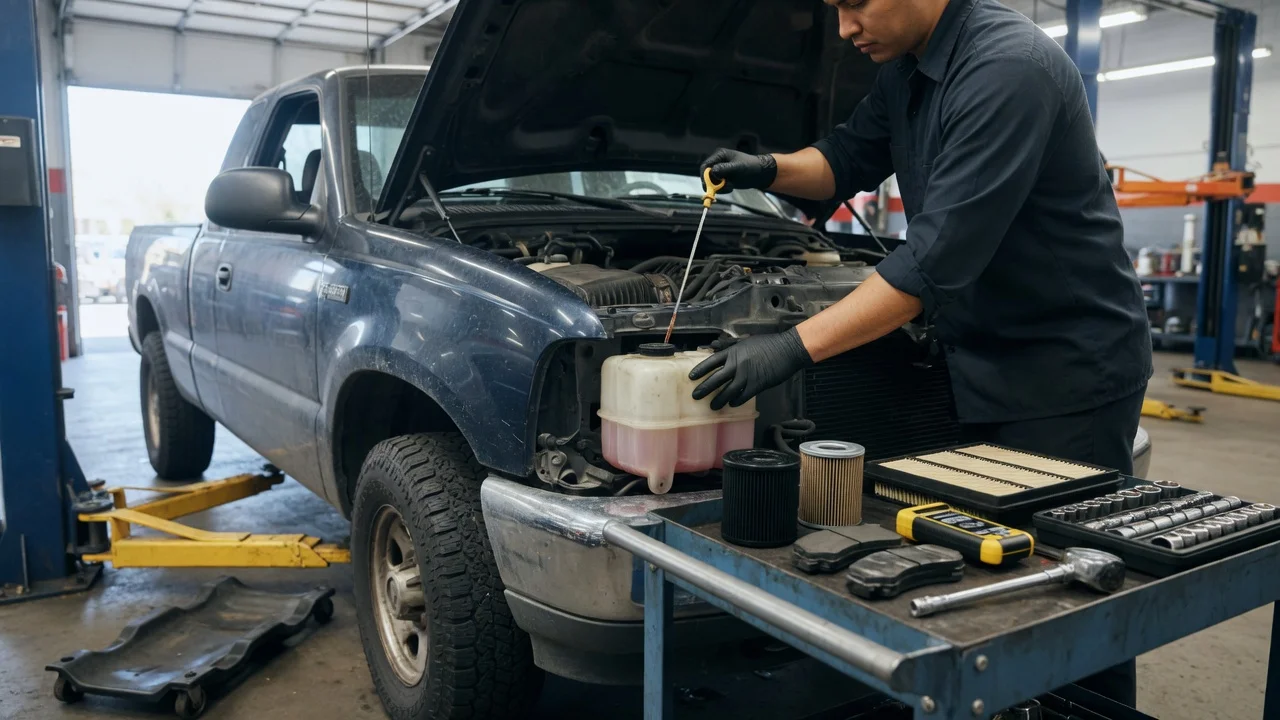
What a pickup truck maintenance checklist should cover
A useful truck maintenance checklist groups inspections and services by interval and duty cycle rather than listing every possible repair. The base list covers engine oil and filter, air and cabin filters, coolant, brake fluid, transmission fluid, transfer case and differential fluids where equipped, battery terminals, belts and hoses, tires, brakes, steering and suspension, lights, wipers, and the underbody. Service schedules vary by model year, generation, powertrain, trim and market, so the owner's manual remains the controlling source for intervals and specifications.
Why the maintenance checklist differs from a passenger car
Pickup trucks add load-carrying and towing components that a standard car checklist may ignore. A four-wheel-drive truck has a transfer case and front differential. A tow package may add a transmission cooler, trailer brake controller, hitch receiver, wiring connector, and trailer sway control. Severe-duty use, including towing, hauling near payload capacity, dusty roads, short trips, mud, and prolonged idling, shortens many service intervals compared with normal driving.
Engine and underhood items
Engine oil is the most common interval item, usually specified with an oil filter replacement at the same service. Diesel and turbocharged gasoline engines may call for different oil specifications than naturally aspirated gasoline engines. During the underhood inspection, check the coolant level in the reservoir rather than opening a hot radiator cap. Inspect drive belts for cracks, glazing, or missing ribs, and check coolant and heater hoses for swelling, hardening, or leaks.
Engine oil and filter; Air filter and cabin filter; Coolant level and condition; Brake fluid level and condition; Battery terminals and hold-down; Drive belt and hose condition; Fuel system components, especially on diesel trucks
Drivetrain fluids and components
Transmission service varies widely. Some automatic transmissions use a sealed design with no routine dipstick check, while others specify fluid changes at intervals that shorten with towing. Transfer case fluid and front and rear differential fluid are listed separately on many truck schedules. Grease fittings on driveshaft U-joints and steering components should be lubricated where the vehicle is equipped with serviceable fittings; some modern trucks use sealed components that are replaced rather than greased.
Tires, brakes, steering and suspension
Tire pressure should be checked cold and adjusted for the actual load, using the pressure listed on the driver's door placard or in the manual for the relevant load condition. Rotation intervals are often shortened on trucks that haul or tow. Inspect tread depth evenly across each tire and look for cuts, uneven wear, and sidewall damage. Brake inspection includes pad or shoe thickness, rotor or drum condition, calipers, and visible brake lines. Steering and suspension checks cover ball joints, tie-rod ends, control arm bushings, shocks or struts, and, on solid-axle trucks, leaf springs and front-end components.
Towing and payload service items
If the truck tows, add the hitch receiver mounting hardware, safety chain attachment points, trailer wiring connector and brake controller to the checklist. Check the trailer brake operation before towing. Towing often moves the transmission and differential fluid to a severe-service schedule and may require more frequent brake fluid inspection because heat affects brake fluid condition over time.
Underbody, lights and safety items
Inspect the frame, body mounts, suspension mounting points, exhaust hangers, and underbody protection for rust, especially where road salt is used. Confirm headlights, taillights, brake lights, turn signals, reverse lights, and auxiliary lights work. Check windshield washers and wiper blades. If corrosion protection or undercoating is used, its condition is part of the inspection rather than a substitute for finding existing rust.
A practical service-order checklist
Record the current odometer reading and compare it with the maintenance schedule.
Check for active warning lights, stored fault codes, leaks, or unusual noises before service.
Change engine oil and filter using the specified oil and torque for the drain plug and filter.
Check coolant, brake, power steering, transmission, transfer case and differential fluids.
Inspect belts, hoses, air filter, cabin filter and battery terminals.
Inspect tires, brakes, steering and suspension; rotate tires when due.
Lubricate serviceable fittings and check towing equipment.
Check lights, wipers, washers and underbody condition.
Record the completed services, date, odometer reading and any deferred items.
When to stop and seek professional diagnosis
A truck should be removed from towing or heavy-load service until a professional diagnosis is completed if there is metal in the oil or transmission fluid, coolant in the oil, oil in the coolant, persistent drivetrain noise, severe steering play, visible brake fluid loss, structural frame rust, or an unidentified fault code that affects engine, transmission, braking or stability systems.
Service area;Normal use;Severe or towing use; Engine oil and filter;Per manual normal interval;Shorter interval per manual severe schedule; Air filter;Inspect at service;Replace earlier in dusty conditions; Coolant;Per manual interval;Check level and condition more often; Automatic transmission fluid;Per manual or sealed design;Shorter severe-service interval; Transfer case and differentials;Per manual;Shorter interval under towing or off-road use; Tires;Normal rotation interval;Load-adjusted pressure and earlier rotation
The most useful practice is to keep one master checklist, separate the normal and severe-service schedules, and note the date, odometer reading, part or fluid specification, and any deferred item every time. That record prevents a skipped transfer case service or brake fluid flush and gives the next inspection a clear starting point.
Material gap: this article does not list intervals or fluid specifications for specific model years because those values are variant-dependent and belong to the applicable owner's manual.