Pep Boys Transmission Fluid Change: Evaluating the Service
This guide helps you evaluate a Pep Boys transmission fluid change as a service option. It covers the information to prepare in advance, the general service flow, how to confirm the result, and the questions most drivers ask about coverage, intervals, and whether a flush is the right choice.
Before you start
A transmission fluid change is performed at a Pep Boys service location rather than through an online tool. Because prices, fluid types, and available appointments depend on your vehicle and the specific store, current details should be confirmed with the location you plan to visit. Before booking, check the owner's manual or service schedule for the transmission fluid specification and replacement interval for your year, make, model, and engine. If you do not know which fluid the manufacturer calls for, a service advisor can look it up using the vehicle details, but having the manual available can make the initial conversation clearer.
Ask whether the quoted transmission fluid change includes a pan gasket replacement, filter replacement if the transmission has a serviceable filter, the correct quantity and type of fluid, and disposal of the old fluid. Some transmissions have a drain plug, while others require removing the pan. If the pan must be removed, the gasket or sealant requirement can affect the total. A basic drain-and-refill removes only part of the fluid; a flush or exchange is a separate process and may not be appropriate for all transmissions.
Note any warning signs that should be discussed before service, such as slipping, delayed engagement, rough shifts, unusual noise, or a burnt smell. If the transmission already shows serious mechanical symptoms, a fluid change is not a guaranteed repair and the shop may recommend diagnosis first. Also confirm the current mileage so the advisor can compare it with the maintenance schedule.
Step-by-step instructions
The exact steps depend on the vehicle and the service selected. This is a general service flow, not a procedure for doing the work at home.
1) Confirm the vehicle details and service scope
Provide the year, make, model, engine, transmission type, and current mileage when requesting the service. Ask for a written or clearly stated breakdown of what is included before authorizing work. Clarify whether the quote is for a drain-and-refill, a pan service with filter, or a fluid exchange. If the advisor cannot see the vehicle, pricing may be revised after inspection if additional parts or fluid are needed.
2) Ask about fluid compatibility
Transmission fluid is not universal. The required specification may be labeled as ATF, CVT fluid, DCT fluid, or a manufacturer-specific fluid. Request confirmation that the fluid planned for the service matches the vehicle manufacturer's specification in the owner's manual. Using the wrong fluid can cause shift quality problems or damage, especially in continuously variable transmissions and dual-clutch transmissions.
3) Let the technician inspect and perform the service
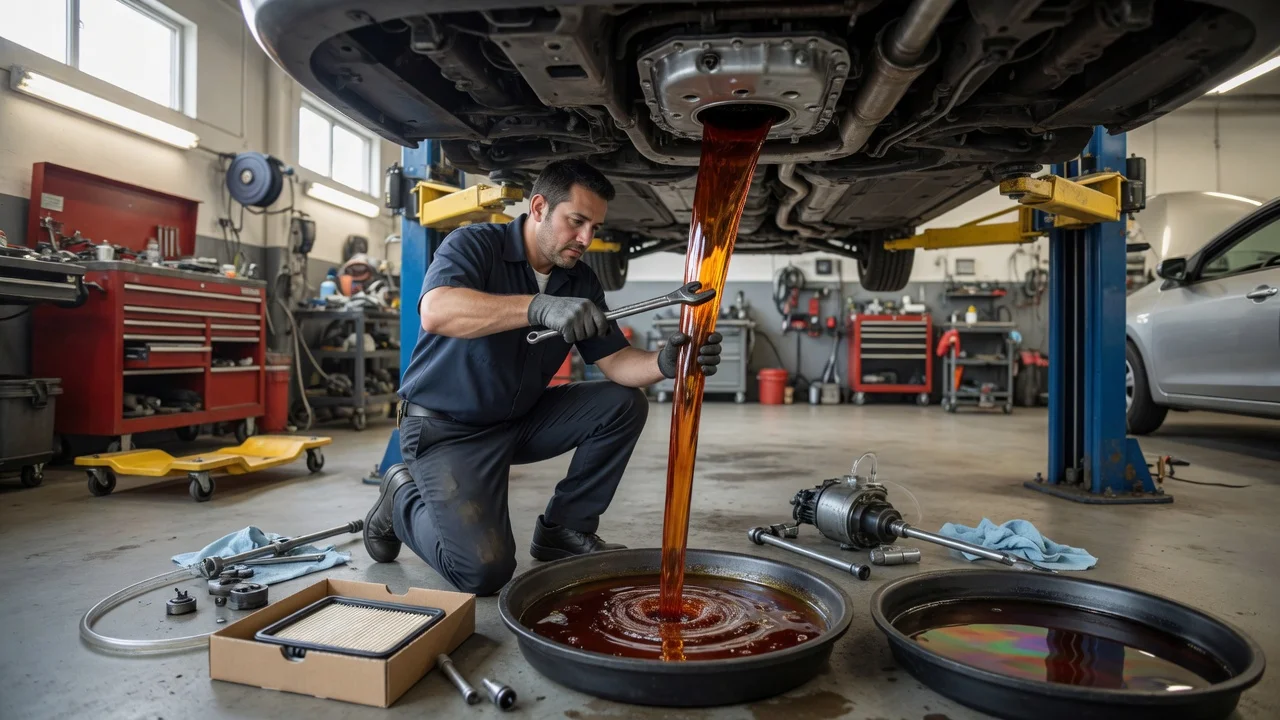
The technician typically raises the vehicle, removes the drain plug or transmission pan, drains the accessible fluid, replaces the filter and gasket where applicable, and refills with the specified fluid to the correct level. Depending on the transmission, the final level may be checked at a specified temperature or with a fill-level plug rather than a conventional dipstick.
4) Keep the service record
Ask for a completed receipt or service record showing the mileage, fluid specification, quantity, filter and gasket if replaced, and any observations from the inspection. Keeping this record preserves the maintenance history and can be useful if a leak or shift concern appears later.
Check the output
After driving normally for a short distance, the transmission should engage promptly and shift without new harshness, flare, or delay. Check the service record against the vehicle's fluid specification. Look under the vehicle after it has been parked for a while for fresh red, amber, or brown fluid spots, which could indicate a pan gasket or drain plug leak. If the vehicle has a transmission dipstick, check the level after the engine and transmission have reached the conditions described in the owner's manual; many newer vehicles require a technician-level procedure and should not be checked by guesswork.
A drain-and-refill does not remove all of the old transmission fluid because a portion remains in the torque converter, cooler lines, and valve body. That is normal and is one reason the owner's manual may recommend more than one drain-and-refill event or a specific exchange method. A fluid change also does not reset an adapted transmission control module or cure existing mechanical wear, so the expected result is clean new fluid, not a transformed transmission.
Common problems and next steps
Will a transmission fluid change void my warranty?
Following the manufacturer's maintenance schedule and using the specified fluid are the key points to document. Keep the receipt showing the fluid type and mileage. If you are concerned about warranty coverage, verify the service interval and specification in the owner's manual before the visit and preserve the service record.
Transmission fluid change vs. flush
A fluid change or drain-and-refill replaces the fluid that drains from the pan. A flush, exchange, or machine-assisted fluid replacement is intended to replace more of the old fluid. Not every transmission should be flushed, particularly if the fluid is very old, dark, or contaminated, or if the transmission has high mileage and a history of poor maintenance. Ask the shop why it recommends one method over the other for your specific vehicle and condition instead of assuming a flush is automatically a stronger service.
How often should transmission fluid be changed?
There is no single correct interval for all cars. The manufacturer's maintenance schedule in the owner's manual is the primary reference. Some vehicles list a specific replacement interval, while others describe severe-service intervals for frequent towing, stop-and-go driving, high temperatures, or heavy loads. Use the schedule for your vehicle rather than a generic mileage rule.
What if the transmission still shifts poorly after the service?
A fluid change is maintenance, not a repair for slipping, grinding, or shift flares. If the problem was present before the service, or if new noise, leaks, or harsh engagement appear, return to the service location with the receipt and describe when the symptom occurs. The technicians can recheck the level and inspect for leaks or other faults, but diagnosis of a mechanical or electrical transmission problem is a separate repair process.