Pennsylvania Tire Tread Depth Requirements for Vehicle Inspection
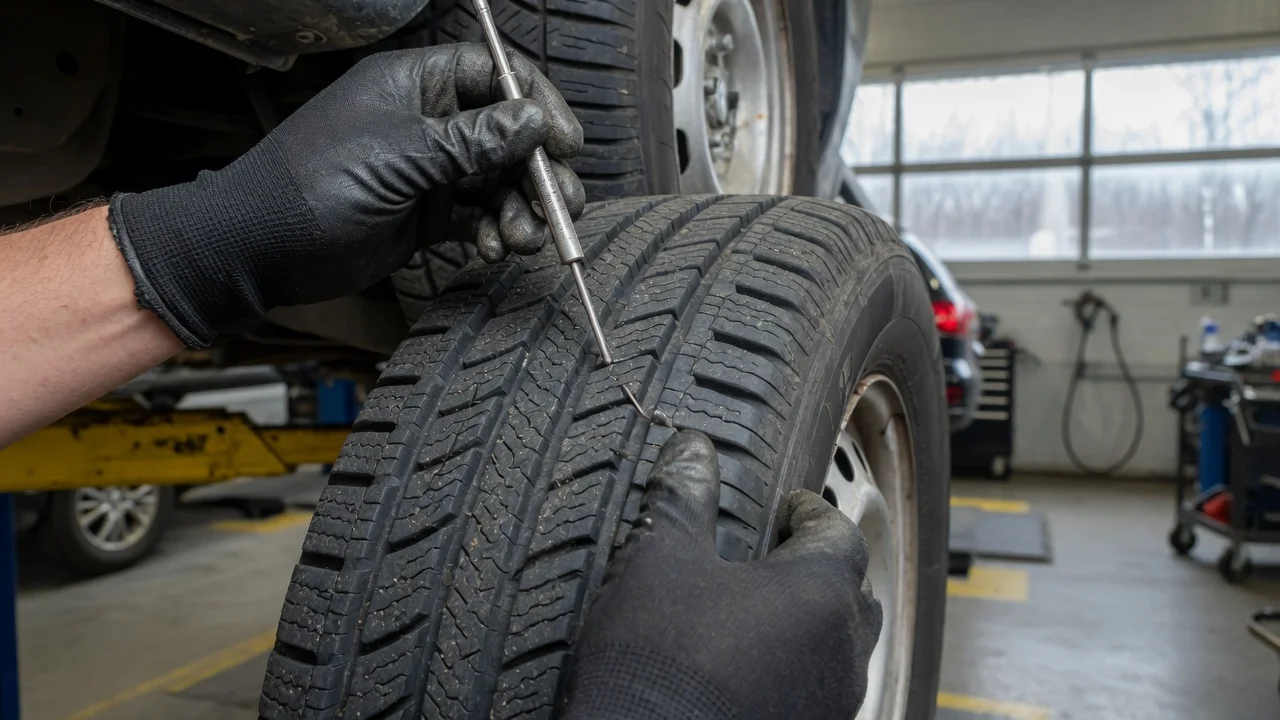
Check the measurement
Tread depth should be measured in the main longitudinal tread grooves, not on the outer shoulder blocks or raised tread elements. Place a tread depth gauge probe into a groove, hold the gauge base flat against the tread surface, and read the value. Repeat the check at multiple points across the tire: near the center and toward both shoulders. Move around the tire so you capture several positions on the circumference. If one groove consistently reads lower than the others, the tire may be wearing unevenly.
Avoid measuring over wear bars. The raised wear indicator bars sit inside the tread grooves and mark a specific remaining depth; the gauge probe should be placed away from these bars. Also avoid cuts, embedded stones, or damaged tread sections that can distort the measurement. For a useful overall picture, record the lowest repeatable reading at each position rather than relying only on the best-looking tread.
Explain the units
Passenger car tire tread depth is commonly expressed in 32nds of an inch in the United States. A new all-season passenger tire may start around 10/32 or 11/32 of an inch, but wear rate depends on tire type, vehicle load, alignment, and use. The same measurements can be converted to millimeters. One 32nd of an inch equals 0.79375 millimeters, so useful reference points are: 10/32 inch is about 7.9 mm, 8/32 inch is about 6.4 mm, 6/32 inch is about 4.8 mm, 4/32 inch is about 3.2 mm, and 2/32 inch is about 1.6 mm.
A tread depth gauge may display either scale. If the gauge reads in millimeters, converting to 32nds can help compare the result with common replacement guidance. Because the conversion is not round, a reading of 3 mm is slightly below 4/32 inch, while a reading of 5 mm is slightly above 6/32 inch. Do not treat rounded values as exact legal or safety limits.
Compare readings with actual requirements
Tire wear indicators are molded into the tread grooves. When the surrounding tread wears down to the point where the wear bars are level with the tread surface, the tire has reached approximately 2/32 inch of remaining tread. Wear bars provide a visual and tactile indicator, but they do not by themselves confirm that a tire is safe for every road condition. Use them as a consistent built-in reference rather than the only inspection point.
A minimum legal tread depth does not promise adequate grip in all weather or road situations. Pennsylvania inspection requirements set a specific acceptable threshold for rejection, while tire manufacturers and service providers may recommend earlier replacement. Check the current inspection standard from the official enforcing authority for the exact depth at which a tire would fail inspection, and compare it with the recommendations in the vehicle owner's manual or tire information label.
Account for driving conditions
Wet grip declines as the tread grooves become shallower because the grooves provide space for water to escape from under the contact patch. A tire at or near the legal minimum may pass a depth check yet have reduced ability to resist hydroplaning in standing water. The exact behavior depends on vehicle speed, tire design, road surface, water depth, and tire condition, so a universal minimum wet-weather threshold cannot be stated from depth alone.
Winter and snow performance deteriorate earlier than legal wear limits for many tires. Tires with shallow tread cannot grip or evacuate snow as effectively as deeper-tread tires. If the car will be used in winter conditions, consider replacing tires before the tread reaches the inspection minimum. Summer or performance tires may have different compound and tread characteristics, but depth alone still does not establish their wet or cold-weather capability.
Make a replacement decision
Base the replacement decision on the lowest reading found during measurement. One shallow groove or one worn section can make the tire unserviceable even if the rest of the tread is deeper. Uneven wear may point to alignment, inflation, or suspension problems. Correcting those issues is important before installing new tires, otherwise the replacement set may wear in the same pattern.
Tread depth is only one part of tire condition assessment. Inspect for cuts, cracks, bulges, exposed cords, sidewall damage, punctures, and age-related deterioration. A tire with acceptable tread depth may still need replacement if damage affects the casing. When the remaining depth is near the inspection limit, or when wet and winter performance is already compromised, replacement is the conservative choice. Match the replacement tire size and load rating to the vehicle specifications rather than using depth as the sole decision factor.