P3160–P3200 Hybrid Codes: Power Loss, No-Start and Fuel Concerns
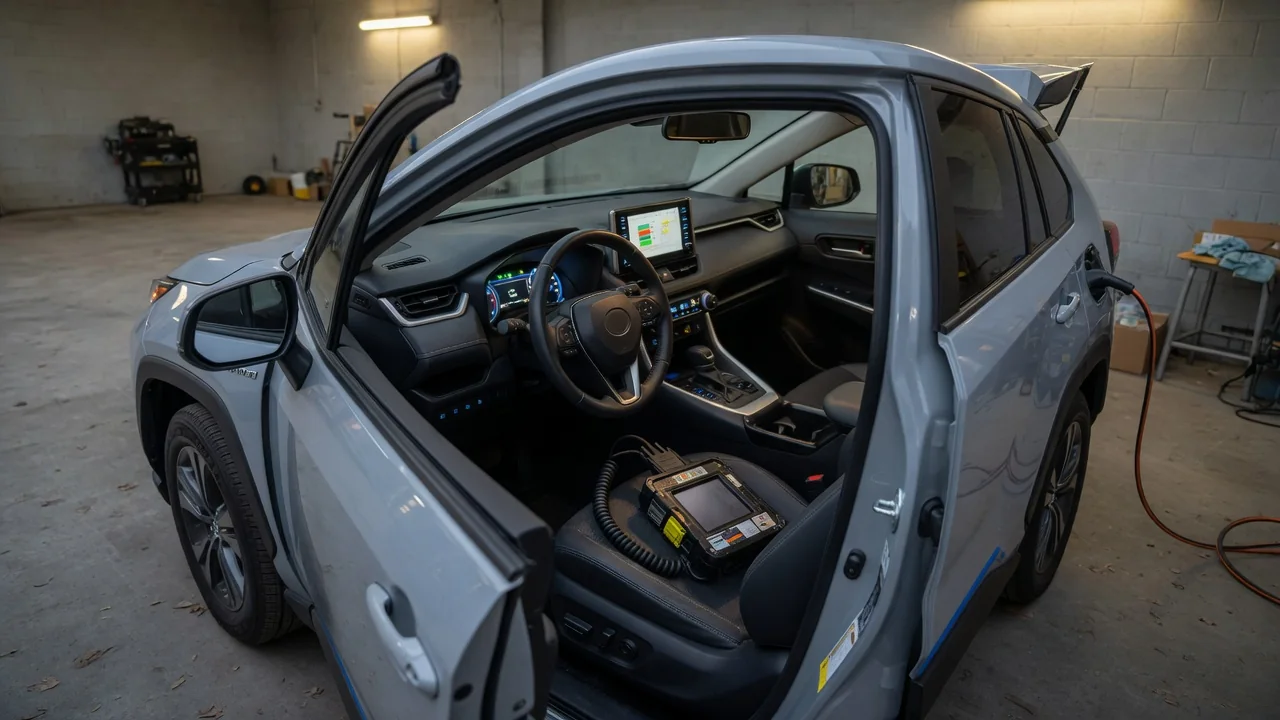
Hybrid engine control codes from P3160 through P3200, including P3187, P3190, P3191, P3193, P3196, and P3200, are manufacturer-specific trouble codes. Adjacent numbers do not share meanings or causes. Identify year, make, model, powertrain, and the reporting module before reading any definition. Save freeze-frame data, pending codes, and the READY indicator state so diagnosis still has original evidence.
Identify P3160, P3180 and P3184 for the Exact Vehicle
Codes between P3160 and P3200 can look related on a scan tool, yet numerical proximity does not establish shared meanings, causes, or diagnostic procedures. P3160, P3180, and P3184 each need the manufacturer-specific definition and any detail code for that exact vehicle before monitored conditions or symptoms are explained. Supply year, make, model, powertrain, and the reporting module, or a generic hybrid reading can aim at the wrong system.
Before any reset, record every stored and pending code, the reporting module, code status, and available freeze-frame data. Freeze-frame captures load, temperature, and hybrid battery state of charge when the fault set. Clearing erases that snapshot and can turn a current fault into a pending-code chase. Photograph or export the scan report so the shop still sees the original evidence.
P3187: Confirm the Monitored Condition Before Naming a Cause
P3187 is not a universal hybrid-system fault. Obtain the vehicle-specific definition and setting criteria first, then describe only the confirmed monitored condition. The control module reports what it detected, such as a failed comparison or an unmet engine start request, which is not the same as the underlying cause. Fuel, air, ignition, or hybrid-control issues can store the same result, so the number alone does not identify a failed part.
Note whether the warning appeared during startup, engine operation, or a loss of propulsion, and list accompanying codes. Timing and companions often matter more than P3187 by itself. When a basic scanner prints an incomplete description, manufacturer-capable scanning is necessary to read detail codes and enable criteria. Until that definition is confirmed, treat P3187 as a flagged condition, not as proof that a hybrid component has failed.
P3190 and a Confirmed Poor Engine Power Description
Verify that P3190 means poor engine power for the specific vehicle before using that interpretation. Confirmed setting criteria typically show that measured output did not match what hybrid engine control requested. The code still cannot identify a failed component, because fuel delivery, air measurement, combustion, and hybrid limits can all reduce power. Freeze-frame data show whether the event occurred at idle, during acceleration, or after a start request.
Record reduced acceleration, rough running, warning messages, and whether the engine starts while the READY indicator is on. Those notes help separate poor engine power from a delayed start or an engine the hybrid strategy kept off. When the vehicle procedure supports it, a technician may check fuel delivery, air measurement, combustion, and related codes stored with P3190. Follow that procedure rather than replacing parts from the number alone.
P3191 and a Confirmed Engine No-Start Condition
Confirm the vehicle-specific P3191 definition before describing it as an engine no-start code. On a hybrid, an engine that remains off can be normal while electric drive supplies propulsion and READY is lit. Interpretation needs a verified failed engine start request plus context such as hybrid battery state of charge, fuel status, and companion codes. P3191 does not by itself prove a starter, injector, or high-voltage fault.
Record the READY indication, messages, audible engine activity, and whether the vehicle lost propulsion, without deliberately reproducing the fault. Repeated starting attempts can consume hybrid battery energy and block READY even if the original problem was intermittent. An unresolved no-start needs professional assessment. Do not force the engine to run or open high-voltage covers. Bring pending codes and freeze-frame so the shop can see the first failure event.
P3193 and a Confirmed Fuel Run-Out Description
Verify that the vehicle defines P3193 as a fuel run-out condition before connecting the code to fuel level. A scan description does not establish tank quantity, and refueling does not automatically clear every associated fault. Air in the lines or a companion power or no-start code can remain after a fill. Treat P3193 as a module judgment about fuel availability under its rules, not as a gauge reading or proof the fuel system failed.
Record the fuel-gauge reading, recent refueling, distance driven since that fill, and whether symptoms began on a slope, without treating any observation as proof. Use the vehicle manual for refueling and restart guidance if the confirmed definition is fuel run-out. Persistent no-start, inability to enter READY, or a fuel odor require assistance rather than repeated cranking. Do not open the fuel system. Save any companion hybrid engine control codes with P3193.
P3196 and P3200: Resolve Definitions and Companion Codes
P3196 and P3200 each need separate manufacturer-specific definitions, setting criteria, and detail codes. Do not infer poor engine power, fuel starvation, battery failure, or engine no-start from their positions next to P3190, P3191, or P3193. A code in this band can monitor a different hybrid engine control condition. Confirm what each module stored, then relate that verified text to the symptom. If a basic tool shows only a generic label, wait for a manufacturer-capable scan.
Once definitions are confirmed, compare each code with the complaint and with accompanying engine or hybrid-control codes. Module information, freeze-frame records, and the vehicle-specific procedure help a technician decide which condition to investigate first. A P3196 event at high load with a power complaint differs from a P3200 stored at key-on with a no-start. Keep pending codes in the record. Clearing one P3160-range result can hide the sequence that explains the others.
Safe Observations and Information to Bring to the Shop
Bring exact dashboard messages, symptom timing, fuel level, recent service, and the saved scan with every code, detail code, and freeze-frame data. Note hybrid battery state of charge if displayed, and whether READY came on. Stop driving and request assistance for loss of propulsion, inability to enter READY, overheating warnings, smoke, or a strong fuel odor. Those are not owner-service conditions.
Owner checks exclude high-voltage access, opening the fuel system, electrical probing, and forced engine operation. A hybrid engine may start automatically while READY is displayed, so stay clear of the engine bay. A useful handoff includes vehicle identification, complete codes and detail codes, freeze-frame data, the symptom sequence, and actions already taken. That lets the technician start from P3180, P3184, P3187, or P3190 evidence as stored, not from a cleared memory.