P3010–P3081 Codes: Hybrid Battery Blocks and Manufacturer Definitions
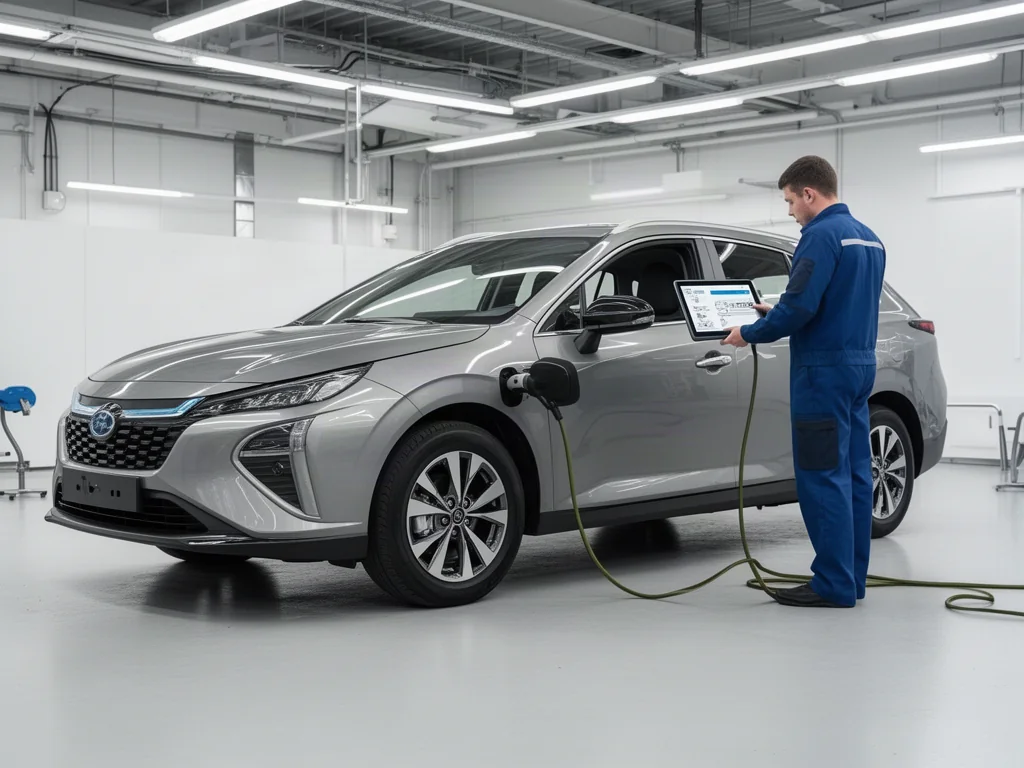
The P3010 family and neighboring manufacturer-specific diagnostic trouble codes from P3010 through P3081 are not a single universal hybrid battery language. On some vehicles they identify hybrid battery blocks, battery modules, or a voltage detection circuit watched by the battery control module. Nearby numbers can mean something else entirely. Confirm year, make, model, powertrain, and the reporting module before treating any of these codes as a failed pack.
Verify the Vehicle-Specific Meaning Before Interpreting P3010
Manufacturer-controlled codes in this range cannot be decoded from the number alone. Before interpreting P3010, collect the vehicle year, make, model, powertrain, the reporting control module, and any detail codes stored with the event. The factory diagnostic description is the only reliable meaning. Numerical proximity does not prove a shared system, a shared fault, or a shared repair. A P3010 result that names a hybrid battery block on one application may describe an unrelated function on another.
The same caution applies to nearby queried results such as a P3007 code or a P3008 code. Those identifiers sit close to P3010 on a scan list, yet they are not automatically hybrid battery-block faults and must receive their own definition checks. If the service information for the identified vehicle does not list them with this series, leave them out of the pack diagnosis. Do not treat P3010 as a universal battery-block assignment.
P3011–P3019: Confirm the Battery Block Assignment
On applications whose factory text assigns hybrid battery blocks, a P3011 code, P3012 code, P3013, P3014, P3015 code, P3016 code, P3017 code, P3018 code, and P3019 code each point to a numbered monitored block rather than a random cell. The assigned block number comes only from that vehicle's documentation. A monitored block can contain multiple battery modules, and numbering follows pack architecture rather than a universal map.
A block fault identifies a monitored condition seen by the battery control module. It does not by itself establish which physical module or sensing path needs replacement. Mapping P3011 through P3019 from the code suffix alone, as if P3015 always meant block five, is not valid. Any assignment must include vehicle applicability and the exact fault wording. Until that wording is confirmed, treat these manufacturer-specific diagnostic trouble codes as labels for a condition, not as proof a module failed.
P3020–P3026: Check Pack Layout and Detection Criteria
A P3020 code, P3021, P3022, P3023, P3024 code, P3025 code, or P3026 code should not be treated as the next numbers in an automatic battery-block sequence until each supported meaning is established for the identified vehicle. Pack layout decides whether those labels even exist. If the installed pack monitors fewer blocks than the suffix implies, a listed assignment does not apply. Confirm the watched block count and factory numbering before extending the earlier pattern.
Operating conditions captured with the code help a technician interpret a reported block condition. Load, state of charge, battery temperature, and whether the event occurred during charge, assist, or idle all change how a voltage reading should be read. Those values are not universal thresholds. A saved code also cannot establish remaining capacity, remaining service life, or the need for a complete pack replacement. It records that a detection criterion was met, not that every module is exhausted.
P3030–P3034: Identify the Exact Voltage-Monitoring Fault
Verify a P3030 code, P3031, P3032 code, P3033, and P3034 independently before describing any of them as a battery block, a voltage detection circuit, or another manufacturer-defined function. The suffix does not automatically continue the earlier block series. Where the confirmed definition concerns voltage sensing, an unreliable measurement path can make healthy battery modules look uneven or hide a real imbalance by sending noisy data to the battery control module.
When that wording names sensing connections, wiring, or monitoring electronics, those items become diagnostic areas because reported block data depends on measurement integrity. Circuit-related language is a reason to have a hybrid specialist evaluate the voltage detection circuit before attributing the event to battery modules. A P3032 result that describes a sensing fault is not interchangeable with a P3030 result that names a different condition. High-voltage disassembly is not a first-look owner task.
P3041, P3051, P3052, P3055, P3056, and P3081: Separate Definitions
A P3041 code, P3051 code, P3052 code, P3055 code, P3056 code, and P3081 code each need a distinct check of vehicle applicability and manufacturer wording. This adjacent range is not a continuation of hybrid battery-block numbering. A P3035 code, P3044 code, P3045 code, P3053 code, P3054 code, or P3064 code can sit on the same scan printout and still describe an unrelated manufacturer-controlled function. Treat every identifier separately. If year, make, model, powertrain, and reporting module are missing, meaning stays unresolved until that information is supplied.
Where factory text is available, connect that confirmed definition to the symptoms and possible triggers described for that application, then follow the professional diagnostic path written for that control module. A P3055 or P3056 result that names a thermal or sensing condition is not the same investigation as a P3081 result with different wording, and none of these belong in a P34xx cylinder-deactivation search. Without the vehicle record, do not invent a battery-block story.
Possible Battery Symptoms and Why Several Codes Appear Together
On confirmed hybrid battery applications, the driver may see a warning message, reduced propulsion assistance, rapid indicated state of charge changes, or increased cooling-fan activity. Those observations support further testing; they are not proof that a particular battery module is weak. Battery deterioration, thermal conditions, and sensing faults can all enter the diagnosis when the vehicle-specific procedure allows it. A noisy voltage detection circuit can produce the same cluster of messages as an uneven pack.
Several codes may reflect a shared fault, a resulting condition, or separate events that happened at different times. Seeing P3018 with P3024, or P3010 with P3030, does not prove that the first caused the second. Code order on the scan tool is not causation. Current, pending, and historical status show whether the condition is still present, recently detected, or stored from an earlier trip. Freeze-frame data records operating conditions at that moment and helps reconstruct when the reported conditions occurred.
Safe Observations and the Information a Hybrid Specialist Needs
Before clearing anything, record the complete scan report, including every related code, detail codes, dashboard messages, symptoms, and the operating conditions shown in freeze-frame data. That record is what a hybrid specialist uses to compare live battery data, sensing integrity, and thermal operation against factory tests. Owner checks should stay external, including only a cooling-inlet inspection the owner's manual permits. Battery covers, connectors, probing, and any high-voltage work are outside that scope.
Professional testing of battery data, voltage sensing, and thermal operation is needed before selecting a repair, because a stored code cannot distinguish a weak module from a measurement problem or a cooling issue. Follow the vehicle warning instructions. If propulsion becomes unreliable, stop safely. A code by itself cannot establish whether continued driving is safe, and it cannot authorize pack replacement. The specialist uses the saved evidence and confirmed factory definitions to decide what, if anything, should be replaced.