P2808 to P2822: Pressure Control Solenoid G and H Codes Explained
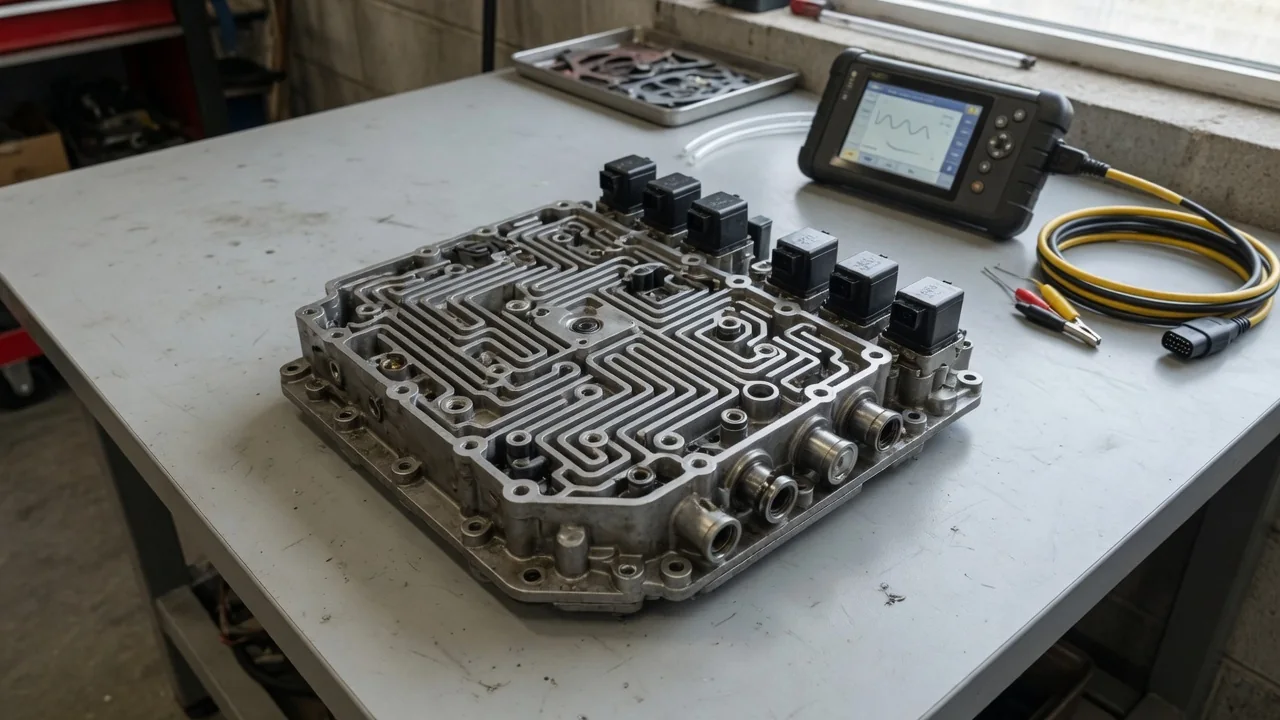
Pressure control solenoid G and H codes describe monitored hydraulic-control faults in an automatic transmission. P2808 and P2813 sit in the solenoid G family, while P2815, P2817, P2820, and P2822 belong with solenoid H. Each code reports a performance, stuck, or control-circuit condition seen by the transmission control module. Confirm the exact definition for year, make, model, and transmission before treating the named solenoid as the failed part.
Verify the Code Meaning for the Vehicle
A stored diagnostic trouble code is a monitored condition, not a parts list. Before interpreting P2808, P2813, P2815, P2817, P2820, or P2822, look up the complete description and enabling criteria in service information for that year, make, model, and transmission. Solenoid G and solenoid H are control-system labels. They do not identify a universal physical location in the valve body, a single replacement part, or one service procedure that applies across manufacturers.
Once the vehicle-specific wording is confirmed, use it consistently. Performance and stuck designations describe disagreement between commanded hydraulic pressure control and the response the module monitors. Electrical and intermittent wording points to a control circuit condition that may appear only under certain temperatures or loads. Open, low, and high refer to the electrical state of that circuit, not to fluid level. Manufacturer-dependent codes need that confirmation because a code identifies a fault condition; it does not prove the named solenoid has failed or must be replaced.
P2808 and P2813 Within the Solenoid G Family
After the service definition is confirmed for the vehicle, P2808 is described as a solenoid G performance or stuck-off condition. That wording means the transmission control module commanded a change related to transmission pressure control and did not see the expected hydraulic or operational response. P2813 is a solenoid G control-circuit-low code. Low in that context is the monitored electrical condition on the control circuit, such as voltage or current below the expected range. It is not a direct statement about fluid level or actual hydraulic pressure in the unit.
Where the same service information lists them, P2809 through P2812 and P2814 complete the solenoid G family with stuck-on, electrical, intermittent, open, and high-circuit designations as those definitions apply. A performance or stuck-off code can justify inspecting hydraulic restrictions, valve-body behavior, and solenoid operation because the module is judging response, not only wiring. A control-circuit-low or related electrical code more often points toward harness, connector, winding, or driver issues. The specific code decides which path to investigate; none of those findings is established by the code number alone.
P2815 and P2817 Within the Solenoid H Family
Present P2815 only after reading the vehicle's complete solenoid H description and diagnostic criteria. Service information may list it as a control-circuit or related electrical designation for solenoid H, but the exact wording must come from that information. P2817, where confirmed as stuck-on, means commanded operation and detected response did not agree: the module expected solenoid H to leave an on state or saw an on-like hydraulic or electrical result it did not command. That disagreement is the monitored fault, not a photograph of a jammed part.
P2816, P2818, and P2819 complete the remaining performance, electrical, and intermittent portion of the solenoid H family when those verified definitions match the vehicle. A stuck designation can involve hydraulic or mechanical behavior in the valve body, a restriction that keeps pressure from changing as commanded, or a solenoid that is electrically held. It does not establish that the solenoid itself is physically jammed. Wiring faults and control-system issues remain possible until tests separate electrical command from hydraulic response.
P2820–P2822: Solenoid H Control-Circuit Faults
After vehicle-specific definitions are confirmed, P2820 describes an open solenoid H control circuit, meaning the module did not see continuity or expected current on that path. P2822 is a control-circuit-high condition, an electrical reading above the expected range. P2821, where listed, completes this group as the low-circuit counterpart. Open, low, and high here are electrical classifications of the control circuit. Circuit high does not by itself mean excessive transmission pressure or a hydraulic overpressure event inside the gearbox.
Possible contributors include a connector that is unseated or corroded, a harness open or short, a missing power supply or ground, a solenoid winding that has failed open or shorted, or a controller-driver problem inside the transmission control module. None of those causes is established by the code alone. Controller replacement in particular requires supporting test evidence that the circuit, solenoid, and power and ground paths are intact. Freeze-frame data can show when the electrical condition was captured, which helps a technician reproduce the same operating state.
Symptoms to Record and Reasons to Stop Driving
Pressure control solenoid G and H faults may appear with harsh or delayed shifts, slipping, limited gear operation, a malfunction indicator, or reduced propulsion if the transmission control module enters fail-safe mode. No single symptom is promised for P2808, P2813, P2815, P2817, P2820, or P2822. Record whether the concern happens cold, after warming up, during engagement into drive or reverse, or under acceleration. That timing often distinguishes an electrical circuit that fails as temperature changes from a hydraulic restriction that shows after the fluid is hot.
Shifts that feel normal do not establish that a stored electrical fault has resolved. A control-circuit open, low, or high condition can remain in memory while the driver still has acceptable gear changes, especially if the fault is intermittent. Stop driving as soon as it is safe and arrange assistance if there is loss of propulsion, severe slipping, smoke, a burning odor, or a transmission overheating warning. Those conditions can worsen clutch or band damage and are not something to diagnose from the roadside.
Safe Observations and Professional Diagnostic Testing
Preserve all stored and pending codes, freeze-frame data, and symptom notes before clearing anything or disconnecting the battery. That snapshot is often the only record of speed, temperature, and load when the transmission pressure control fault set. Owner observations should stay limited to looking for visible leaks from a safe standing position and any fluid check the owner's manual explicitly allows. Some transmissions have no simple dipstick and require workshop procedures for a valid level check, so guessing from appearance is not a substitute for service information.
Professional diagnosis compares related codes, then checks electrical integrity of the control circuit, commanded solenoid operation, and hydraulic response against vehicle-specific specifications. Do not probe live circuits, apply power directly to solenoids, work beneath an unsupported vehicle, or open hot transmission components. Repair is confirmed only through the prescribed diagnostic procedure and a controlled operational check that the enabling conditions can run. Clearing P2808, P2813, P2815, P2817, P2820, or P2822 without that verification does not prove the valve body, wiring, or transmission control module work is complete.