P2757 and Related Torque Converter Clutch Solenoid Codes
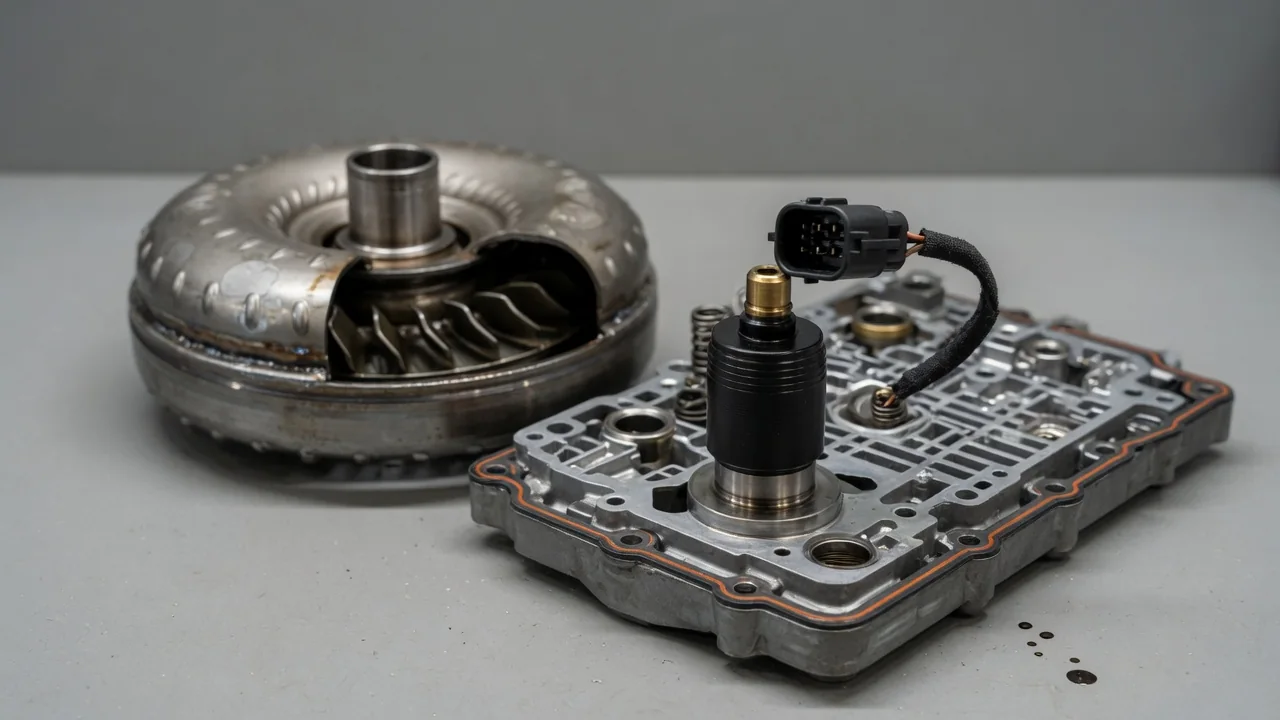
When a scan tool reports P2757 or a related torque converter clutch pressure control solenoid code, the result is a starting point, not a parts list. This family includes stuck-on, electrical, circuit open, low, and high variants as well as torque converter clutch circuit low and high codes. Exact wording and diagnostic criteria depend on the vehicle, so confirmation comes first, then symptoms, possible causes, and a testing-based repair path.
What P2757 Means and What the Code Can Establish
Before interpreting P2757 or any neighboring code, confirm the exact description and diagnostic criteria for the vehicle, model year, and transmission. Manufacturer-dependent definitions vary, and a generic scan-tool label is not enough. In many applications, P2757 identifies torque converter clutch pressure control solenoid control circuit performance or stuck-off behavior. The torque converter clutch and its pressure control system manage lockup operation during suitable speed, load, and temperature conditions so the converter can reduce slip when commanded.
A stored P2757 code means the control system detected a condition that met its enable criteria, not that the solenoid itself has failed. The solenoid control circuit, hydraulic passages, and transmission valve body all participate in commanded clutch engagement. Freeze-frame data can show whether the concern appeared during lockup, and torque converter slip speed compared with commanded state helps a technician judge whether the clutch responded as expected. Replacement is a later decision, after the vehicle-specific procedure isolates the actual fault.
P2757 Symptoms and When to Stop Driving
P2757 symptoms can include a warning light, shudder during lockup, unexpected engine-speed changes while cruising, reduced fuel economy, or elevated transmission temperature. Some drivers notice little more than a lamp; others feel harsh or delayed clutch apply. Symptoms may be intermittent or absent, so they cannot identify the failed component on their own. A P2757 code and a similar drivability complaint still require electrical and hydraulic testing rather than a parts swap based on feel.
Record when anything unusual occurs, including warm-up state, speed, load, and displayed warnings, without trying to force the fault to return. That history helps a technician compare operating conditions with freeze-frame snapshots. If the vehicle shows overheating warnings, severe slipping, loss of propulsion, or repeated stalling, stop safely and arrange assistance. There is no universal safe remaining distance, because heat, fluid condition, and how lockup is being commanded can change quickly from one trip to the next.
P2755, P2756, P2758, and P2759 Fault Descriptions
After vehicle-specific verification, P2755 is commonly a torque converter clutch pressure control solenoid control circuit fault, while P2756 is often a range or performance fault for that same function. P2758 is usually designated stuck-on, meaning the control system believes the clutch is remaining applied when it should release. Unintended clutch application can stall at idle, cause shudder, or make engine speed drop abruptly when coming to a stop. Those effects still do not prove a single failed part.
P2759 is typically an electrical designation for the pressure control solenoid circuit rather than a hydraulic pressure reading. Wiring, connectors, solenoid operation, hydraulic control, and valve-body faults remain possible, and which of those apply depends on the stored code and on testing. A stuck-on code may point toward mechanical or hydraulic hold of the clutch, while an electrical code more often directs attention to the solenoid control circuit. Confirm the layout for that transmission before assuming a particular solenoid assembly.
P2761–P2764 Pressure Control Solenoid Circuit Codes
P2761, P2762, P2763, and P2764 also belong to the pressure control solenoid group, but solenoid names and pinouts differ by transmission. Verify the vehicle's terminology before assigning any of these codes to a physical component. Usual definitions are P2761 for control circuit or open, P2762 for range or performance, P2763 for circuit high, and P2764 for circuit low. A P2761 code or P2764 code therefore describes a monitored electrical condition, not a dipstick-style fluid-level finding.
Circuit high and circuit low refer to voltage or signal states the module sees on the solenoid control circuit. They do not measure transmission fluid pressure or level. Connector damage, open circuits, shorts, solenoid electrical faults, or control-module issues may all require investigation when a P2763 code or P2764 appears. Professional testing against the vehicle's wiring diagram and diagnostic procedure is required before recommending replacement. Guessing a solenoid from the code number alone can miss a damaged connector or an interrupted circuit.
P2769 and P2770 Torque Converter Clutch Circuit Faults
Confirm the applicable definitions before treating P2769 as torque converter clutch circuit low and P2770 as torque converter clutch circuit high. These codes concern the TCC control circuit, and the exact component arrangement depends on the transmission. A P2769 code does not automatically mean low line pressure, and a P2770 code does not automatically mean the clutch is hydraulically over-applied. Both still need circuit checks that match the vehicle's diagram rather than a generic converter replacement.
P2770 symptoms can include a warning light, altered lockup behavior, engine-speed fluctuations during steady driving, and reduced fuel economy, though some vehicles show no obvious symptoms. Drivers may notice the same pattern with other TCC circuit faults, so the complaint cannot pick the failed part. A high-circuit code alone cannot prove high hydraulic pressure, a stuck clutch, or a failed torque converter. Electrical conditions on the control circuit and hydraulic lockup operation are related but separate findings that testing must keep distinct.
How Diagnosis Determines the Repair Path
Preserve all stored and pending codes and freeze-frame data before clearing anything. Accompanying faults can show whether the concern is isolated to the torque converter clutch circuit or shared with other solenoids. Owner checks should stay limited to safely accessible observations such as visible leaks and external damage. Follow the owner's manual for any permitted fluid check, and avoid inspecting hot, moving, or underneath-vehicle areas. Those notes help a shop, but they do not substitute for circuit or hydraulic tests.
A professional assessment typically reviews fluid condition, electrical circuit integrity, commanded clutch engagement, torque converter slip speed, and hydraulic performance where the vehicle's procedure calls for it. Repair choices follow confirmed findings: wiring or connector repair, an identified solenoid or valve-body repair, or internal transmission or torque converter work when testing supports it. Clearing a P2757 code is not a repair. Completion requires the prescribed verification of lockup operation and a check for returning faults, without bypass wiring, forced lockup, or improvised pressure testing.