P2418–P2422 and P2450: EVAP Valve Codes and Safe Diagnosis
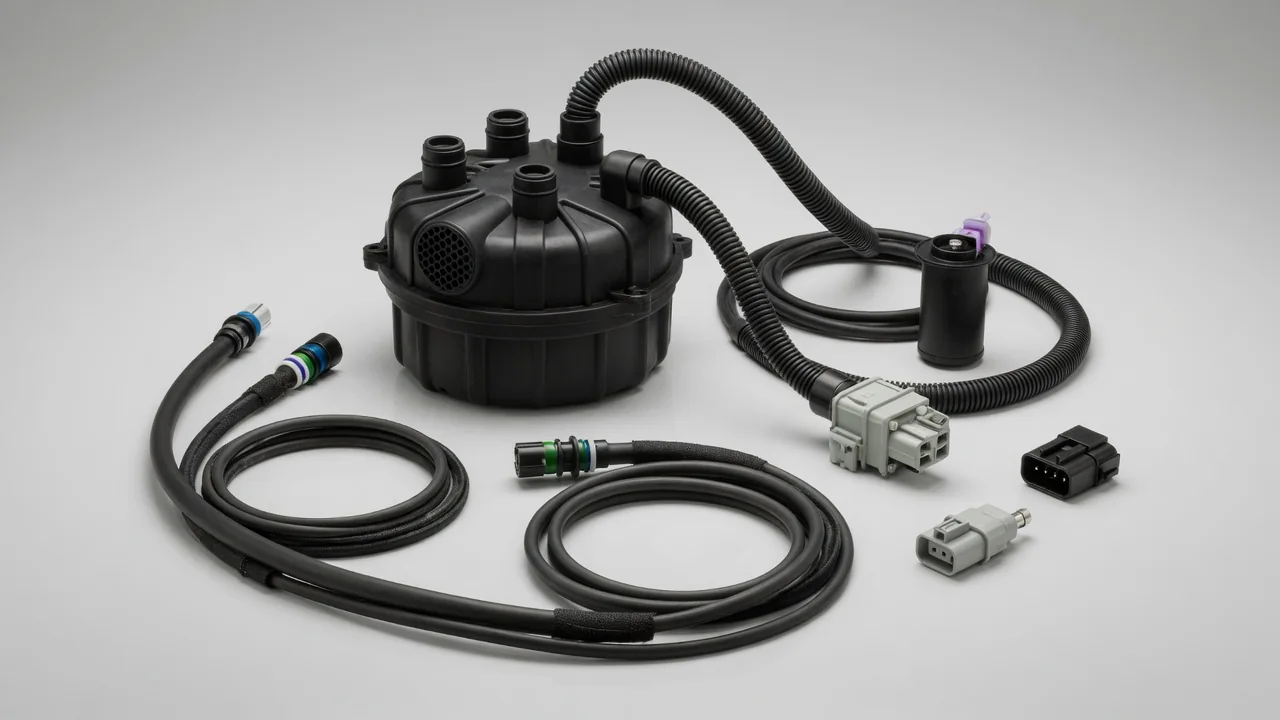
When a scan tool stores P2418, P2419, P2420, P2421, a P2422 code, or P2450, the evaporative emissions system has reported a switching valve or vent control valve concern. Those results describe electrical or performance conditions the control module detected, not a confirmed failed part. Match each definition to the vehicle’s year, make, model, and engine, then use freeze-frame data, recent refueling behavior, and the EVAP monitor path before replacing hardware.
Verify the Code Definition for the Vehicle
Service information for that year, make, model, and engine is the only reliable source for what a stored P2418 code, P2419 code, P2420 code, P2421 code, P2422, or P2450 code actually means on a given vehicle. The evaporative emissions system contains fuel vapor in the tank, charcoal canister, and connecting lines so it does not escape to the atmosphere. Valve names, plumbing layouts, and monitoring strategies differ by application, so a switching valve on one platform may not match a vent control valve arrangement on another.
Before clearing memory, record every stored and pending result, capture freeze-frame data, and note whether recent refueling produced early nozzle shutoff, slow fill, or a fuel odor. Freeze-frame snapshots show engine running conditions when the EVAP monitor set the concern and help a technician reproduce the same operating window. A diagnostic trouble code identifies a detected condition, such as an unexpected circuit voltage or an incomplete seal, and does not establish which component needs replacement until the vehicle-specific procedure is completed.
P2418, P2419, and P2420 Switching Valve Circuit Faults
After the application definition is confirmed, P2418 commonly refers to an EVAP switching valve control circuit that is open, P2419 to a circuit low condition, and P2420 to a circuit high condition. Open, low, and high describe electrical states the module measured on the control circuit, not the physical valve position and not tank vapor pressure. A P2419 code or P2420 code can appear while the valve itself still moves, and a P2418 code can appear from a broken wire even when the valve mechanism is intact.
Possible sources include wiring harness damage, connector corrosion, poor terminal contact, an open or shorted valve coil, and a missing supply or failed driver in the control module. None of those possibilities can be ranked without measurements on that vehicle. Application-specific wiring diagrams, connector views, and electrical tests are required before condemning the EVAP switching valve or the module. A reading that looks high or low at one pin may be normal on another circuit design, so substituting a valve from another application is not a valid shortcut.
P2421: Vent Valve Reported Stuck Open
Once the vehicle-specific definition is confirmed, P2421 is commonly described as an EVAP vent valve stuck open. That result means the EVAP monitor did not see the sealing behavior it expected when the vent control valve was commanded closed. If the valve fails to seal, fresh air can still enter the charcoal canister path and the system may never hold the closed condition used during a leak or integrity check. The fuel tank pressure sensor reading is often part of that evaluation, so an unexpected pressure trace can set the concern without proving the valve is the failed part.
Debris in the vent path, mechanical damage to the valve, and actuation faults that leave the valve off its seat are all possibilities that still require confirmation on that application. A check engine light is typical, and many drivers notice no change in idle, power, or fuel economy because the condition is about vapor containment rather than combustion. Symptoms alone cannot confirm valve position. A P2421 code can share freeze-frame conditions with other evaporative codes, so related circuit or performance results should stay on the same work order until they are interpreted together.
P2422: Vent Valve Reported Stuck Closed
After verifying its meaning for the vehicle, P2422 is commonly described as an EVAP vent valve stuck closed. Restricted venting can keep tank pressure from equalizing as fuel is added, which may produce repeated fuel nozzle shutoff or a tank that is hard to fill. Those refueling symptoms have other possible causes, including a restricted filler neck, a failing onboard refueling vapor recovery path, or a charcoal canister that cannot accept vapor as designed. A P2422 code is therefore a starting point for diagnosis, not proof that the vent control valve is mechanically seized.
A sticking valve, contamination at the seat, and restricted vent passages or filters are diagnostic possibilities on vehicles that use those components. The fuel tank pressure sensor may show an abnormal rise during fill or during an EVAP monitor event if venting is blocked. At the pump, stop at the nozzle’s normal automatic shutoff and do not try to force more fuel into the tank. Overfilling can push liquid fuel toward the charcoal canister and complicate later testing, and it does not confirm or clear a P2422 condition.
P2450: Switching Valve Performance or Stuck Open
Confirm the application-specific definition before treating P2450 as an EVAP switching valve performance or stuck-open result. On many vehicles a P2450 code means the EVAP monitor detected an unexpected system response while the switching valve was being commanded. That response is inferred from pressure or flow behavior, not from a direct view of the valve. Incomplete sealing, a valve that does not fully change state, or a vapor path that does not follow the commanded route can all produce a similar monitor outcome.
Sticking, incomplete sealing, restricted vapor paths through the charcoal canister or associated hoses, and control problems on the switching valve circuit are possibilities to investigate with the vehicle’s diagnostic procedure. Pressure feedback from the fuel tank pressure sensor and commanded valve operation often need professional testing before the switching valve can be identified as the cause. A P2450 finding can sit beside P2418, P2419, or P2420 if the electrical circuit is also out of range, and those related results should be resolved using the same wiring diagrams rather than by replacing the valve on the code number alone.
Safe Observations and Professional Diagnostic Tests
Useful observations include when the check engine light appeared, whether refueling shutoff happened early or repeatedly, any fuel odor around the tank or filler, and visible damage to readily accessible wiring or hoses. Stay outside vapor lines and do not crawl under an unsupported vehicle to reach a canister or valve. Those notes help a technician choose the correct service-information path for P2421, P2422, or P2450 without disturbing the evaporative emissions system. Photographing connector positions and recording related pending codes preserves evidence that would be lost if memory is cleared first.
Professional diagnosis typically includes wiring integrity checks, commanded valve response, fuel tank pressure sensor data, and approved EVAP leak testing from service information. Do not energize a valve with a jumper, bypass vapor lines, blow compressed air through the system, or build a homemade smoke tester; fuel vapor requires suitable equipment and procedures. Stop driving and arrange assistance if there is visible fuel leakage or a strong persistent fuel smell. Repair verification means confirming system operation and allowing the applicable EVAP monitor to run, not merely clearing the light after a parts swap.