P2400–P2407 Codes: EVAP Pump Control and Sense Circuit Faults
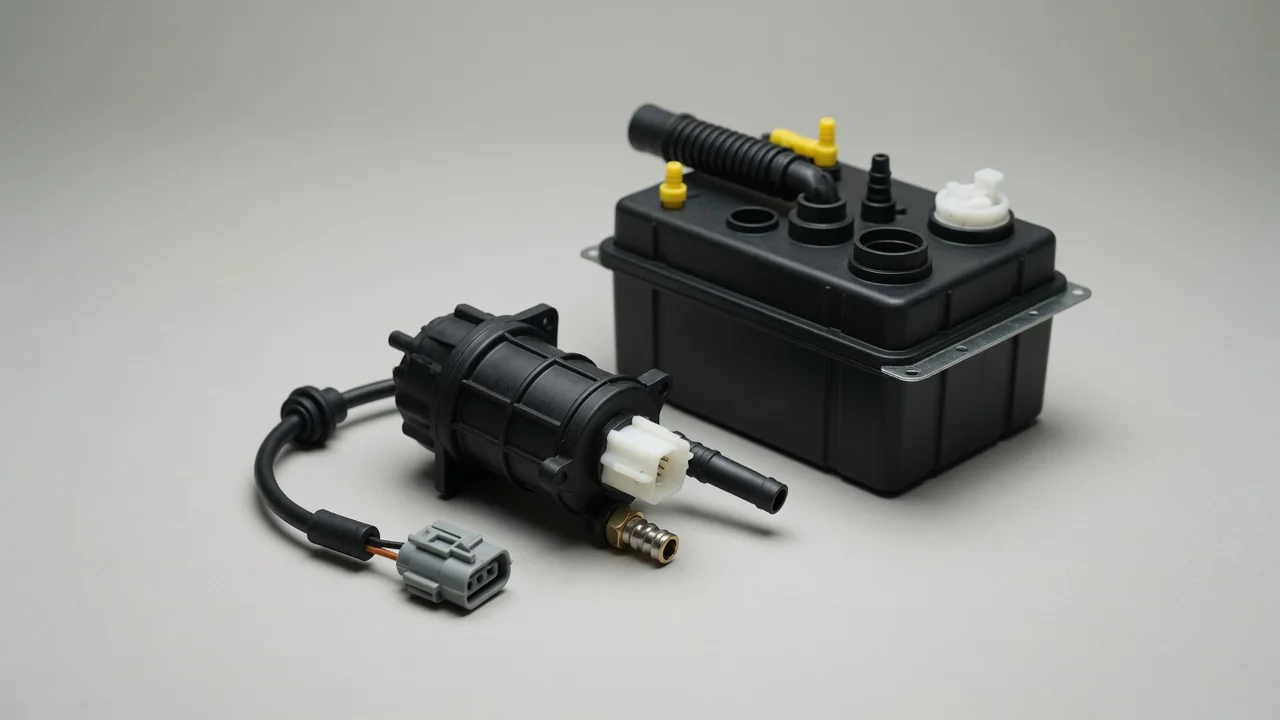
When a scan tool stores P2400, P2401, P2402, P2404, P2405, P2406, or P2407, the module has flagged an electrical issue with the EVAP leak detection pump. These codes describe control circuit and sense circuit conditions, not a proven vapor leak. Confirm the factory description for the year, make, model, and engine before treating any code as a failed pump.
What the EVAP Leak Detection Pump Does and What These Codes Establish
An EVAP leak detection pump helps the control module check fuel vapor system integrity during the EVAP monitor. Instead of relying only on engine vacuum, the pump can apply a controlled pressure or vacuum so the module can look for leaks in the tank, lines, and vapor components. Layout, location, and command strategy differ by manufacturer and model year, so the same code family can describe different hardware. Before interpreting a stored fault, obtain the complete code text and the diagnostic procedure written for that year, make, model, and engine.
In the common numbering, P2400, P2401, and P2402 address EVAP leak detection pump control circuit open, low, and high conditions. P2403 covers control circuit range/performance, while P2404 through P2407 cover sense circuit range/performance, low, high, and intermittent faults. A circuit code is evidence that the module saw an electrical result outside its test limits. It does not by itself prove a vapor leak exists, that the pump has failed internally, or that a replacement part is required. Vehicle-specific confirmation is essential because manufacturer-dependent definitions and enable criteria can change the meaning of the same number.
P2400 and P2401: Control Circuit Open and Low Conditions
A P2400 code is commonly described as EVAP leak detection pump control circuit/open, meaning the module did not see a continuous electrical path when it expected one. A P2401 code is commonly described as EVAP system leak detection pump control circuit low, meaning a monitored voltage or current fell below the threshold used for that test. Those wordings still require confirmation against the vehicle's service information. An open circuit is an interrupted path, such as a broken wire, a disconnected electrical connector, or an internal break. Circuit low is an electrical result, not a report of low fuel level.
Possible causes of P2400 and P2401 include a damaged wiring harness, loose or corroded terminals, missing power or ground at the pump, and an internal pump electrical fault. Circuit low does not directly establish low pump pressure or a mechanical leak in the vapor system. The module is reporting how the control circuit behaved under specified test conditions, which can be produced by a short to ground, a high-resistance joint, or a failed driver path as readily as by a bad pump. Test the affected circuit according to the vehicle procedure before replacing the pump.
P2402: EVAP Leak Detection Pump Control Circuit High
A P2402 code generally identifies an EVAP system leak detection pump control circuit high condition. The monitored value and the criteria that set the fault are defined in that vehicle's diagnostic information, so the same P2402 code can trip on voltage, current, or a related electrical metric depending on the design. High describes the electrical result the module recorded, not excessive fuel tank pressure and not a finding that the pump generated too much mechanical output. Treating P2402 as a pressure complaint skips the actual test the module performed.
Typical electrical causes include a wiring short to voltage, a poor ground, a damaged electrical connector, an internal pump winding or driver fault, and a control driver problem where the circuit design supports that path. Distinguishing those possibilities requires the wiring diagram and measurements taken under the prescribed operating conditions, not a guess based on the code number alone. A circuit high result can appear with the pump still mechanically capable of moving air, which is why a replacement decision should wait until the control circuit has been isolated.
P2404, P2405, and P2406: Sense Circuit Performance, Low, and High
After vehicle-specific verification, P2404 is commonly listed as EVAP leak detection pump sense circuit range/performance, a P2405 code as sense circuit low, and P2406 as sense circuit high. The sense circuit provides electrical feedback associated with pump operation so the module can compare commanded control with the result it actually sees. How that feedback is generated depends on the vehicle; some designs monitor current or voltage in the pump circuit, and a separate replaceable sensor should not be assumed. Range/performance means the feedback did not follow expected operating behavior during the test window.
Sense circuit low and sense circuit high mean the feedback left specified electrical limits rather than proving the pump moved too little or too much vapor. A P2404 code, P2405, or P2406 can follow a pump feedback fault, damaged sense wiring, poor terminal contact, or a supply or ground problem that corrupts the signal the module reads. Because the sense path is often part of the pump assembly, the repair may be a connector, harness, or the pump itself once testing isolates the source. The code remains an electrical finding until those checks are complete.
P2407: Intermittent Sense Circuit Faults and Symptoms to Record
A P2407 code is commonly described as EVAP leak detection pump sense circuit intermittent or erratic, meaning the module saw an unstable or dropout feedback signal rather than a steady out-of-range value. Detection criteria still must be verified for the specific vehicle, because the duration and pattern that qualify as an intermittent signal are manufacturer-defined. Loose terminals, corrosion in an electrical connector, wiring harness chafing, or an intermittent internal pump fault can interrupt that feedback only under vibration, heat, or moisture. The resulting P2407 code is still electrical evidence, not proof the pump has failed as a mechanical assembly.
A check engine light may be the only noticeable symptom, and ordinary driving behavior does not establish that the EVAP monitor is completing correctly. Record when the light appeared, any recent fuel or underbody work, weather at the time, all stored and pending codes, and available freeze-frame data; do not try to recreate the fault by stressing wiring. Treat fuel odor as a separate observation. If a strong fuel smell or visible fuel leakage is present, stop in a safe location and seek assistance rather than continuing to drive or attempting leak checks at the roadside.
Safe Initial Checks, Professional Testing, and Repair Confirmation
Preserve stored, pending, and permanent codes plus freeze-frame data before clearing anything. Clearing a P2400 code, P2401, P2402, P2404, P2405, P2406, or P2407 can reset readiness monitors and erase the snapshot that shows engine speed, load, and temperature when the fault set. With the vehicle off, an owner can look only at visible, safely accessible wiring damage or a loose electrical connector. Do not crawl under an unsupported vehicle or disturb fuel-system fittings. Jumping pump terminals, bypassing controls, applying improvised pressure, and homemade smoke testers are not appropriate owner checks.
Professional diagnosis may include supply and ground checks, circuit integrity testing of the control circuit and sense circuit, commanded pump operation, and evaluation of feedback using the vehicle-specific procedure. Leak testing belongs in that sequence only when the electrical findings call for it, not as a first step for every pump code. After the identified fault is corrected, confirm that the applicable EVAP monitor completes under the manufacturer's enable conditions. Immediate readiness should not be promised, and there is no universal drive cycle that substitutes for those conditions.