P2312 to P2326 Codes: Ignition Coil E Through I Circuit Faults
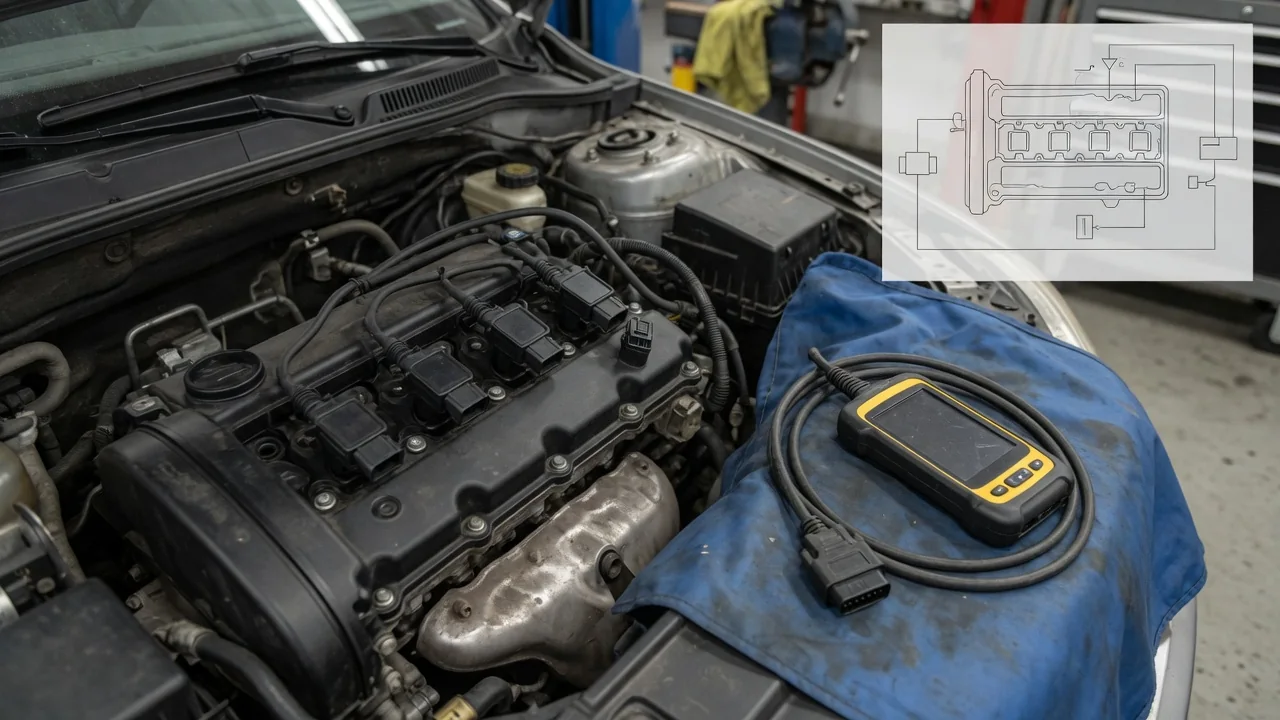
Codes P2312 through P2326 describe ignition coil control circuit and secondary ignition circuit faults for coils E through I on engines that use those designations. Six-cylinder and larger layouts are typical, but not every engine supports every code in the range. Coil letters are not cylinder numbers. Confirm the vehicle-specific definition, coil identification, and cylinder numbering before linking a code to an engine misfire or a replacement part.
Verify the Code Definition and Locate the Named Coil
A stored P2312, P2313, P2314, P2315, P2316, P2317, P2320, P2323, P2324, P2325, or P2326 value should be interpreted only after service information for that year, make, model, and engine confirms the exact definition. Scanner translation can mislabel a coil letter. The standard E-through-I grouping describes ignition coil control circuit and secondary ignition circuit monitoring, yet applicability depends on ignition architecture. Six-cylinder and larger engines do not necessarily support every code in this range.
Coil letter identification does not establish cylinder numbering, bank location, or firing order. Coil E is not automatically cylinder five, and coil I is not automatically cylinder nine. Locate the named coil from the vehicle’s coil identification chart before assigning symptoms or companion engine misfire codes to a position. If the reported designation does not fit the engine, recheck vehicle selection, scanner translation, and the original code before suggesting a coil, ignition driver, or wiring harness part.
P2312, P2313, and P2314: Ignition Coil E Faults
After vehicle-specific verification, the usual descriptions are P2312 for ignition coil E control circuit low, P2313 for control circuit high, and P2314 for the secondary circuit. Low and high describe monitored electrical conditions on the control side, such as voltage or driver feedback that falls outside the expected window. Those readings do not measure spark strength and do not prove that the coil has failed. An open circuit, a short, a poor coil connector, damaged wiring harness, or ignition driver concern can produce similar circuit results.
P2314 points to the secondary ignition circuit that delivers high voltage toward the spark plug. Where those parts apply, a coil, spark plug, spark plug boot, insulation leak, or connection problem may contribute, but no single cause is certain. Locate coil E from the correct service diagram before connecting a rough idle or a companion misfire code to a cylinder. Coil E on one engine can sit on a different bank or firing position than coil E on another.
P2315, P2316, and P2317: Ignition Coil F Faults
Once applicability is confirmed, P2315 typically means ignition coil F control circuit low, P2316 means control circuit high, and P2317 means a secondary circuit fault for coil F. Connector damage, wiring harness faults, coil faults, and ignition driver problems remain possibilities whose relevance depends on circuit design. A low or high result is an electrical condition the module observed, not a ranking of spark quality. Testing must follow the manufacturer’s procedure for that coil connector and driver arrangement.
For P2317, plug condition, spark plug boot damage, or contamination can contribute where those secondary parts exist, yet the code cannot identify the defective component by itself. Freeze-frame data showing engine speed, load, and temperature, together with accompanying engine misfire codes, help a technician investigate intermittent rough running. Coil F still requires the service layout; the letter does not mean cylinder six. Intermittent connector pin tightness or harness chafe can set the same family of codes without a failed coil winding.
P2320: Ignition Coil G Secondary Circuit Fault
P2320 should be treated as an ignition coil G secondary circuit fault only after the vehicle’s service information confirms that definition. The secondary circuit delivers ignition voltage to the spark plug after the control side commands the coil. A stored circuit code shows that the monitor saw an unexpected secondary condition; it does not prove the coil, plug, or boot has failed, and it does not measure remaining spark energy. Other circuit or insulation paths can produce the same result.
Possible symptoms include rough idle, hesitation, reduced power, and a malfunction indicator light, while an intermittent fault may leave no obvious drivability complaint. Coil G identification still requires an engine-specific diagram because letter G is not a universal cylinder number. Assessing the coil, plug, spark plug boot, and related wiring can require professional testing within the vehicle’s specified method. Visual inspection of a cool, stopped engine may show contamination or a displaced boot, but that observation does not complete the diagnosis.
P2323: Ignition Coil H Secondary Circuit Fault
Confirm the vehicle-specific definition before treating P2323 as an ignition coil H secondary circuit fault. The engine must actually support a coil H designation; many six-cylinder layouts never use that letter, and assuming cylinder eight is a mapping error. Service information locates coil H on the correct bank and firing position. Damaged insulation, spark plug boot or plug problems, contamination, and coil faults can contribute where those components apply, without any ranking of how often each cause appears.
Recent ignition work, the moment symptoms began, and companion codes can guide inspection without justifying automatic coil replacement. A new plug that was not fully seated, a boot that was torn during service, or a connector that was not locked can set P2323 after otherwise routine maintenance. An engine misfire code on a different cylinder than the mapped coil H location is a reason to recheck coil letter identification rather than replace two parts. Circuit evidence still needs the specified tests.
P2324, P2325, and P2326: Ignition Coil I Faults
After verifying that the vehicle uses this range, the standard descriptions are P2324 for ignition coil I control circuit low, P2325 for control circuit high, and P2326 for the secondary circuit. Confirm the engine’s coil I assignment; not every large engine uses this designation, and the letter does not identify cylinder nine. Circuit low or high findings require evaluation of the wiring harness, coil connector, the coil, and control electronics under the manufacturer’s test procedure rather than a parts-first decision.
For P2326, secondary ignition components and insulation can be involved where the design uses a coil-on-plug path to the spark plug. Oil or moisture in a well, a cracked spark plug boot, or a tracking path on the coil tower may disturb the secondary ignition circuit without proving a failed coil or control module. An ignition driver inside a module can also set control-side codes if its output does not match commanded conditions. Only the specified tests separate those possibilities.
Safe Observations, Driving Decisions, and Professional Diagnosis
Record all codes, code status, freeze-frame data, and symptoms before clearing anything. Freeze-frame data preserves the operating snapshot when the monitor set the fault, and clearing codes can remove that evidence. Owner observations should stay limited to accessible visual checks with the engine off and cool, such as visibly damaged wiring, a loose-looking coil connector, or external contamination. Energized probing, spark testing, and disconnecting a coil on a running engine are not owner procedures because they can cause injury or additional circuit damage.
A flashing malfunction indicator light, severe shaking, or substantial power loss warrants stopping safely and arranging assistance, because an active engine misfire can damage the catalytic converter. Professional diagnosis confirms coil location from service information, inspects relevant secondary and control components, and performs vehicle-specified circuit and ignition tests before choosing a repair. After work, verify that symptoms and returning codes stay gone under the conditions that originally set the fault. Clearing the warning light alone does not establish a successful repair.