P2146 to P2156: Fuel Injector Group Supply Circuit Codes Explained
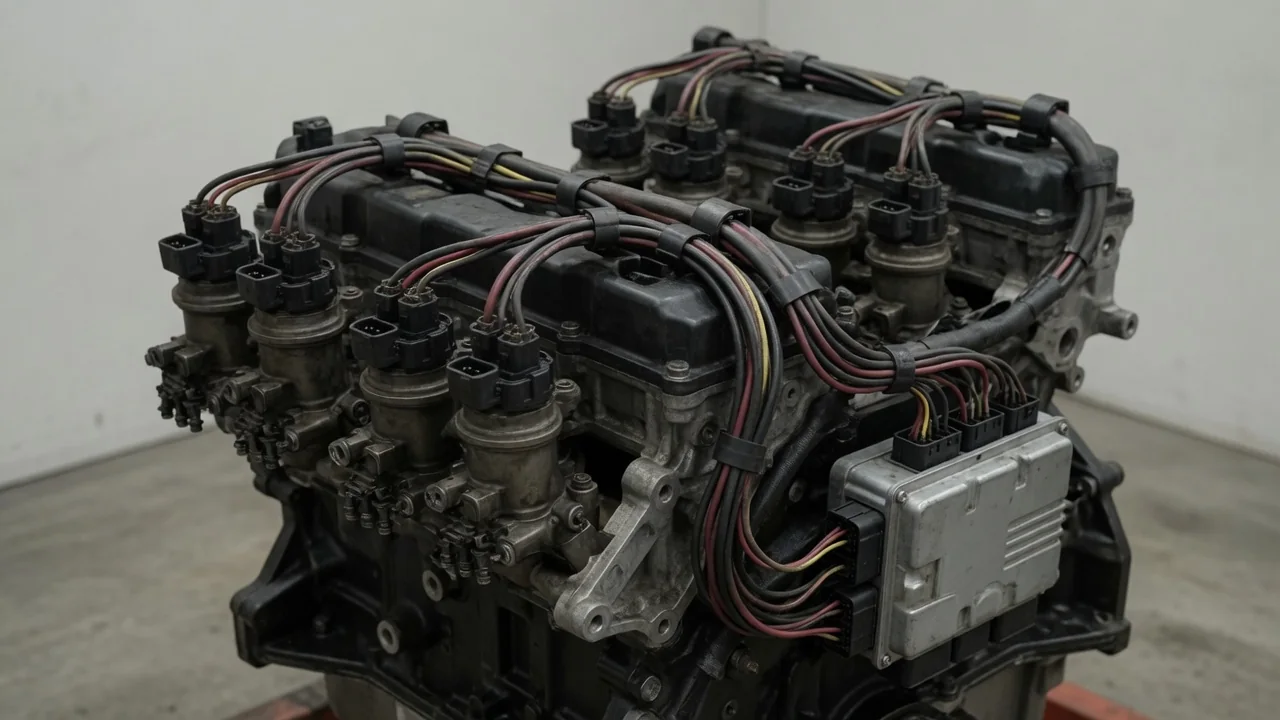
Fuel injector group supply circuit codes from P2146 through P2156 point to monitored electrical conditions on a shared injector power path, not a confirmed failed injector or a fuel-pressure reading. Scan tools may label P2146, P2149, P2152, or P2155 as an open circuit, and nearby numbers as circuit low or circuit high. Confirm the definition and injector group layout for the vehicle before treating any of those codes as a parts list.
Confirm the Code Definition and Injector Group Layout
A P2146 code, a P2149 code, or any neighboring injector group supply voltage entry must be read against the diagnostic information written for that vehicle's year, engine, and control system. Generic scan-tool text can be close enough to mislead. Manufacturer-dependent numbering and monitoring criteria mean the same five-character code can describe a slightly different circuit, enable condition, or test sequence from one platform to another, so the service description and procedure come first.
An injector group is an electrical grouping, not a cylinder map. The letter A, B, C, or D does not by itself identify cylinder numbers, an engine bank, or a physical location on the rail. On many engines, injectors share a fuel injector supply voltage feed or driver path, so one open, low, or high reading can involve several nozzles at once. Those words describe a monitored electrical condition under defined operating criteria, not fuel pressure and not proof that any injector has failed.
P2146, P2147, and P2148: Injector Group A Supply Faults
In many generic listings, P2146 is injector group A supply voltage circuit/open, P2147 is circuit low, and P2148 is circuit high. A P2147 code or P2148 code still needs vehicle-specific confirmation because the control module's voltage thresholds, enable conditions, and circuit names can differ. Open usually means the module did not see an expected path under those criteria. Circuit low and circuit high describe voltage outside the expected window, not a fuel quantity measurement.
The monitored group A injector group circuit can include shared electrical supply wiring, connectors, a branch of the harness, one or more injectors, or the injector driver module, depending on how the engine is built. Because several injectors may sit on the same feed, P2146 by itself cannot name the nozzle that needs replacement, and P2147 or P2148 cannot either. Testing has to isolate the path before any part is condemned, since a corroded pin or a damaged splice can set the same family of codes as an internal injector fault.
P2149, P2150, and P2151: Injector Group B Supply Faults
Standard descriptions often list P2149 as injector group B supply voltage circuit/open, P2150 as circuit low, and P2151 as circuit high, again subject to the vehicle's own definition. A P2149 code or a P2150 code should be treated as an electrical observation on that group's supply, not as a cylinder-bank diagnosis. Only the vehicle wiring diagram can show which injectors and which circuit branches belong to group B, because the letter is an electrical label, not a physical address.
Companion codes stored with P2149 can widen the testing scope without proving a shared root cause. Supply-related entries, control-module faults, or individual injector codes may appear together after the same event, yet each still needs its own confirmation. If P2150 or P2151 is present, the diagram still decides which harness sections, splices, and driver channels serve group B. Interpreting those extra codes as one failed injector, or as a failed driver by default, skips the circuit isolation the control system's grouping actually requires.
P2152: Injector Group C Supply Circuit/Open
The usual generic description for P2152 is injector group C supply voltage circuit/open, and a P2152 code still requires confirmation on the specific vehicle because not every engine implements group C the same way, or at all. Open in this family means the module did not see the expected continuity or voltage signature on that supply path under its enable conditions. It does not say whether a connector, a harness section, an injector winding, or a driver circuit produced the reading.
Assigning affected cylinders from a generic scan-tool label is unsafe until the group C layout is confirmed in the vehicle's wiring information. Some engines group injectors by firing pairs, others by rail side, and others by driver-channel design that does not match cylinder numbering. Until that layout and the code's support status are verified, P2152 should be treated as an electrical group fault on a shared supply, not as a map of which cylinders to service or which injector to replace.
P2155 and P2156: Injector Group D Supply Faults
Generic text often lists P2155 as injector group D supply voltage circuit/open and P2156 as circuit low; both need vehicle-specific verification, including whether group D even exists on that engine. A P2155 code does not mean cylinder four, the fourth injector, or a particular bank. Group D is another electrical cluster on the shared injector power architecture, and its members are defined by the wiring diagram, not by the letter's place in the alphabet.
Circuit low on P2156 is a monitored voltage condition, not a diagnosis of a weak battery, a short to ground, or a failed injector. The control module compares the group D supply against its own criteria during defined operating windows; several wiring, connector, and driver faults can produce a low reading. Until those criteria and the circuit layout are known, replacing an injector because P2156 is stored is guessing. The same caution applies to an open-circuit P2155: the code is evidence to interpret, not a parts authorization.
Symptoms and When to Stop Driving
A group supply fault can leave the engine running roughly, misfiring, short of power, stalling, or refusing to start, but not every vehicle will show those symptoms, and some will set a code with little more than a lamp. Because the injectors on that group share electrical supply, more than one cylinder can be affected at once. Those symptoms still cannot pinpoint whether the wiring harness, a connector, an injector, or the driver is at fault.
Severe shaking, repeated stalling, a major loss of power, or a flashing malfunction indicator lamp are reasons to pull over safely and arrange assistance rather than continue driving. Fuel odor, visible leakage, or smoke are reasons to stop operating the vehicle and seek professional help, because injector circuits sit next to pressurized fuel. Continuing to crank or drive after those signs can add damage that the original supply-circuit code never described.
Safe Observations and Professional Circuit Testing
Before anything is cleared, preserve stored and pending codes, freeze-frame data, and notes about starting behavior, engine temperature, moisture, or recent work. Freeze-frame captures operating conditions when the fault set and can show whether the event happened at idle, under load, or after a soak. Owner inspection should stay visual, with the vehicle off and cool: look for chafing, connector corrosion, loose mounting, or obvious wiring-harness damage around accessible injector connectors. Do not disconnect injector components or probe live circuits.
Possible causes include damaged wiring, poor connections, supply or ground faults, internal injector electrical faults, and injector driver module faults; none of those is assumed more common than the others. A technician uses vehicle-specific wiring information and approved electrical tests to isolate the open, low, or high condition before replacing injectors or modules. Live probing, jumper wires, feeding battery power into injector circuits, and opening fuel lines are not owner tasks. Injector systems can involve elevated electrical voltage and high fuel pressure, so diagnosis belongs on the correct diagram.