P2100–P2110 and P2116: Throttle Control Codes and Limp Mode
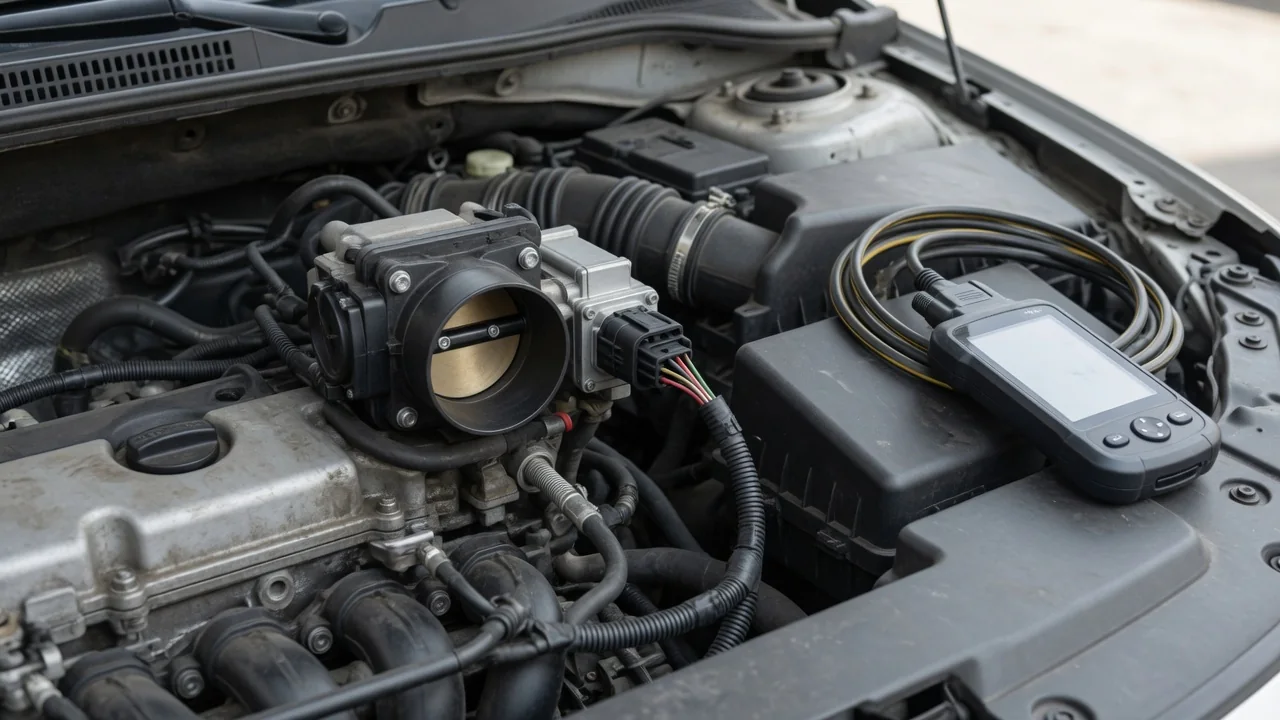
Many modern engines have no cable between the accelerator pedal and the throttle plate. Electronic throttle control reads pedal input, commands a throttle actuator motor, and checks feedback to confirm the plate moved as expected. When that loop breaks down, codes from P2100 through P2110, plus P2116, can appear with reduced engine power or forced idle. Each code describes a condition the system detected. It does not prove a part has failed.
P2101: What Throttle Actuator Range or Performance Means
The P2101 code generally identifies a throttle actuator control motor circuit range or performance problem, meaning results fall outside the limits the engine computer expects. In an electronic throttle control system, the controller compares commanded throttle position against feedback from position sensors while also monitoring how the motor circuit behaves. If the actual response lags, overshoots, or strays too far from the command under the enabling conditions, a performance fault can set. Wording and diagnostic criteria vary, so confirm the exact description for the vehicle's year, make, model, and engine before interpreting P2101 or any related code.
Drivers may see a check engine or electronic throttle warning light, get a hesitant or weak response from the accelerator, or receive a reduced engine power message. Not every vehicle behaves the same way, and some show only a stored code. Several conditions can produce the fault: a sticking or deposit-restricted throttle plate, intermittent wiring or connector corrosion on the motor circuit, or position feedback signals that disagree with each other. The code alone does not establish that the throttle body needs replacement. Testing must show which part of the command-and-response loop is actually failing.
P2100, P2102, and P2103: Throttle Motor Circuit Faults
On many vehicles, the P2100 code describes an open throttle actuator control motor circuit, P2102 indicates circuit low, and P2103 indicates circuit high. Confirm each definition in the manufacturer's service information. Low and high refer to electrical conditions the controller monitors on the motor circuit, such as voltage or current falling below or rising above an expected range. They do not mean the throttle is stuck partly closed or wide open, and they say nothing directly about engine speed. A P2102 code is not a report of low idle, and a P2103 code does not indicate a racing engine.
Possible explanations include an interrupted wire, a connector with spread or corroded terminals, a short to ground or to voltage, an internal actuator fault, or a problem with the driver circuit inside the controller. The code by itself does not rank these possibilities. With the engine off, owners can reasonably look for obvious harness damage near the throttle body, wiring chafed against brackets, or a connector that looks loose or unlatched. Back-probing a powered circuit, checking the motor against a specification, or commanding the actuator with a scan tool should be left to a qualified technician.
P2107 and P2108: Throttle Control Module Faults
P2107 generally points to a throttle actuator control module processor fault, and the P2108 code generally concerns module performance. Manufacturers define these codes differently enough that the exact description and setting conditions should be checked. Despite the word module, many vehicles handle throttle control inside the engine or powertrain control module rather than in a standalone unit, and other architectures divide the functions in other ways. The wording therefore does not establish that the vehicle has a separately replaceable throttle module. Ordering parts based on the code name alone can waste time and money.
A P2107 code or P2108 code can reflect conditions around the controller rather than a failure inside it. Low or unstable supply voltage, a weak battery, a poor ground, water intrusion at a connector, or related sensor and communication faults can all disturb how the controller judges its own operation. Those factors and any accompanying codes need assessment before anyone concludes the controller has failed. A replacement controller may need programming, security setup, or throttle adaptation, so vehicle-specific professional diagnostics should come before any recommendation to replace a module.
P2104, P2105, P2106, and P2110: Protective Operating Limits
These codes describe what the control system did in response to a problem. P2104 usually means forced idle, the P2105 code forced engine shutdown, the P2106 code forced limited power, and the P2110 code forced limited RPM. Exact definitions should be confirmed for the vehicle. They typically record a protective strategy the controller commanded after detecting a throttle, pedal, or related fault it could not trust, rather than naming a failed component. A P2104 code stored beside a motor circuit or sensor code often shows that the idle limit was a result, not the cause.
To find the initiating problem, a technician needs the full scan report, including every stored and pending code, its status, and any freeze-frame data. Neither code numbering nor the order a scan tool displays codes in establishes which fault occurred first, so timing and context have to be interpreted. If accelerator response becomes unreliable, the engine stalls, or limited engine speed or power cannot support safe travel, stop in a safe place and arrange assistance. An engine that runs normally after a restart has not been repaired, and the underlying condition may return without warning.
P2109 and P2116: Minimum Stop Position Performance
The P2109 code generally refers to throttle/pedal position sensor A minimum stop performance, and the P2116 code to sensor E minimum stop performance. Both definitions need confirmation for the specific vehicle. The letters A and E are designations assigned within the manufacturer's system. Depending on the design, a letter may correspond to a sensor in the throttle body or in the accelerator pedal assembly. Before connecting either code to a physical part, identify what sensor A or E denotes in that vehicle's wiring and diagnostic information instead of assuming it is the first sensor in sight.
Minimum stop performance means there is a problem with the expected resting reference position or with the signal observed there. The controller expects a closed throttle or released pedal to report a consistent value, and a reading that drifts outside its learned or allowed window can set the fault. No universal voltage or angle applies across vehicles. Possibilities include a throttle plate that does not fully return because of deposits or binding, an unsteady position feedback signal, wiring or connector problems, or a learned reference lost after battery or intake work. Any relearn must follow the applicable service information.
What to Record and What Professional Testing Must Establish
Before clearing anything, save all codes with their status and whatever freeze-frame data the scan tool provides. That snapshot may include engine speed, load, and commanded throttle position when the fault set. Note when reduced engine power occurred and whether it followed a cold start, rain, or a pothole. Also mention any recent battery replacement, intake cleaning, or throttle body service. Owners can safely note dashboard messages and look for visible harness damage. Do not force the throttle plate by hand, apply power to actuator terminals, or try to bypass protective operation.
A professional evaluation should verify module power and ground under load and check circuit integrity between the controller and the actuator or sensors. It should also compare commanded throttle position with feedback data while the system operates. Manufacturer-approved actuator tests can show whether the motor responds smoothly across its range. After the cause is established and repaired, verification should include any required adaptation, a test drive or procedure that meets the monitor's enabling conditions, and a recheck for returning codes or symptoms. Clearing the warning light alone does not confirm the repair worked.