P2072–P2074 Codes: Throttle Control and Airflow Correlation Faults
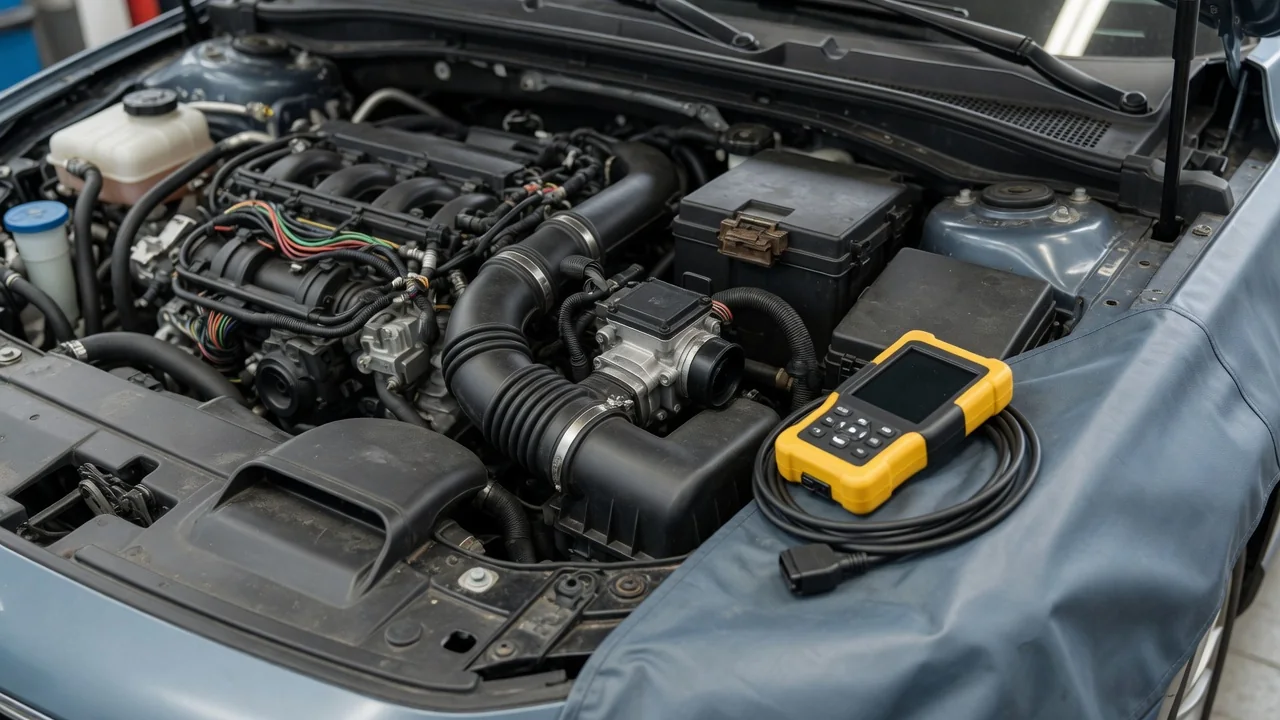
P2072, P2073, and P2074 codes typically flag electronic throttle control and airflow correlation issues rather than a proven failed part. A P2074 code, like a P2072 code or P2073 code, means the module saw an unexpected relationship between throttle position and airflow or pressure. Exact meaning depends on year, model, and engine. Stored freeze-frame data helps show whether the mismatch appeared at idle or under higher load.
Verify the Vehicle-Specific Meaning of P2072–P2074
Before treating a P2072 code, P2073 code, or P2074 code as a throttle-body failure, confirm the definition and enable criteria for that vehicle's year, model, and engine. Manufacturers assign similar numbers to related but not identical tests. One calibration may compare throttle angle with manifold absolute pressure, another with a mass airflow sensor, and a third may add idle or load conditions. Service information for that powertrain is the only reliable source for what the stored fault actually measured.
Nearby numbers do not prove a shared failed component or an identical diagnostic path. Electronic throttle control uses a throttle actuator and position feedback so the module can command airflow. An airflow correlation fault means the observed combination of throttle position and airflow or pressure did not match the expected relationship for that operating point. That mismatch can come from leaks, ducting, sensor signals, wiring, or actuator behavior. The code identifies an unexpected relationship; it does not by itself prove that any one sensor has failed.
P2072 and a Possible Throttle Ice-Blockage Condition
Some vehicles define a P2072 code around restricted throttle movement that can occur when ice forms in the throttle body, but that interpretation applies only after the service definition for that year, model, and engine confirms it. Cold ambient temperature, recent rain or snow, and a history of condensation in the intake can provide useful context. Those conditions do not establish that ice caused the stored fault. A dry, warm trip can still set related throttle-control faults for unrelated mechanical or electrical reasons.
If the applicable definition involves restricted throttle travel or a throttle actuator concern, evaluation still belongs to vehicle-specific procedures. A stored P2072 code does not justify replacing the throttle body on its own. Do not force the throttle plate, apply improvised heat, or try to clear a suspected blockage while the engine is running. Those actions can damage the actuator, injure fingers, or cause sudden engine speed changes. Leave any thaw, inspection of ice, or actuator testing to a technician working with the engine off and the manufacturer's method.
P2073 and Airflow-to-Throttle Correlation at Idle
A P2073 code should be explained as an idle correlation problem only after confirming that the vehicle's definition concerns manifold absolute pressure or mass airflow sensor readings versus throttle position at idle. In that operating condition the module holds a small throttle opening and expects a matching airflow or manifold pressure. Electronic throttle control still commands the actuator, so idle airflow is not a purely mechanical rest position. When the observed combination drifts from the expected idle relationship, the module stores the correlation fault without naming the failed part.
Diagnostic possibilities at idle include intake air leaks, cracked or poorly seated intake-path parts, implausible sensor signals, and throttle operation that does not match the commanded angle. Which of those apply depends on how that engine measures air and how it seals the intake. A rough idle, a stall, or even an apparently smooth idle cannot identify or exclude a particular failed component. Unmetered air can raise idle speed on one design and cause a lean stumble on another, so P2073 still needs vehicle-specific signal comparison rather than a guess based on how the engine felt.
P2074 and Airflow Correlation Under Higher Load
Treat a P2074 code as a higher-load airflow correlation fault only after confirming that the vehicle's definition specifies manifold absolute pressure or mass airflow versus throttle position under load. At that operating point the module expects more airflow as the throttle actuator opens. An intake restriction, collapsed or damaged ducting, an implausible mass airflow or pressure signal, or throttle operation that does not follow the command can all disrupt that expected relationship. Load-related correlation looks at a different airflow demand than an idle test, even when the same sensors are involved.
Freeze-frame data and other stored operating conditions show engine speed, load, throttle angle, and related airflow or pressure values when the P2074 code set, so a driver does not need to reproduce the fault through hard acceleration. Those snapshots help a technician judge whether the mismatch appeared during a moderate pull, a grade, or another higher-demand moment. The stored result still does not establish whether the underlying problem is mechanical, electrical, or related to sensor contamination. Distinguishing a torn duct from a biased signal or a sticky actuator requires the tests written for that vehicle.
Symptoms and Safe Observations Before Service
A P2072, P2073, or P2074 code may be accompanied by a warning lamp, reduced engine power, hesitant throttle response, a rough idle, or stalling, but not every vehicle will show those symptoms. Some drivers notice only a lamp after a cold start or a single loaded acceleration. When the warning appeared, record weather, engine temperature, driving conditions, and any recent intake-related work such as filter or duct service. That history later helps separate a possible ice-related P2072 event from an idle P2073 correlation or a P2074 mismatch under higher load.
Owner inspection should stay limited to accessible intake ducting and visibly loose connections, and only with the engine off and cool. Do not move throttle parts, pry the plate, or disconnect sensors, the throttle actuator, or vacuum lines in an attempt to test airflow correlation. If throttle response becomes unpredictable, the engine repeatedly stalls, or reduced engine power prevents safe merging or hill climbing, stop in a safe place and arrange assistance. Continuing to drive through an unstable electronic throttle control condition can leave the vehicle without usable power in traffic.
Professional Testing That Establishes the Cause
A technician should preserve stored, pending, and accompanying codes plus freeze-frame data before clearing faults, because those records show the operating point where airflow correlation failed. Clearing first erases the idle-versus-load distinction that separates many P2073 and P2074 interpretations and can hide related throttle or sensor codes. Diagnosis then follows vehicle-specific procedures, evaluating supported throttle position, mass airflow sensor, manifold absolute pressure, and electrical circuit signals rather than substituting a generic parts list. The same P2074 code on two engines can require different tests if one relies on pressure and the other on measured airflow.
Professional work may include intake leak testing, circuit checks at the sensors and throttle actuator, and throttle assessment using the manufacturer's commanded tests. Those steps stay inside shop procedures; they do not require a universal voltage or airflow threshold, and they should not include improvised plate movement. After a repair, verification should confirm normal electronic throttle control and watch monitor results under the idle or higher-load conditions that originally set the code. A cleared warning light alone does not establish success if the correlation test has not run or if freeze-frame conditions have not been revisited.