P2065–P2069 Codes: Fuel Level Sensor B Faults Explained
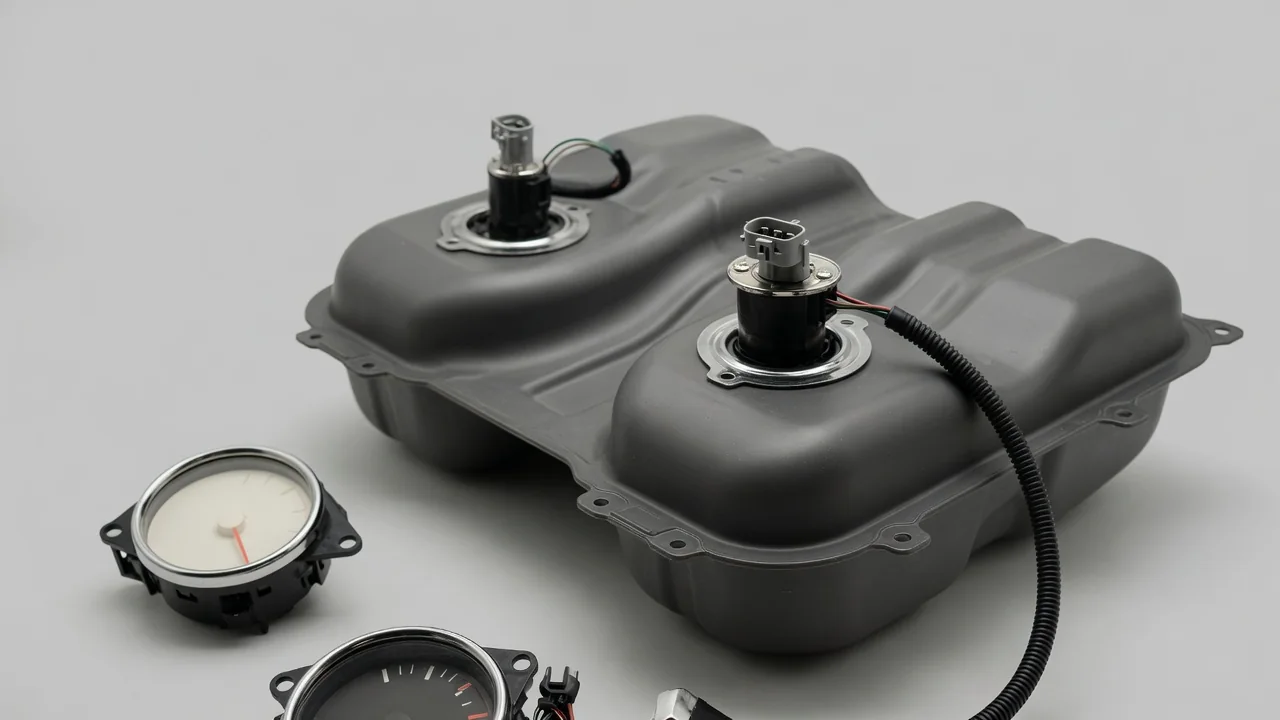
When a scan tool reports P2065, P2066, P2067, P2068, or P2069, the control module has flagged a problem with fuel level sensor B, the secondary fuel level sender used on many saddle fuel tank designs. These codes describe circuit, range, low, high, or intermittent behavior in the sender circuit. They do not by themselves prove a pump or pressure failure. Vehicle-specific service information is required before treating any of them as a failed sending unit.
What Fuel Level Sensor B Measures in a Saddle Tank
A saddle fuel tank straddles the driveline, so fuel can sit in two pockets that do not always equalize quickly. Many of these tanks use more than one sending unit so the control module can estimate volume in each section. Fuel level sensor B is the monitored secondary fuel level sender for one of those circuits. Confirm the code description, tank layout, sensor B identification, and monitoring conditions in the applicable service information before interpreting a stored P2065 through P2069 code.
Sensor B identifies a monitored level-sensor circuit, not a universal part number or a fixed corner of the tank. On some vehicles the secondary sender is a float arm in the opposite saddle; on others it is integrated with a transfer or jet pump module. These codes concern fuel-level information used for the gauge and remaining-range logic. None of these faults, by themselves, establish a fuel-pressure problem or a failed fuel pump. Treat a stored code as a request to verify the sender circuit, not as proof that a pump assembly must be replaced.
P2065 and P2066: Circuit and Range/Performance Faults
After the applicable service information is confirmed, P2065 is the fuel level sensor B circuit code, meaning the module saw a problem with the monitored sender circuit as a whole. A P2066 code is a range/performance fault: the reading or its behavior failed criteria the vehicle expects for that sensor. It does not name a failed part. A sticking float arm, sender wear, or an electrical connection problem can produce a value that looks implausible relative to the other tank section or recent operating history.
Context is what turns a stored P2065 or P2066 code into a useful diagnosis. Note the indicated fuel level, whether the tank was recently filled, and any companion codes from the other sender, the pump circuit, or related body modules. Freeze-frame or recorded operating conditions show whether the fault set after a fill-up, during a long grade, or at a particular indicated volume. Those details help a technician decide whether the module saw a stuck float, a wiring issue, or a reading that simply did not match expected tank behavior, without assuming the sending unit has already failed.
P2067 and P2068: Low and High Circuit Signals
Once the applicable definitions are confirmed, P2067 is fuel level sensor B circuit low and P2068 is fuel level sensor B circuit high. A P2067 code and a P2068 code describe the monitored electrical signal, typically signal voltage on the sender circuit, not the amount of fuel remaining in the saddle fuel tank. An empty pocket can still produce a valid mid-range voltage, and a full tank can still set a high or low circuit fault if the wiring or sender is wrong. Do not treat the word low as empty or high as a full tank.
A defective sending unit, damaged wiring, a poor connector, or a problem on the reference or ground path can all pull the signal toward an extreme. Whether that extreme appears as circuit low or circuit high depends on how the vehicle designs the sender circuit, not on a universal rule about opens and shorts. A P2068 code is not automatically a short to voltage, and a P2067 code is not automatically an open. Use the vehicle's circuit diagram and diagnostic specifications before attributing either fault to a particular type of short or to an open conductor.
P2069: An Intermittent Sensor B Signal
A P2069 code is an intermittent fuel level sensor B circuit fault. Exact detection criteria must be confirmed for the vehicle. A brief dropout can accompany a loose connector, an intermittent electrical connection at the tank harness, damaged wiring, or a worn area of the sender's sensing element that the float arm contacts only at certain levels. The code shows the module lost a stable reading for a period it considers unacceptable, not proof the sending unit has failed.
Note when the gauge or distance-to-empty display changes: after refueling, over bumps, or at a particular indicated fuel level. Do not try to recreate those conditions in an unsafe way, and do not drive with a known fuel leak just to capture a dropout. A normal live reading during one inspection does not exclude a P2069 code, because the fault is defined by intermittence. Recorded scan data, pending versus confirmed status, and a history of when the erratic fuel gauge moved are often more useful than a single snapshot of signal voltage.
Gauge Symptoms and Safe Observations Before Service
Drivers may see a stuck or jumping fuel gauge, an unexpected low-fuel warning, or an unreliable distance-to-empty display when fuel level sensor B is reporting poorly. An erratic fuel gauge is common when the secondary fuel level sender drops in and out, but symptoms vary by vehicle. If the cluster filters readings or combines both senders, a sensor B fault can produce only a small lag, a frozen last value, or almost no visible change. The absence of a dramatic gauge swing does not mean a stored P2065, P2066, P2067, P2068, or P2069 code is irrelevant.
Record every available code and the dashboard symptoms before clearing anything, and note recent refueling and any fuel-system repair history. Do not rely on the gauge or the range estimate while those readings are suspect, and do not run the tank low as a test of the fault. If fuel odor or visible leakage is present, stop in a safe place, keep ignition sources away, and arrange professional assistance. Fuel vapor and liquid fuel are fire hazards; diagnosis of a sender circuit is not a reason to ignore a leak or to keep driving until the tank is empty.
Professional Diagnosis and Evidence Needed Before Replacement
A technician starts with vehicle-specific service information, companion codes, and available sender data to identify the affected circuit. Electrical testing and inspection distinguish wiring or connection faults from a defective sender. Fuel-system access belongs in qualified service because of fire and vapor risk. The stored code is a starting point for that inspection, not a parts list. Signal voltage and ground integrity should be evaluated against the published circuit design before an in-tank component is disturbed.
On a saddle fuel tank, transfer behavior or other fuel-level plausibility issues may deserve investigation when the vehicle's design and the test results support it. One pocket can read full while the other is starved if a transfer path is restricted, which can look like a sender problem until both circuits are compared. Confirm whether the secondary fuel level sender is serviced separately or only as part of a larger assembly before recommending parts; a code cannot establish compatibility. Repair verification includes checking sender data and gauge operation and confirming the fault does not return under the applicable monitoring conditions.