P2040–P2057 Codes: DEF Sensors and Reductant Injector Circuit Faults
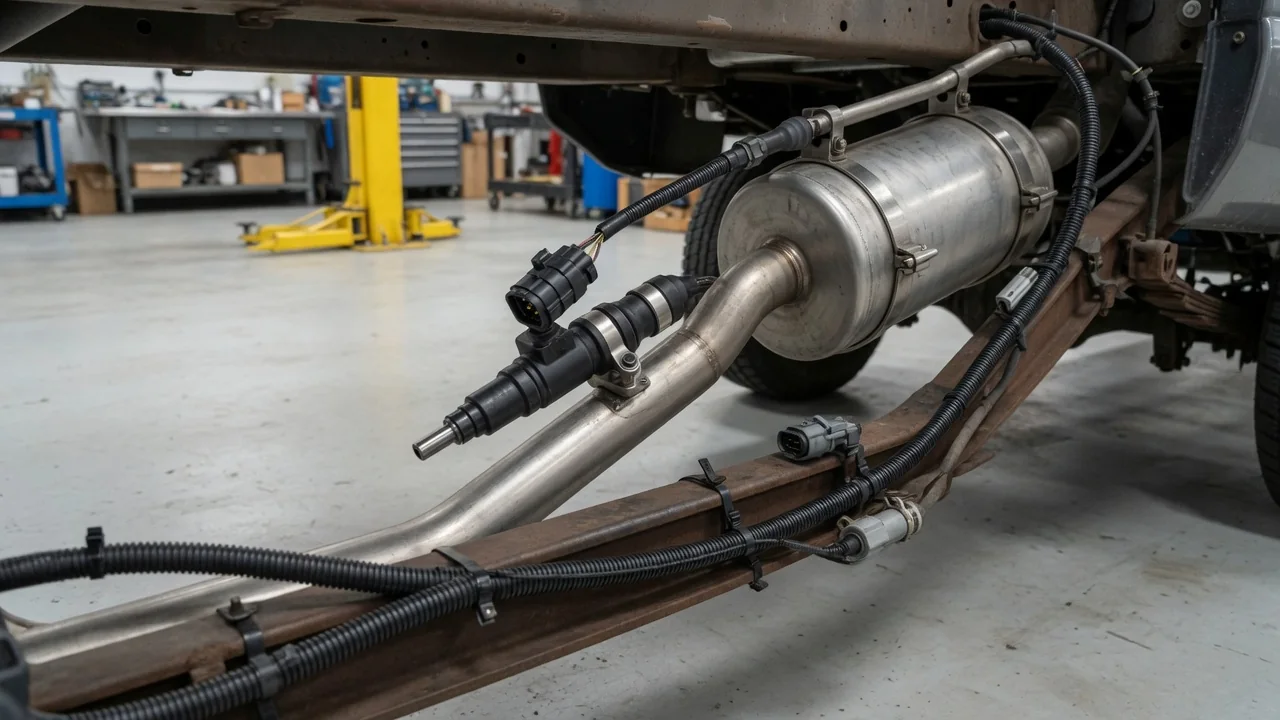
P2040 through P2057 codes on diesel vehicles with selective catalytic reduction often point to monitored problems in reductant dosing hardware, including the injection air pressure sensor, reductant temperature sensor, and injector control circuit. A stored code identifies a condition the control module saw, not a confirmed failed part. Bank and unit identification, freeze-frame data, and the exact service definition for the vehicle must guide diagnosis of diesel exhaust fluid system faults.
Confirm the Code Definition and SCR System Layout
Confirm each code's full definition in service information for the vehicle's year, model, engine, and emissions configuration before interpreting it. Manufacturer-dependent codes need that vehicle-specific confirmation because the same number can describe different monitored circuits on different platforms. Selective catalytic reduction relies on measured reductant dosing of diesel exhaust fluid so nitrogen oxides can be reduced in the catalyst. The code records a monitored electrical or plausibility condition; it does not prove which component failed.
Establish bank and unit locations from the manufacturer's SCR layout rather than inferring injector placement from the code number. Not every vehicle uses every listed sensor or dosing unit, so a guessed exhaust arrangement can send testing to the wrong device. Record all stored and pending codes, dashboard messages, and freeze-frame data before clearing anything. Conditions captured with the fault help a technician recreate the event and keep later testing aligned with the monitored condition.
P2040, P2041, and P2043: Pressure and Temperature Sensor Faults
After confirming applicability, a P2040 code identifies reductant injection air pressure sensor circuit high, while a P2041 code describes an intermittent condition in that sensor circuit. Those labels refer to the electrical signal the module evaluated, not physical pressure by itself. A high circuit signal can come from an open ground, a short to voltage, connector corrosion, or a sensor no longer producing valid output. Intermittent activity can appear with a damaged wiring harness, loose terminal, or a connection that changes with heat and vibration.
A verified P2043 code is a reductant temperature sensor range/performance fault, meaning the reported temperature was implausible versus expected conditions. An implausible temperature can distort reductant dosing because the module uses fluid temperature when controlling diesel exhaust fluid delivery. Range/performance does not prove the sensor failed; contaminated fluid, DEF crystallization near the sensing element, poor reference voltage, or a grounded circuit can produce the same reading. Professional evaluation compares live data for plausibility, then checks reference voltage, grounds, connectors, and wiring with the correct documentation.
P2047, P2048, and P2049: Bank 1, Unit 1 Injector Circuit
Subject to vehicle-specific confirmation, a P2047 code identifies a bank 1, unit 1 reductant injector circuit/open condition. A P2048 code identifies circuit low on that injector control circuit, and a P2049 code identifies circuit high. Open, low, and high describe monitored electrical conditions, not diesel exhaust fluid level and not the quantity of reductant actually dosed. The module is reporting that the injector driver circuit did not match the expected voltage or continuity pattern during the dosing command.
Possible contributors include wiring harness damage, poor terminal contact, an injector electrical fault, and a control-driver fault inside the module. None should be ranked by frequency without testing, because the same P2048 or P2049 pattern can arise from several points on the circuit. Circuit testing belongs before any injector recommendation. Visible DEF crystallization around a dosing unit can explain a leak or spray problem, yet deposits cannot establish the cause of an electrical open, low, or high code.
P2050, P2051, and P2052: Bank 1, Unit 2 Injector Circuit
On an applicable bank 1 layout, P2050 identifies a circuit/open condition for the unit 2 reductant injector. P2051 identifies circuit low and P2052 identifies circuit high on that same injector control circuit. Those codes describe electrical monitoring of the driver and wiring, not a measured shortfall in diesel exhaust fluid volume. Service diagrams establish which dosing device is designated unit 2 on the selective catalytic reduction layout, and that assignment can differ between engines.
When several related injector codes store together, technicians examine shared supplies, grounds, and harness routing because a crushed conduit, corroded splice, or common power feed can affect more than one dosing unit. That pattern does not authorize replacement of every injector on the bank. Keep conclusions tied to the identified circuit: a P2050 open on unit 2 is not evidence that unit 1 failed. Confirm continuity, voltage, and terminal condition on the designated circuit before parts are changed.
P2054, P2055, and P2057: Locate the Affected Bank 2 Circuit
With vehicle-specific definitions confirmed, P2054 identifies bank 2, unit 1 reductant injector circuit low, and P2055 identifies bank 2, unit 1 circuit high. P2057 is the verified bank 2, unit 2 circuit low definition and requires positive identification of that unit before testing. Bank and unit designations must follow the manufacturer's selective catalytic reduction layout. Some vehicles label banks by catalyst path rather than by cylinder bank, so injector placement comes from the service diagram.
Once the correct unit is identified, connector condition, circuit integrity, and injector electrical checks help isolate the fault. Connector corrosion, pushed-out terminals, and chafed wiring near heat shields are useful inspection points on bank 2 circuits. Injector electrical checks belong to the identified circuit; generic pin assignments and resistance values are not interchangeable across manufacturers. A circuit-low result on P2054 or P2057 remains an electrical finding until testing shows whether the wiring, injector path, or driver is responsible.
Warning Messages, Drivability Changes, and Safe Observations
A stored reductant circuit fault may illuminate the check-engine light and may also trigger diesel exhaust fluid or emissions system warnings. Some vehicles show no obvious drivability change at first if the module can still command reductant dosing. On applicable vehicles, an unresolved injector control circuit or sensor fault can lead to reduced-power operation or restart restrictions. The actual dashboard message and the owner's manual should guide how urgently the vehicle needs service.
Owner observations should stay limited to recording when warnings appear and viewing safely accessible areas with the vehicle off and components cool. Look for damaged wiring, loose connectors, or residue around dosing hardware without probing connectors or opening the exhaust. Adding diesel exhaust fluid may restore a low-level warning, but it will not resolve a sensor or injector circuit fault. If the vehicle cannot be driven safely, or if restart is inhibited, seek professional assistance.
Professional Testing, Emissions-Compliant Repair, and Verification
A professional diagnostic sequence starts with verified code definitions, companion codes, freeze-frame data, and wiring diagrams for the exact emissions configuration. Live data for the injection air pressure sensor and reductant temperature sensor is compared for plausibility before any part is condemned. Manufacturer-directed electrical tests of the injector control circuit then separate an open, a short to ground, a short to voltage, and a driver fault. Commanded dosing, pressure testing, electrical probing, and component removal stay reserved for qualified technicians using the specified procedures.
Repair recommendations must follow those test results, such as restoring damaged wiring or replacing a component that failed electrical or functional tests. Emissions deletes, bypasses, and defeat devices are not legitimate repairs and can leave the vehicle noncompliant. Clearing codes alone does not confirm a repair. After work is complete, operate the system through the conditions that set the fault, check for returning P2047, P2048, P2051, P2052, P2055, or related codes, and complete any manufacturer-directed validation so reductant dosing is restored correctly.