P2039 to P2043 Codes: Reductant Injection Air Pressure Sensor Faults
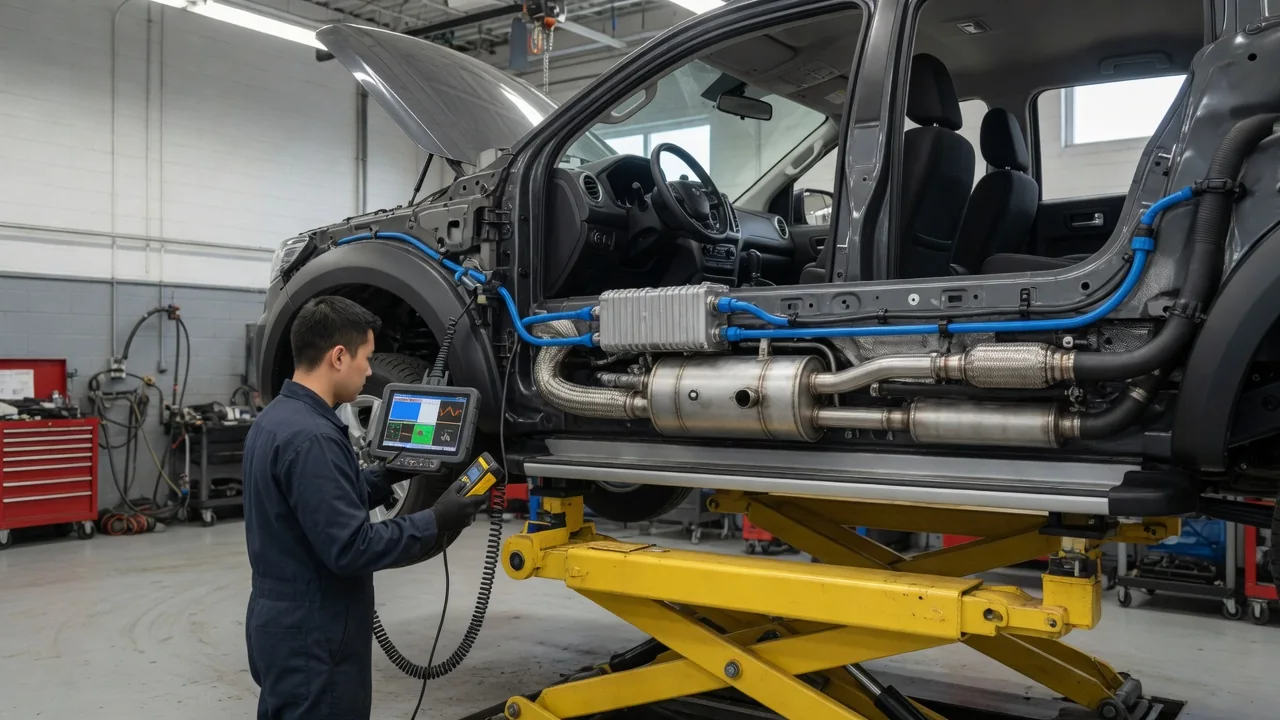
When a diesel truck or SUV displays a P2039, P2040, P2041, P2042, or P2043 code, the diagnostic path often leads to the selective catalytic reduction (SCR) system. These codes can involve the reductant injection air pressure sensor on engines that use compressed air to help atomize diesel exhaust fluid. Because code definitions vary among manufacturers—and some vehicles do not even use an air-assisted injector—you must confirm the exact meaning for your model before interpreting the fault.
How the P2039 to P2043 Code Range Relates to Air-Assisted SCR Dosing
Selective catalytic reduction lowers oxides of nitrogen in diesel exhaust by injecting a precise mist of diesel exhaust fluid upstream of a catalyst. Some systems use an air-assisted reductant injector, where compressed air helps break the fluid into fine droplets that mix thoroughly with exhaust gas. A dedicated reductant injection air pressure sensor monitors that air supply so the control module can adjust dosing and detect problems.
Many modern SCR systems inject the fluid under high pressure without any compressed air assistance. On those vehicles, a reductant injection air pressure sensor does not exist, so a code in the P2039 to P2043 range may be defined differently—perhaps as a reductant temperature sensor fault—or may be unused. Generic code lists often group nearby numbers, but the actual definition depends on the specific engine, model year, and emissions architecture.
P2043: Confirming the Definition Before Reading Anything Into It
P2043 is the most commonly searched code in this group, but its wording can differ between generic references and factory service information. Some sources associate P2043 with the reductant injection air pressure sensor circuit, while others assign it to a reductant temperature or level sensor. Because the same numeric code can carry distinct meanings on different engines, there is no single universal interpretation.
To confirm what P2043 means for your vehicle, a manufacturer-level scan tool that reads enhanced codes is ideal; otherwise, consult the service information or a technician familiar with that brand. If the definition is indeed a circuit range or performance fault, the module has received a sensor reading that does not make sense compared to its expected values under the current operating conditions. That inconsistency does not prove the sensor itself has failed—wiring, connectors, air supply problems, or even calibration issues can create the same code.
P2040: When the Sensor Circuit Reads Out of Its Expected Band
Where P2040 applies to the reductant injection air pressure sensor circuit, a manufacturer may define it as an out-of-range signal, a voltage too high or too low, or a general circuit fault. This means the control module is seeing an electrical value outside the boundaries it expects for the sensor’s reference, ground, or signal line. Confirm your vehicle’s specific wording, because the diagnostic approach changes if the code instead points to a different component.
A circuit fault is an electrical behavior, while an actual air pressure problem in the dosing system is a mechanical or pneumatic condition. A scan tool alone cannot always separate the two. Safe owner-level checks include looking for visible harness damage near the SCR components, a loose or corroded connector in an accessible location, or recent repair work that may have disturbed wiring. Do not probe or unplug emissions components; measuring reference voltage, ground, and signal against factory specifications is a job for a technician.
P2042: Reading This Code in Context With Other SCR Faults
P2042 may be defined differently depending on the vehicle and the reference source. Some lists tie it to the reductant injection air pressure sensor, while others assign it to a reductant heater or level sensor. Before acting, check the exact definition for your model, because the same numeric code can point to entirely different components on different engines.
When P2042 appears alongside other SCR, DEF dosing, or NOx-related codes, that cluster can indicate a shared problem such as a wiring harness issue, a power supply fault, or a bad ground affecting multiple sensors. Freeze frame data from the code event shows operating conditions—engine speed, temperature, load, and sometimes sensor voltages—that can help a technician attempt to reproduce the fault. Never replace a sensor or module based only on the code number; part applications and diagnostic logic vary by manufacturer.
P2039 and P2041: Intermittent and Low-Signal Style Faults
P2039 and P2041 fall at the edges of this numeric block. Where manufacturers use them for the air pressure sensor circuit, they typically describe signal behavior such as low voltage, high voltage, or intermittent readings. However, some vehicle applications may assign these numbers differently, so verify each code for your exact model rather than assuming a fixed definition.
Intermittent faults are especially difficult because the code may set and then clear on its own, leaving no active problem to observe. The issue often appears only under certain temperatures, vibration, or moisture. Owners can help by writing down when the warning appears, the weather conditions, recent DEF top-ups or refueling, and whether the code returns after clearing. Diagnosing an intermittent electrical fault usually requires live data monitoring and wiring tests under controlled conditions by a qualified technician.
Symptoms, Driving Limits and When to Get Professional Testing
Symptoms that commonly accompany SCR sensor faults include a check engine or emissions warning, a DEF system message, and on some vehicles a countdown to reduced power or restricted restarts. The exact behavior depends on the manufacturer’s emissions strategy, but any derate or no-restart warning should be taken seriously and diagnosed promptly before the limit arrives.
Exhaust and SCR components get extremely hot, and parts of the dosing system can be pressurized—never attempt repairs or disassembly without proper precautions. Handle diesel exhaust fluid according to the label. Tampering with, disabling, or bypassing emissions equipment is not a solution and may violate emissions regulations. For warranty or emissions coverage questions, contact the manufacturer or a dealer.