P2014–P2022 Codes: Intake Manifold Runner Position Faults
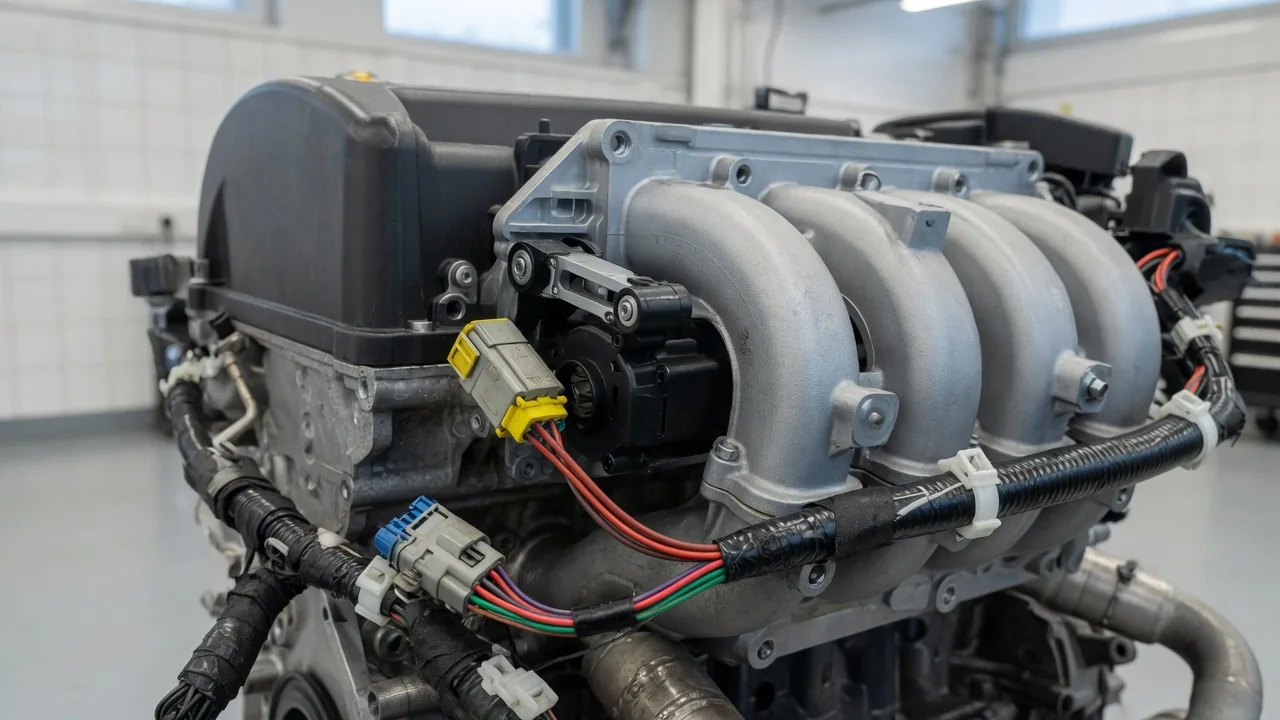
Intake manifold runner control faults from P2014 through P2022 mean the control module has detected a problem with runner position feedback on bank 1 or bank 2. A P2015 code is a frequent range/performance example, and related labels cover circuit, low, high, and intermittent faults. Each code is evidence to interpret rather than proof a sensor has failed, and the exact definition must be confirmed for the vehicle's year, engine, and manufacturer.
P2014–P2018: Bank 1 Runner Position Fault Labels
A scan tool may show a P2014 code, a P2015 code, a P2016 code, a P2017 code, or a P2018 code as a bank 1 intake manifold runner control position problem. Those standard labels typically mean P2014 is a sensor signal circuit fault, P2015 is range/performance, P2016 is circuit low, P2017 is circuit high, and P2018 is an intermittent circuit fault. The wording still has to be confirmed against service information for the year, engine, and manufacturer, because some makers assign different circuit names or diagnostic steps to the same number.
Bank 1 is the cylinder bank that contains cylinder 1. That is not always the driver's side, and it is not always the bank nearest the firewall, so physical location has to come from engine-specific diagrams rather than from habit. Even when the description names a runner position sensor, the stored code only reports that the module saw a circuit or feedback disagreement. Wiring, connectors, actuator linkage, and the runners themselves can produce the same P2015 or companion bank 1 labels, so the code does not independently justify sensor replacement.
P2019–P2022: Bank 2 Runner Position Fault Labels
On engines with a second cylinder bank, a P2019 code typically points to a bank 2 runner position sensor signal circuit fault, a P2020 code to range/performance, a P2021 code to circuit low, and a P2022 code to circuit high. Those labels still need vehicle-specific confirmation, and not every engine even has a bank 2. Inline four-cylinder layouts usually monitor one runner assembly, while V-type engines may have separate actuators, sensors, and intake manifold runner control hardware on each bank.
Before assigning a physical location to P2019, P2020, P2021, or P2022, confirm that the engine actually uses a bank 2 runner control system and how those components are arranged. Some intakes share a shaft, others use a dedicated actuator per bank, and the sensor may be built into the actuator or mounted separately. Circuit low and circuit high describe the monitored electrical signal, not whether the runners themselves are open or closed. A P2022 high-signal fault can come from a short to voltage, a failed sensor, or a wiring problem, and it does not by itself report runner flap position.
Symptoms and Signs That Need Prompt Attention
A check-engine light is often the first sign of a P2015, P2017, or related runner position fault, yet the engine may still idle and drive without an obvious complaint. When symptoms do appear, they can include an uneven idle, hesitation on acceleration, reduced power, or a change in fuel economy as the intake manifold runner control no longer matches the intended airflow path. Those same signs can also come from ignition, fuel, or vacuum issues, so the drivability picture cannot identify whether the sensor, actuator, wiring, or runner mechanism is at fault.
An intermittent circuit fault such as P2018 can set during a brief wiring glitch and then leave little to feel in the driver's seat. Freeze-frame data records the operating conditions when the fault occurred, which can connect a momentary hesitation or a light that came on after a cold start to the stored runner position feedback event. If the engine runs severely rough, stalls, the check-engine light flashes, or power loss makes driving unsafe, stop when it is safe to do so and seek assistance. No stored code implies a guaranteed remaining driving distance.
Electrical and Mechanical Causes Behind Runner Feedback Faults
Runner position feedback depends on a clean sensor signal circuit, a stable supply, and a sound ground. Chafed harnesses, stretched pins, moisture in connectors, and loose grounds can produce a P2014, P2016, P2017, P2019, or P2021 circuit complaint without any mechanical failure inside the intake. A true sensor fault or an actuator problem remains possible, but those parts should be tested rather than replaced on the code alone. Circuit low and circuit high simply report where the measured voltage sat relative to the module's expected window.
Mechanical trouble can still set a range/performance code such as P2015 or P2020 when commanded runner position and reported position no longer agree. Carbon deposits, binding flaps, worn actuator linkage, or travel that stops short of the commanded stop can make the feedback look implausible even when the electrical circuit is intact. Vacuum-operated systems add another path: a leaking hose, failed solenoid, or weak vacuum supply can keep the runners from moving, but that family of faults applies only when the engine uses vacuum actuation. Electric actuators, integrated sensor-actuator units, and separate position sensors all appear depending on the engine.
Safe Observations to Record Before Diagnosis
Before any code is cleared, record every stored and pending fault, including P2014 through P2022 if more than one is present, along with status and freeze-frame data when the scan tool provides it. Note when the light set, whether the complaint is cold-start only, and whether it returns after a restart. That snapshot is the only way an intermittent circuit fault can later be matched to load, temperature, or rpm. Clearing first erases the commanded runner position context that a technician needs to decide which tests are relevant.
With the engine off and cool, a visual check of accessible harnesses, connectors, and visible actuator linkage can reveal broken clips, oil-soaked plugs, or an obviously disconnected rod without dismantling the intake. Recent intake service or a disturbed connector is useful context, but it should not be assumed to be the cause. Do not force runner linkage, reach toward parts that can move when the engine is running, probe energized circuits, or command the actuator without the training and equipment those tests require. Those steps belong in a controlled diagnostic setting.
Professional Tests and Evidence That Confirm the Repair
A technician starts with the vehicle-specific service information, then uses related codes and live scan data to decide whether the next step is electrical or mechanical. For a P2015 or P2020 range/performance fault, commanded runner position is compared with reported position through the specified operating range, using the manufacturer's expected movement and tolerances rather than a generic guess. Companion circuit codes such as P2017 or P2022 steer the work toward signal integrity first. The same scan session can show whether bank 1 and bank 2 disagree, which matters on engines that control each bank separately.
Professional testing may include wiring integrity checks, power and ground verification, sensor output measurement, actuator operation, and confirmation that the runners actually travel. Only after those results point to a specific failure is a repair selected. Success is not proven by turning the light off. The applicable monitor, or the prescribed operating conditions in the service procedure, must run without the fault returning. If P2016, P2018, P2019, or P2021 reappears, the original evidence was incomplete and the circuit or mechanical path needs another look rather than a second guess at the same part.