P1200 Code: Vehicle-Specific Meaning, Symptoms and Diagnosis
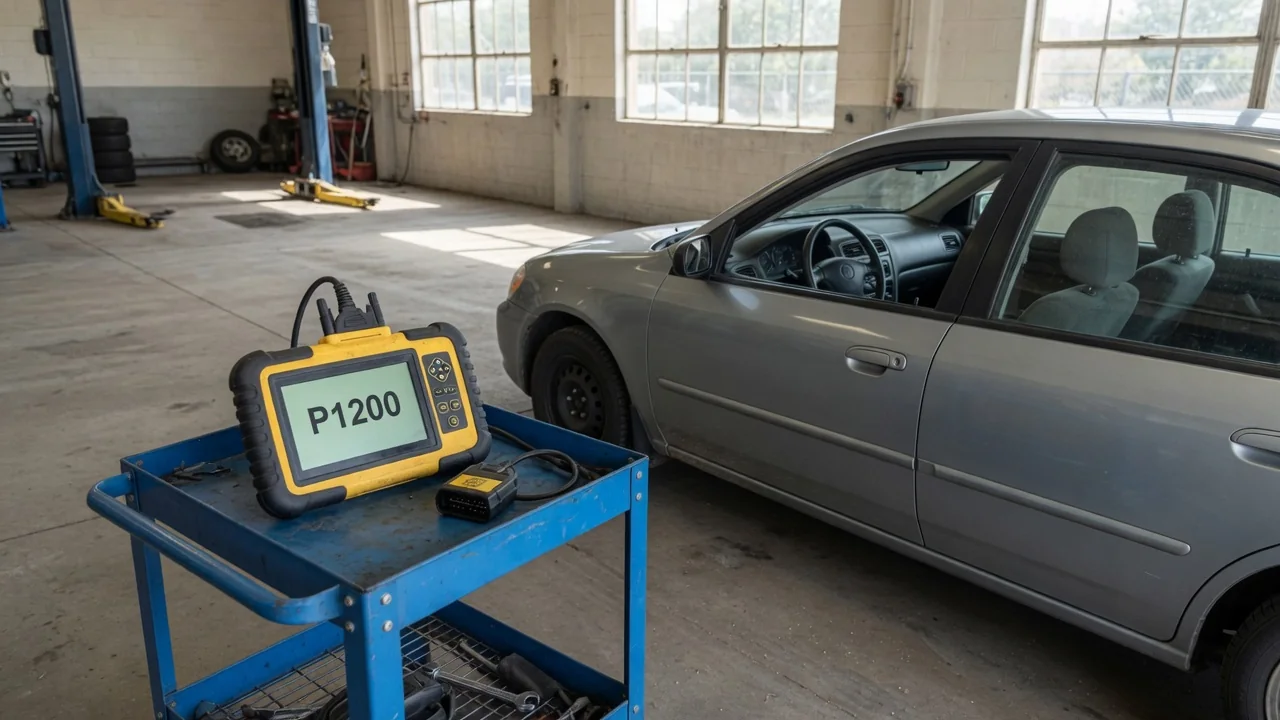
P1200 is a manufacturer-specific trouble code, so its meaning is not the same on every vehicle. Before treating a P1200 code as a parts list, confirm the definition for the exact make, model, year, engine, and the control module that stored it. A check engine light or a stored P1200 is evidence of a diagnostic condition. It is not proof that a particular injector, pump, sensor, or module has failed.
Verify the Vehicle-Specific Meaning of P1200
A P1200 code cannot be interpreted from a generic label. Manufacturers assign this identifier to different systems, so the same alphanumeric string can describe one circuit, actuator, or control function on one vehicle and a completely different condition on another. Vehicle identification comes first: make, model, year, engine family, and any powertrain or emissions package that changes the service information. Those details select the correct definition and the correct diagnostic path. Without them, a scanner string is only a starting clue, not a diagnosis.
A generic scan tool may display P1200 with a brief phrase that does not match the vehicle-specific service information. The reporting control module also matters, because the same code stored by different controllers can point to different circuits and tests. Read the diagnostic scan report, including which module set the code and whether the status is current, pending, or history. P1200 identifies a diagnostic condition that met a manufacturer's criteria. It does not, by itself, prove that a particular part has failed.
Symptoms and Warning Signs to Record
Symptoms tied to a P1200 code depend on the verified definition, not on a universal list. A check engine light may appear with no obvious driving complaint, or the driver may notice a change that seems unrelated until the definition is confirmed. Record starting behavior, idle quality, any loss of power, stalling, and when the warning first appeared. Note whether the concern showed at startup, after warmup, or during ordinary driving. Those observations help a technician match freeze-frame data to real operating conditions.
Do not try to recreate a severe condition on the road. If the vehicle starts poorly, runs roughly, or loses power, describe what happened instead of repeating it. Stop driving and seek assistance when running problems are severe, when the check engine light flashes, or when the vehicle no longer feels reliably controllable. A flashing warning is a cue to reduce demand and get the vehicle to a safe place, not a reason to keep driving in hope the P1200 code will clear itself.
Possible Causes Must Follow the Confirmed Definition
Every proposed cause of a P1200 code has to follow the manufacturer-specific diagnostic description and the system that description names. A wiring problem, a loose connection, a component that is not operating as commanded, or a control-related fault belongs in the conversation only when the applicable procedure supports that path. Jumping to an injector, pump, sensor, or control module because those parts appear with other diagnostic trouble codes is not a diagnosis. The confirmed definition tells the technician which circuit, actuator, or strategy to evaluate.
Companion trouble codes and recent service history can add context without proving a shared cause. Another stored code may describe a related circuit, a different module, or an unrelated condition that happened to set at the same time. A recent battery disconnect, connector work, or component replacement may explain why P1200 appeared, or it may be coincidental. Naming a failed injector, pump, sensor, or control module from P1200 alone is unjustified. Parts replacement should wait until testing matches the confirmed definition.
Safe Checks Before a Diagnostic Appointment
Before a diagnostic appointment, preserve the complete diagnostic scan report, including P1200, any companion trouble codes, code status, and available freeze-frame data. Do not clear codes or disconnect the battery just to turn off the check engine light. That memory often contains the operating snapshot a technician needs: engine speed, load, temperature, and related parameters at the moment the condition was detected. Record recent repairs, starting difficulties, and the circumstances around the warning so the shop does not have to reconstruct them from memory.
Limit owner checks to what can be seen with the vehicle parked and the engine off. Look for obvious connector damage, disconnected vacuum or electrical plugs in easy reach, and fluid under the vehicle, while staying away from hot surfaces, moving parts, and any electrical probing. Fuel odors, visible leaks, or damaged wiring are reasons to stop and request professional assessment rather than continue hands-on troubleshooting. Those findings belong in the notes for the appointment; they are not a substitute for vehicle-specific testing of the P1200 code.
Professional Testing That Guides a P1200 Repair
A technician confirms the meaning of P1200 with vehicle-specific service information and a scan tool that can talk to the reporting module. Code status, freeze-frame data, and companion trouble codes then decide which tests are appropriate. A current code with a snapshot of operating conditions points the procedure one way; a history code or an intermittent fault may require a different monitoring plan. The goal is to reproduce or confirm the diagnostic condition under controlled, safe conditions, not to replace parts from a generic description.
Electrical checks, live-data review, or system-performance tests follow only after the confirmed meaning identifies the relevant circuit or function. A technician looks for evidence that the fault is present: a command that is not followed, a reading that is out of the specified range for that vehicle, or a circuit that fails the manufacturer's test. Repair recommendations should rest on that evidence. Pressure-system work, energized circuit testing, and module programming belong with qualified professionals who have the correct tools and safety procedures.
Confirming the Repair and Handling a Returning Code
A successful repair addresses the demonstrated cause of the P1200 code, not merely the stored identifier. Clearing P1200 without correcting the condition does not establish success, because the check engine light can stay off until the monitor runs again. After the work, the shop should scan the modules involved, confirm related codes, and complete manufacturer-prescribed repair verification under safe operating conditions. That process may include a controlled drive cycle or monitor completion, depending on the vehicle-specific procedure, rather than a short idle check.
An intermittent fault can allow the warning to stay off after a repair even though the underlying condition is not fully resolved. Further observation is reasonable when the original P1200 set only under specific conditions captured in freeze-frame data. If the code returns, retain the original diagnostic scan report, test findings, and repair details so the next diagnosis starts from evidence instead of from a blank history. Repeating the same untested parts swap is less useful than comparing the new snapshot with the first one.