P0987–P0990: Transmission Pressure Sensor/Switch E Codes
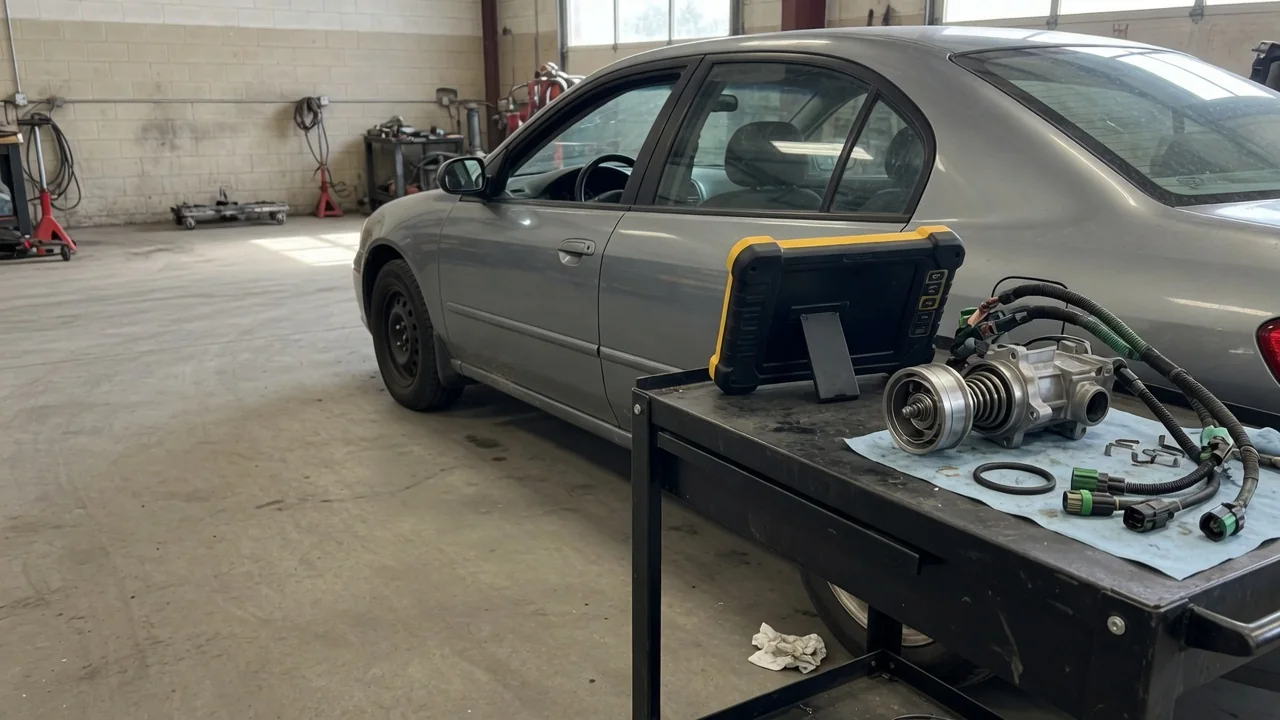
Codes P0987, P0988, P0989, and P0990 report the transmission fluid pressure sensor or pressure switch E circuit to the transmission control module. These manufacturer-dependent labels cover circuit, range/performance, low, and high signal voltage conditions, not a proven failed part. Confirm the exact definition for the vehicle's year, make, model, and transmission, and record freeze-frame data and shift symptoms before clearing anything.
Verify the Vehicle’s Code Definitions and Sensor E Designation
Service information for the specific year, make, model, and transmission is the starting point for P0987, P0988, P0989, and P0990 because the same number can describe different circuits or monitors on different designs. Pressure switch E is a circuit designation, not a universal part name, so the physical location, whether the component is a sensor or a switch, and the diagnostic procedure all come from that vehicle's documentation. Interpreting signal voltage without that context can send a technician toward the wrong harness, connector, or control strategy.
Before any code is cleared, record every stored and pending fault, available freeze-frame data, and the driver's observations about shift quality, warning lights, and when the concern appears. Freeze-frame snapshots of temperature, gear, and operating state later help a technician match the monitor to the conditions that set it. These four codes are evidence that the transmission control module saw an unexpected E-circuit condition. They do not by themselves prove a failed transmission fluid pressure sensor, a hydraulic pressure problem, or a need to replace the transmission.
P0987: Pressure Sensor/Switch E Circuit Fault
After the vehicle-specific definition is confirmed, P0987 is commonly listed as a transmission fluid pressure sensor or pressure switch E circuit fault. That wording means the transmission control module did not see an expected electrical condition on the E circuit, not that a particular part is proven defective. Possible contributors include a damaged wiring harness, poor connector contact, a sensor or switch fault, and a supply or ground problem where the circuit design uses those paths. Which of those applies depends on that transmission's schematic, not the code number alone.
Some vehicles display a warning light, shift more harshly or later than expected, or enter a restricted transmission operating mode when this monitor fails. Others store P0987 with little change in how the vehicle drives, so missing drivability does not dismiss the code. Replacing a transmission fluid pressure sensor without professional circuit testing and vehicle-specific operating data can miss an open, a short, or a control-module input problem. Scan data and the published diagnostic flow turn a circuit fault into a justified repair.
P0988: Pressure Sensor/Switch E Range or Performance Fault
Once applicability is verified, P0988 is commonly listed as a transmission fluid pressure sensor or pressure switch E range/performance fault. Range/performance means the monitored response did not match what the transmission control module expected for that operating state, unlike a simple open or short. Signal voltage can still be present and look plausible while remaining outside the expected window. That is why P0988 should not be treated as a duplicate of P0987, P0989, or P0990 without the vehicle's monitor description.
Possible contributors include an implausible sensor or switch signal, wiring that introduces resistance or intermittent contact, and hydraulic conditions only when the transmission's diagnostic procedure supports that path. Freeze-frame data showing fluid temperature, selected gear, and operating state help a technician recreate the window in which the monitor ran, because a cold idle snapshot differs from a hot, loaded shift. A range/performance code does not by itself identify a defective component or prove internal transmission damage. The published tests, not the code label, decide whether the next step is electrical, hydraulic, or both.
P0989: Pressure Sensor/Switch E Circuit Low
The vehicle's service information still comes first, but P0989 is commonly listed as transmission fluid pressure sensor or pressure switch E circuit low. Low describes the monitored electrical signal, typically a signal voltage the transmission control module judged below its threshold, not a low transmission fluid level and not proven low hydraulic pressure. Mixing those meanings can send someone toward adding fluid or assuming a pump problem when the monitor may only be reporting an electrical condition on circuit E.
Depending on circuit design, a circuit-low result can follow a short to ground, a sensor or switch malfunction that pulls the signal down, or a supply or wiring fault that starves the input. Those possibilities are not interchangeable across every transmission, which is why professional checks against the correct wiring diagram and specifications matter. Improvised jumper-wire tests and casual connector probing are not a substitute for that process and can damage a control-module input. Until those measurements exist, P0989 remains a circuit observation, not a parts verdict.
P0990: Pressure Sensor/Switch E Circuit High
P0990 likewise needs that same vehicle-specific check; it is commonly listed as transmission fluid pressure sensor or pressure switch E circuit high. High describes the monitored electrical signal, often a signal voltage judged above the expected range, and it does not establish excessive hydraulic pressure or an overfilled transmission. Treating the label as a stuck valve or overfill story reads a hydraulic meaning the code does not provide. The same E circuit that can set P0989 low can set P0990 high when the electrical condition moves the other way.
Where the circuit design supports those interpretations, possible causes include wiring faults, a poor ground, a sensor or switch problem, an open that lets the signal float high, or a short to a voltage source. Intermittent connection problems on a moving harness mean a key-on bay check may not recreate P0990. Professional monitoring under the temperature, gear, and load in freeze-frame data can reveal a drop-out a static meter reading misses. Until that work is done, circuit high remains an electrical observation, not proof of a failed switch.
Safe Observations, Driving Decisions, and Repair Confirmation
Useful owner notes for P0987 through P0990 include shift behavior, warning messages, whether the concern appears cold or after a long drive, visible fluid spots under a parked vehicle, and recent service or battery work. Those observations should be gathered without reaching into moving parts or hot components. Fluid-level checks belong only in an owner-accessible procedure specified for that vehicle. Any method that requires lifting the vehicle, handling hot fluid, or using special equipment should wait for a professional, because an incorrect level reading can send diagnosis in the wrong direction.
Loss of propulsion, severe slipping, overheating warnings, or substantial leakage are reasons to stop safely and arrange assistance rather than guess a remaining distance. A shop confirming these codes may compare wiring-harness integrity and signal voltage against scan data, then perform only the hydraulic tests service information prescribes for that transmission. Repair is complete when the stored fault no longer returns and the original shift or warning symptoms stay gone through the conditions that previously set P0988, P0989, or P0990. That confirmation step separates a cleared code from a solved E-circuit problem.