P0845–P0848: Transmission Fluid Pressure Sensor/Switch B Codes
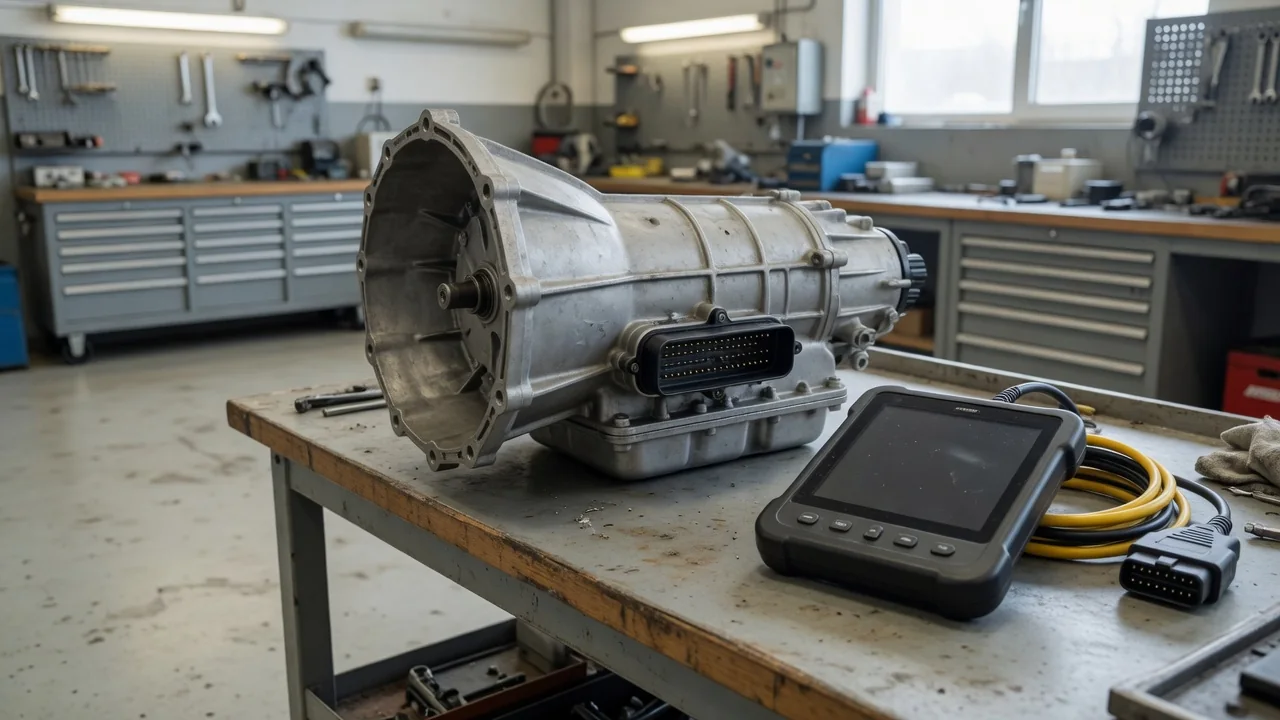
When a scan tool reports P0845, P0846, P0847, or P0848, the transmission control module has logged a concern involving transmission fluid pressure sensor or pressure switch B. These codes cover circuit, range/performance, circuit-low, and circuit-high conditions. They are diagnostic evidence, not proof a part failed. Meaning and test criteria depend on the vehicle, so interpretation starts with the correct service description.
Confirm the Code Meaning and Identify Sensor or Switch B
P0845 through P0848 share a family of descriptions, yet the full wording and the criteria that set them are manufacturer-dependent. Before treating any of these codes as a circuit or hydraulic problem, confirm the exact definition for that year, make, model, and transmission. The letter B is a circuit or component designation, not a universal location. Physical mounting, whether the device is a sensor or a switch, and how the module monitors it come from vehicle-specific service information.
A stored code means the control module detected a monitored fault condition that met its detection rules. It does not identify which part must be replaced. The transmission fluid pressure sensor, pressure switch B, related wiring, the connector, or hydraulic behavior the circuit is reporting can produce similar stored results. Replacing a sensor or switch from the code number alone skips distinguishing an electrical issue from an operating issue the sensor is merely reporting.
P0845: Transmission Fluid Pressure Sensor/Switch B Circuit
On many applications, P0845 is described as a transmission fluid pressure sensor/switch B circuit fault, but that wording still must be confirmed for the vehicle. A circuit code typically means the module saw an electrical condition outside the rules for that circuit, not that a component has already failed. Possible contributors include damaged wiring, connector corrosion, a poor connection at pressure switch B, a sensor fault, or an electrical supply issue. None of those is established until testing matches the vehicle's criteria.
Companion codes stored with P0845 help decide whether the concern is isolated to pressure switch B or shared with other transmission circuits. Fault status—pending, current, or history—shows whether the condition is still present. Freeze-frame data captures conditions when the code set, such as temperature, gear, and vehicle speed, which guides how to reproduce the circuit fault. Professional testing then follows the wiring diagram for that transmission, because supply, ground, and signal assignments are not interchangeable across designs.
P0846: Transmission Fluid Pressure Sensor/Switch B Range/Performance
P0846 is commonly described as a range/performance fault for transmission fluid pressure sensor or switch B. After confirming that description, the code concerns whether the monitored response stayed within expected operating criteria, not simply whether a wire is open. An implausible reading can come from the sensing circuit, a slow switch, or an actual hydraulic operating problem the device is reporting. Which is more likely depends on how that transmission uses pressure switch B and how the module compares the signal to other inputs.
Scan data is useful only when compared with the operating conditions and expected readings specified for that transmission. A live value that looks odd in isolation may be normal at that temperature, gear, or line-pressure command. Replacing the transmission fluid pressure sensor without checking the underlying condition can leave P0846 unresolved if the issue is hydraulic, mechanical, or elsewhere in the circuit. The range/performance fault remains until the monitored response meets the criteria the transmission control module expects.
P0847: Transmission Fluid Pressure Sensor/Switch B Circuit Low
P0847 is commonly labeled a circuit-low condition for transmission fluid pressure sensor/switch B. The detection threshold is defined by the vehicle's diagnostic criteria, not by a universal voltage. A low electrical signal means the module saw voltage, frequency, or switch state on the low side of its programmed window. That reading does not establish low transmission fluid level or low hydraulic pressure. Treating P0847 as proof of a dry or weak hydraulic system confuses an electrical report with a mechanical fact.
Possible sources of a circuit-low result include a short to ground, a lost supply, a high-resistance connection, connector corrosion, or a failed sensor or switch, each requiring testing. A technician verifies supply, ground, and signal behavior against the applicable wiring diagram, because the same circuit-low description can mean different electrical events on different designs. Measurements at the transmission control module and at the device help separate a harness problem from a component problem without guessing which end of the circuit is at fault.
P0848: Transmission Fluid Pressure Sensor/Switch B Circuit High
P0848 is commonly described as a circuit-high condition for the same sensor or switch B circuit, after the vehicle-specific definition is confirmed. Circuit high means the module saw the electrical signal on the high side of its detection window. A high electrical signal does not prove hydraulic pressure is excessive. The code reports how the circuit looked electrically, not a measured line-pressure value. Actual overpressure, if it exists, is established only by hydraulic pressure testing specified for that transmission.
Depending on circuit design, an open circuit, a short to voltage, a ground fault, or a failed component can all produce a circuit-high result. Pull-up and pull-down arrangements are not the same, so an open on one design can look electrically opposite to an open on another. Before recommending a sensor, switch, wiring repair, or transmission control module, the circuit has to be tested against manufacturer specifications. Replacing the module because P0848 is stored is not justified until those checks are complete.
Symptoms to Record and Conditions That Call for Stopping
Vehicles that store P0845, P0846, P0847, or P0848 may illuminate a warning lamp, shift harshly or late, limit gear selection, or lose drive. None of those symptoms is guaranteed, and some vehicles show only a stored code. Record when the concern appears—cold start, hot operation, after a long stop, or under load—and whether it is intermittent or persistent. Note dashboard messages and any other transmission or engine codes, because that timeline is often more useful than the code number alone.
Owner checks should stay within what is safe from outside the vehicle. Look for visible leaks on the pavement or the case, and check fluid only as the owner's manual explicitly permits. Do not open hot or pressurized transmission connections. If the vehicle loses drive, slips severely, displays an overheating warning, or shows a substantial fluid leak, stop in a safe location and arrange professional assistance. Continuing to drive under those conditions can add mechanical damage a pressure-sensor circuit code never described.
Professional Tests That Establish the Cause
Professional diagnosis starts by recording every relevant code and its freeze-frame data before anything is cleared. Clearing first erases the conditions that explain when P0845, P0846, P0847, or P0848 set. Inspection then looks at connectors and wiring for corrosion, damage, and poor seating, followed by circuit measurements and scan-data evaluation under specified operating conditions. Those steps separate an intermittent connection from a steady electrical fault and show whether the module is seeing a plausible response from pressure switch B.
When electrical results do not explain the stored condition, vehicle-specific fluid assessment and professional hydraulic pressure testing become relevant, especially with a range/performance fault. Those tests belong in a shop equipped for the transmission and do not include opening a hot or pressurized system in a driveway. After a repair, confirmation means the identified fault was corrected and that codes and symptoms do not return during the prescribed verification procedure. A code that stays gone only until the next drive cycle has not been resolved.