P0800, P0835-P0838, P0856 and P2771: Transfer Case, 4WD Switch and Traction Codes
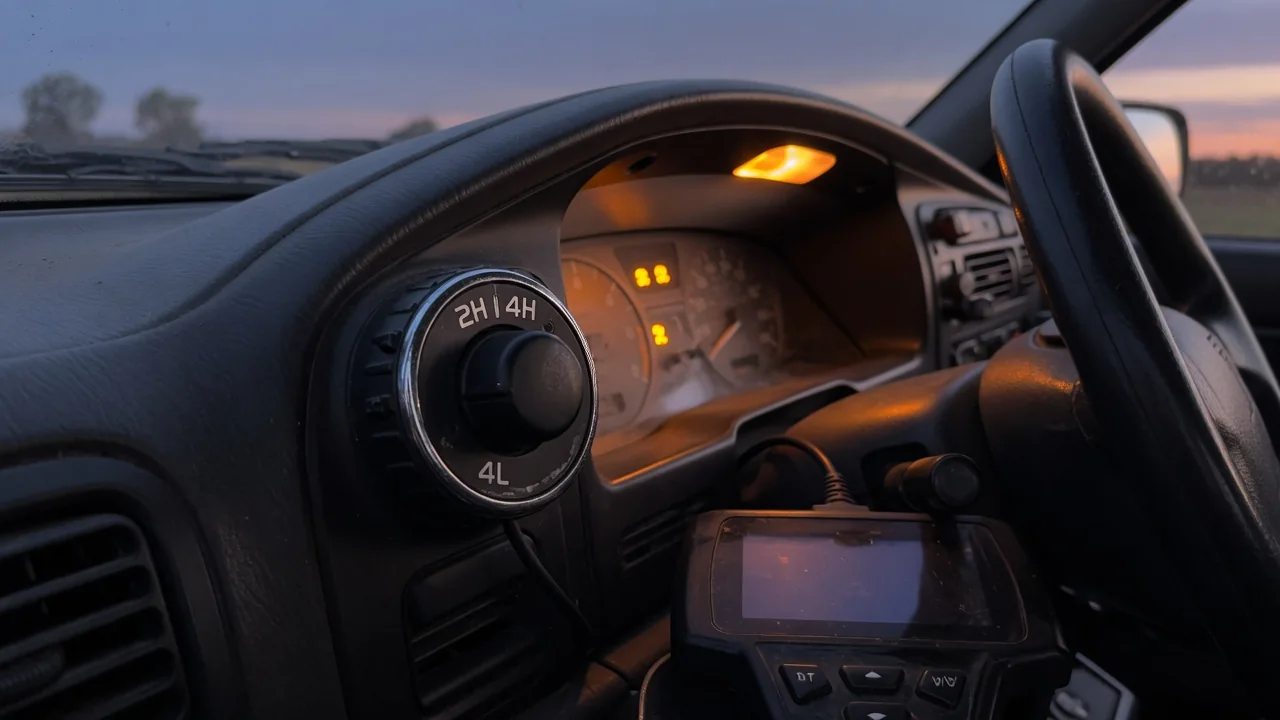
Diagnostic trouble codes P0800, P0835–P0838, P0856, and P2771 point to problems in the transfer case control system, four-wheel-drive selector switch circuits, and traction control signal exchange. These codes often appear together because the modules share switch states, sensor data, and network messages. A single corroded connector or a weak battery can trigger several codes at once. Generic code descriptions are only a starting point; manufacturers assign different meanings and setting conditions. Write down every stored code and freeze frame data before clearing anything, and verify each code against vehicle-specific service information.
How Transfer Case, 4WD Switch and Traction Input Codes Fit Together
These codes cover three related areas: the transfer case control system, the driver's 4WD mode and 4WD Low selector switch circuits, and signals shared between the traction control and powertrain modules. The transfer case control module monitors the selector switch, encoder motor, and range position sensor to engage or disengage 4WD modes. When it sees a problem, it can store a code and request the check engine light through the engine computer. The traction control module also monitors wheel speed and stability inputs, and it communicates with the powertrain modules over the CAN network.
Generic SAE code descriptions are only a starting point. Manufacturers can define, set, and name these codes differently, so a P0856 on one truck might mean a missing traction control message, while on another it could be a wheel speed sensor performance fault. Before interpreting any code, check the exact meaning for your vehicle model, engine, and transfer case option. This step prevents misdiagnosis and wasted parts. Codes often show up together because the systems share a switch, a connector, or a network message—not because every pairing is common. Write down all codes from every module and save freeze frame data before clearing.
P0800 Code: Transfer Case Control System MIL Request
P0800 generally means the transfer case control module has asked the engine computer to turn on the check engine light. It is a flag, not a root cause. The transfer case module stores its own fault codes in internal memory, and a basic engine code reader may not show them. You need a scan tool that can access the transfer case control module specifically. Without reading those codes, you are working in the dark. The check engine light is simply a request; the actual fault lives in the transfer case system.
Possible contributing areas include transfer case control faults such as an encoder or shift motor circuit problem, damaged wiring, loose or corroded connectors, poor module power or grounds, and communication problems on the CAN bus. A failing transfer case motor that cannot reach the commanded position will set a range or performance code, and then the module asks for the check engine light. Clearing P0800 without fixing the underlying transfer case fault will usually cause it to return. Always confirm the vehicle-specific setting conditions before replacing any part.
4WD Switch Circuit Codes P0836 to P0838, and Where P0835 Fits
Codes P0836 through P0838 are generic four-wheel-drive switch circuit faults. P0836 usually indicates a general circuit malfunction, P0837 a range/performance problem, and P0838 a low circuit input. Exact wording and setting logic depend on the manufacturer, so a P0837 on one vehicle might mean the switch signal is stuck, while on another it could be an intermittent switch. These codes all point to the driver's 4WD selector switch or its wiring. The module reads the switch position to know whether the driver wants 2WD, 4WD high, or 4WD low.
Generic tables often list P0835 under clutch pedal switch circuits rather than the 4WD switch. On many manual transmission vehicles, P0835 is the clutch pedal position switch circuit low. But on some four-wheel-drive systems, P0835 can be a manufacturer-specific transfer case switch code. You must confirm what P0835 means on your vehicle before assuming it relates to 4WD. Range/performance faults mean the signal is implausible or unexpected—like a switch reporting two positions at once—while a circuit low fault means the voltage sits below the expected range, often from a short to ground or an open circuit.
General causes include a worn or failed selector switch, damaged wiring or connectors, corrosion in the switch housing, poor grounds, a reference voltage problem, or a module fault. Do not assume one cause is more likely than another without testing. Related symptoms include a 4WD mode that won't engage or disengage, an indicator light that doesn't match the selected mode, or warning messages such as "Service 4WD." Sometimes the system will default to 2WD or refuse to shift into low range until the fault is corrected.
P2771 Code: 4WD Low Switch Circuit Range/Performance
P2771 generally points to an implausible or out-of-range signal from the 4WD Low switch circuit. The transfer case control module compares the Low switch signal with other inputs, such as transfer case position sensor feedback and vehicle speed. If the switch says the driver wants 4WD Low but the transfer case position sensor says the shift motor is still in high range, the module sees a mismatch and can set P2771. It may also set this code if the Low switch signal is intermittent during a shift attempt.
Possible symptoms include 4WD Low not engaging at all, a flashing or wrong Low indicator light, or shift requests being ignored. The module may lock out low range if it cannot confirm the transfer case has shifted. General areas to inspect include the Low switch or selector assembly, connector condition, wiring chafe points where the harness passes near the transfer case, and the related transfer case position input. A scan tool with live data can show whether the switch status changes when the driver selects different modes.
P0856 Code: Traction Control Input Signal
P0856 generally means the engine or transmission module saw a problem with a signal or message coming from the traction control or ABS system. The traction control module monitors wheel speed sensors and vehicle stability, and it sends a torque reduction request or a traction active message to the engine computer. If that message is missing, implausible, or corrupted, the powertrain module can set P0856. You must verify what P0856 means on your vehicle, because some manufacturers use it for a specific wheel speed sensor signal or a traction control torque request signal.
Because P0856 often originates in the ABS or stability control module, you need to scan that module too. The root fault may be stored there, such as a wheel speed sensor performance fault or a module internal failure. Possible symptoms include traction control or stability warning lights, reduced power in some situations, or changes in shifting behavior. These symptoms do not apply to every vehicle. Communication network problems, low battery voltage, and wiring or connector faults are general possibilities that need proper testing before replacing any module.
Symptoms and Safe Observations Before Diagnosis
Before diagnosis, make safe observations. Note which warning lights are on: check engine, 4WD, traction control, ABS, or stability control. Check whether the 4WD indicators match the selected mode. If you select 4WD High and the indicator flashes or shows 2WD, that is a clue. Observe whether the problem is constant or comes and goes. Record the conditions when the fault appears: after rain, on rough roads, after a cold start, or during a mode change. These details help a technician reproduce the fault.
Check that the battery and charging system are healthy. Low voltage can set several module codes at the same time because sensors and motors draw current and the modules monitor reference voltages. A battery that drops to 11 volts during a shift attempt can cause a range performance code. Do not drive hard or off-road when 4WD, traction control, or stability control warnings are on. Avoid repeatedly forcing mode changes. The system may be trying to protect itself from further damage. Instead, diagnose the codes before using the vehicle under load.
Diagnostic Direction and When Professional Testing Is Needed
A logical diagnostic order starts with confirming the vehicle-specific code definitions for every stored code. Then scan all modules, not just the engine computer. Review freeze frame data to see the conditions when the code set: vehicle speed, engine temperature, battery voltage, and gear position. Check for manufacturer service information that may describe known wiring chafe points or switch failures. Finally, inspect the related circuits: connectors, wiring, grounds, and reference voltages. This sequence prevents guessing and wasted parts.
Live data is essential. A scan tool that shows switch status, transfer case position, and traction control messages can tell a switch fault apart from a wiring or module fault. If the switch status changes correctly but the transfer case position does not, the problem is downstream. Guessing and replacing switches or modules based only on the code can waste money and leave the real fault in place. Professional testing is recommended for circuit and network diagnosis, transfer case motor or encoder checks, and any module programming. Work that involves lifting the vehicle or the drivetrain should be left to a qualified technician with proper equipment.