P0670, P0683 and P0684: Diesel Glow Plug Control Faults
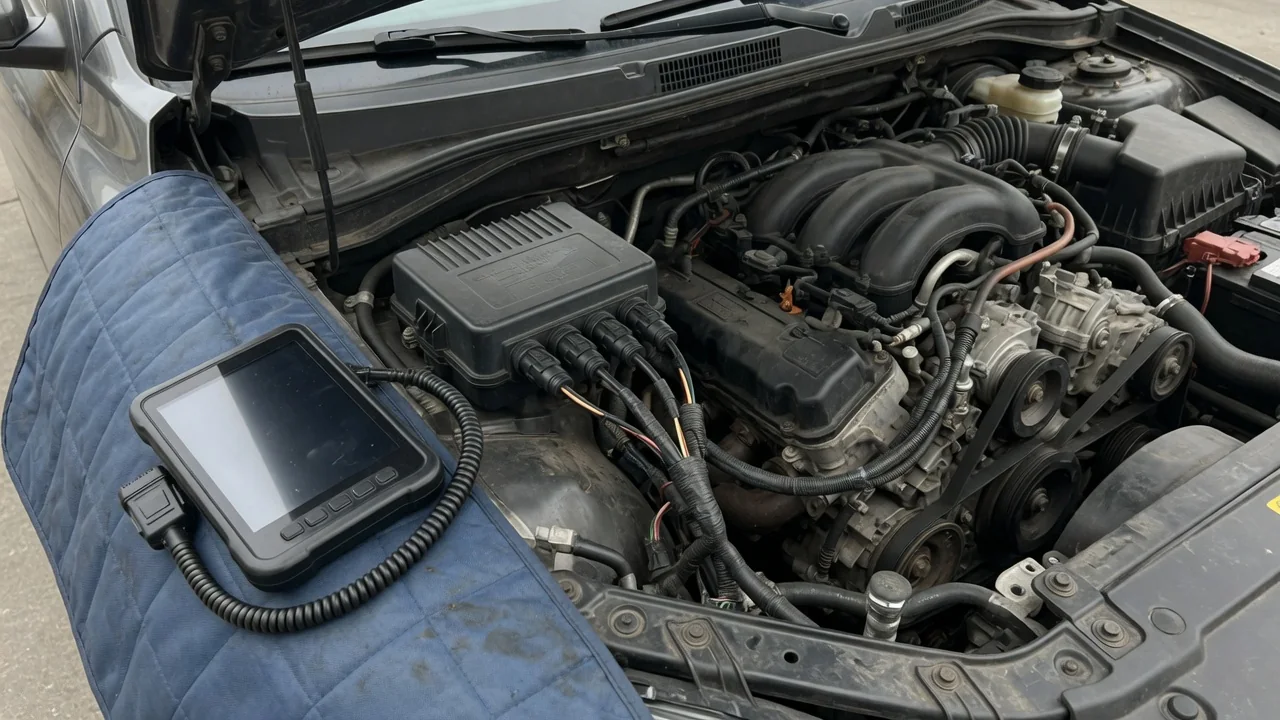
Diesel glow plug control faults such as P0670, P0683, and P0684 point to how the glow plug control module is commanded, powered, or talked to, not to a single failed heater. Cylinder glow plug circuit codes from P0671 through P0678 can appear with them. Cold-start symptoms may be obvious or almost absent. Exact wording, freeze-frame data, and the vehicle’s year, make, model, and engine must be confirmed before any part is blamed.
Confirm What P0670 Means for the Diesel Engine
On many diesel applications, a P0670 code is stored when the engine controller sees a problem in the glow plug control module control circuit rather than a proven heater failure. That module’s job is to command glow plug heating so the combustion chambers reach a temperature that supports ignition when the engine is cold. Because manufacturers do not all use the same wording, the stored definition and the diagnostic procedure must be confirmed for the vehicle’s year, make, model, and engine before the code is interpreted.
A control circuit finding is evidence of a monitored electrical condition, not proof that the glow plug control module itself has failed. Connectors, wiring, power, ground, or a related glow plug relay can produce the same stored result. Before anything is cleared, record all stored and pending codes, freeze-frame data, and any recent battery or electrical work. That snapshot shows whether the fault set during a cold start, after a voltage drop, or with companion cylinder glow plug circuit codes already present.
Understand the Communication Fault Reported by P0683
After the vehicle-specific definition is confirmed, P0683 typically refers to a glow plug control module communication circuit problem. The engine controller expects a valid exchange with the module; if that path is interrupted, the P0683 code can set even when individual heaters still work. Interrupted module power and ground, a corroded connector, or damaged communication wiring in the harness can all break that exchange. The same communication circuit can fail after a jump-start, a battery replacement, or water intrusion at a poorly sealed plug.
Identify the vehicle’s actual communication arrangement before treating P0683 as a network failure. Some engines talk to the glow plug control module over a dedicated line, a serial link, or another arrangement that only the manufacturer’s information identifies. Companion power-supply and communication codes change the testing sequence because a module that never wakes cannot answer, and a controller that never receives a reply cannot distinguish a silent module from a broken wire. That identification keeps diagnosis from chasing the wrong network.
Interpret P0684 Range and Performance Wording
Subject to vehicle-specific confirmation, P0684 is often described as a glow plug control module communication-circuit range and performance fault. Range and performance wording means a monitored signal or response fell outside the conditions the controller expects, not that a universal voltage or timing threshold was published for every diesel. The P0684 code can appear with P0683 when the link is present but unstable, delayed, or incomplete. That distinction matters because a noisy or intermittent communication circuit can still pass a simple continuity check.
Intermittent connections, supply problems, or a module that answers inconsistently can all warrant investigation without establishing that any one part has failed. Checking commanded operation and feedback may require suitable scan equipment and manufacturer diagnostic information so the technician can see whether the controller requested heat and whether the module acknowledged that request. Without that comparison, a range and performance result is only a clue that the communication circuit did not behave as the monitor expected during the recorded freeze-frame conditions.
Recognize Cold-Start Symptoms and Record Safe Observations
Cold-start symptoms associated with these faults can include extended cranking, a failure to start, rough running just after the engine fires, and a brief puff of exhaust smoke. A stored P0670, P0683, or P0684 code may still produce few obvious symptoms if the engine is already warm or if only part of the glow system is affected. Record ambient temperature, whether the engine was cold, warning-light behavior, and whether the symptom repeats. Those notes later help a technician match freeze-frame data to the actual start attempt.
Those observations alone cannot establish a glow plug fault, because fuel delivery, compression, battery condition, and other starting or combustion problems can produce the same hard-start pattern. Seek professional help for repeated no-start events, stalling, persistent heavy smoke, or signs of electrical overheating. Avoid repeated prolonged cranking, which can overheat the starter and further discharge a weak battery without proving what the control circuit or communication circuit actually did. A single difficult morning start is useful history, not a diagnosis of a failed heater.
Read Accompanying P0671 Through P0678 Cylinder Circuit Codes
When cylinder-specific codes accompany the module faults, P0671, P0672, P0673, and P0674 commonly refer to glow plug circuits for cylinders 1 through 4, while P0675, P0676, P0677, and P0678 cover cylinders 5 through 8 on engines that use those positions. Exact wording still has to be verified for the engine. Cylinder numbering must be confirmed before any physical plug is identified, because bank layout and firing order do not always match the number a parts catalog assigns to a replacement heater.
A cylinder circuit code can involve the plug, its connector, the wiring harness, or a module output and does not prove the plug needs replacement. Multiple cylinder codes stored with a module code warrant checking shared electrical supplies and controls without assuming one common cause. Two adjacent cylinders may share a harness section, while four or eight codes together more often point toward module power and ground, a glow plug relay, or a control circuit that never commanded heat. Each stored result still needs its own confirmation.
Evaluate Module, Relay and Wiring Causes Before Replacing Parts
Before any module or heater is replaced, evaluate module power and ground, circuit protection, harness condition, and glow plug relay function on vehicles that use a separate relay. Owner observations should stay limited to accessible wiring damage or loose connectors with the engine off and cool. Leave live electrical measurements to qualified technicians. Relay bypassing, feeding glow plugs directly from the battery, and probing energized high-current circuits are unsafe and can damage the control circuit or the module. Visible corrosion or a melted connector is useful evidence, not a complete diagnosis.
A technician should use vehicle-specific procedures to check battery condition, supply voltage, grounds, communication, and module output rather than substituting a part on suspicion. Repair confirmation includes watching for code recurrence and comparing starting behavior under the original cold conditions; clearing codes alone does not confirm a repair. If P0670, P0683, or P0684 returns on the next cold start, the communication circuit, control circuit, or a shared supply was not restored. If cylinder codes return on only one circuit, that path still needs isolated testing after shared power is proven sound.