P0613 and P0614 Codes: TCM Processor and Module Compatibility Faults
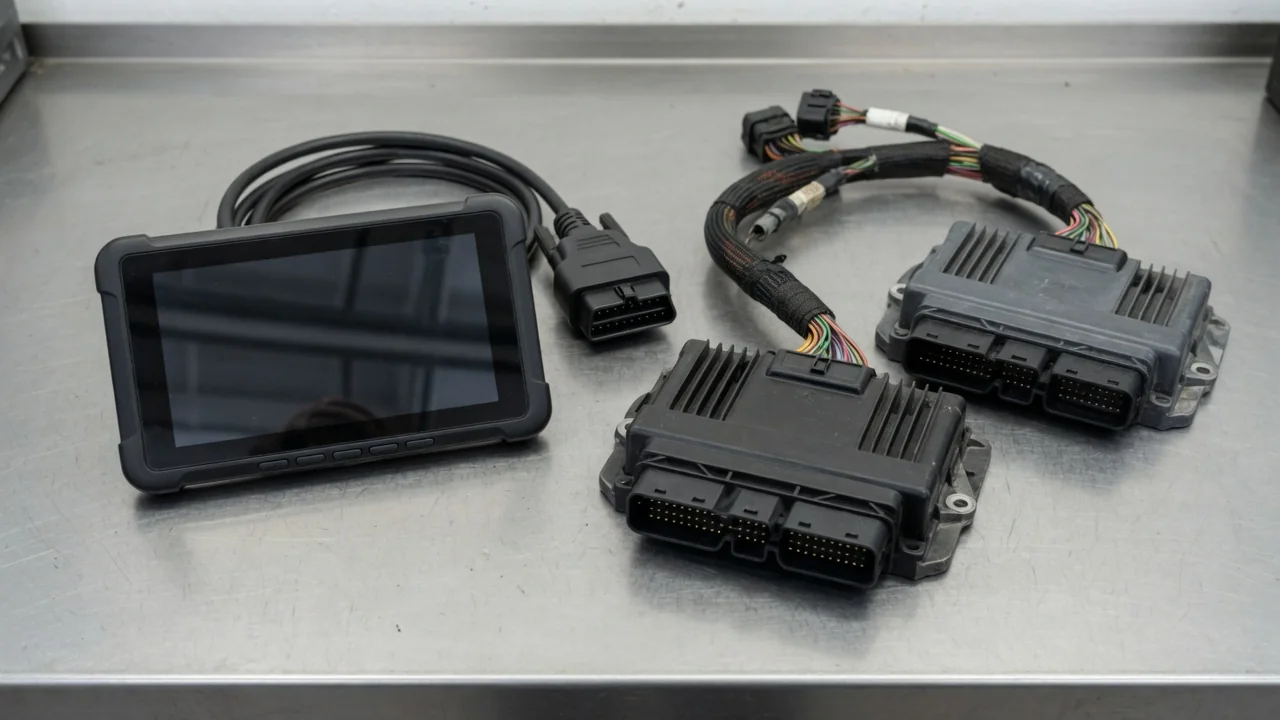
When a scan tool reports P0613 or P0614, the stored codes are a starting point, not a parts list. A P0613 code typically points toward a transmission control module processor concern, while P0614 generally involves engine control module and transmission control module compatibility. Both still need the exact year, make, model, and powertrain definition from service information, because a short scanner label can miss the diagnostic criteria that actually apply.
Verify What P0613 and P0614 Mean for the Vehicle
P0613 and P0614 are manufacturer-dependent diagnostic trouble codes, so the first useful step is confirming each code's official definition and enabling criteria for the vehicle in front of you. Service information for that year, make, model, and powertrain is the source that matters, not a generic scanner string. A basic scan tool may list P0613 as a transmission control module processor fault and P0614 as an ECM and TCM incompatibility, yet omit which modules are compared, how long the condition must be present, and which monitors set the result.
Treat those descriptions as evidence to interpret. A P0613 code does not, by itself, prove the transmission control module has failed internally or that replacement is required. Processor-related criteria can also be satisfied by voltage instability, incomplete control module programming, or communication faults that make the processor appear unresponsive. P0614 generally concerns module compatibility between the engine control module and the transmission control module, but the affected controllers, calibration identification checks, and compatibility rules still have to be confirmed on that application before any hardware is condemned.
Symptoms and Conditions to Record With a P0613 Code
A P0613 code may be accompanied by a malfunction indicator or transmission warning lamp, harsh or delayed shifts, restricted gear selection, limited transmission operation, or difficulty starting, but none of those signs is guaranteed on every vehicle. Some powertrains store the fault with little drivability change, while others limit transmission function as soon as the processor monitor fails. Record what the driver actually felt, when it started, and whether the concern is constant or intermittent, because that timeline later helps separate an internal processor issue from a power, ground, or programming problem.
Stored, pending, and active status should be captured with the rest of the scan report, along with any freeze-frame data the tool can retrieve while the vehicle is safely parked. Those snapshots show operating conditions at the moment the monitor ran; they do not independently identify a failed part. Note whether symptoms began after a dead battery, charging-system trouble, electrical work, module replacement, or a programming attempt. That history is especially relevant when P0614 is also present, because an incomplete calibration or mismatched module pairing can set compatibility faults without a mechanical transmission failure.
Why These Codes Can Appear After Module Replacement
A replacement transmission control module or engine control module can physically bolt in and still be the wrong hardware or software for the vehicle. Fitment of connectors and mounting points does not establish module compatibility. Before any further parts are ordered, the installed unit needs application-specific identification: part information, hardware level, calibration identification, and the manufacturer-specified configuration steps. A used or remanufactured module that came from a similar-looking donor can carry a different software package or transmission calibration, which is enough to set P0613 or P0614 after installation.
Incomplete control module programming is another possibility when these codes appear after a swap, but replacement history alone does not prove that programming is the cause. The session may have been interrupted, the wrong calibration selected, or a required setup routine skipped, leaving the processor or the module pairing incomplete. Conversely, a correctly programmed original module can still report P0613 if module power and ground were disturbed during the work. Investigate identification, software status, and configuration against service information rather than assuming the new part is either good or bad.
What Professional Testing Needs to Establish
Professional diagnosis should evaluate module power and ground, and the related wiring, before condemning an internal processor. Low supply voltage, a high-resistance ground, or an intermittent feed can make a transmission control module look as if its processor has failed and can also disturb the engine control module handshake that P0614 monitors. Accompanying low-voltage or communication faults should influence the test order, because they may explain why the processor monitor ran, but they do not prove a single shared root cause until each circuit and each module is checked against that vehicle's diagrams.
Once supplies are stable, a technician still needs to verify module communication, identification, and software status using vehicle-specific service information. That includes confirming the scan tool can address the transmission control module, that reported calibration identification matches the file specified for the powertrain, and that any required configuration completed. Control module programming, when indicated, belongs on appropriate equipment with a stable power source and the prescribed procedure. Do-it-yourself flashing or exploratory probing of control circuits is not a safe substitute, because an interrupted write or a shorted data line can add faults rather than clear them.
Safe Next Steps and Confirmation After Repair
Owners should limit their own observations to dashboard messages, when symptoms started, available service records, and scan information that can be read while the vehicle is safely parked. If shifting becomes unpredictable or the vehicle loses propulsion, stop in a safe place and arrange assistance rather than continuing to drive. Bring the original scan report, any replacement-module invoices, and notes about a recent programming attempt to the shop. Those documents help the technician see whether P0613, P0614, or both were present before work began and whether module compatibility was already in question.
Successful repair is not shown by a cleared memory alone. Confirmation should follow the manufacturer-required checks for that powertrain, then reassess code status for P0613 and P0614 after the specified verification routine. The original symptoms, including warning lamps, abnormal shifting, restricted operation, or starting trouble, need to stay resolved under the same conditions that first produced them. If P0613, P0614, or related communication faults return, the processor or compatibility concern has not been closed, and further evaluation of programming, supplies, or module identification is still required.