P0600 Code: Communication Fault Symptoms and Diagnosis
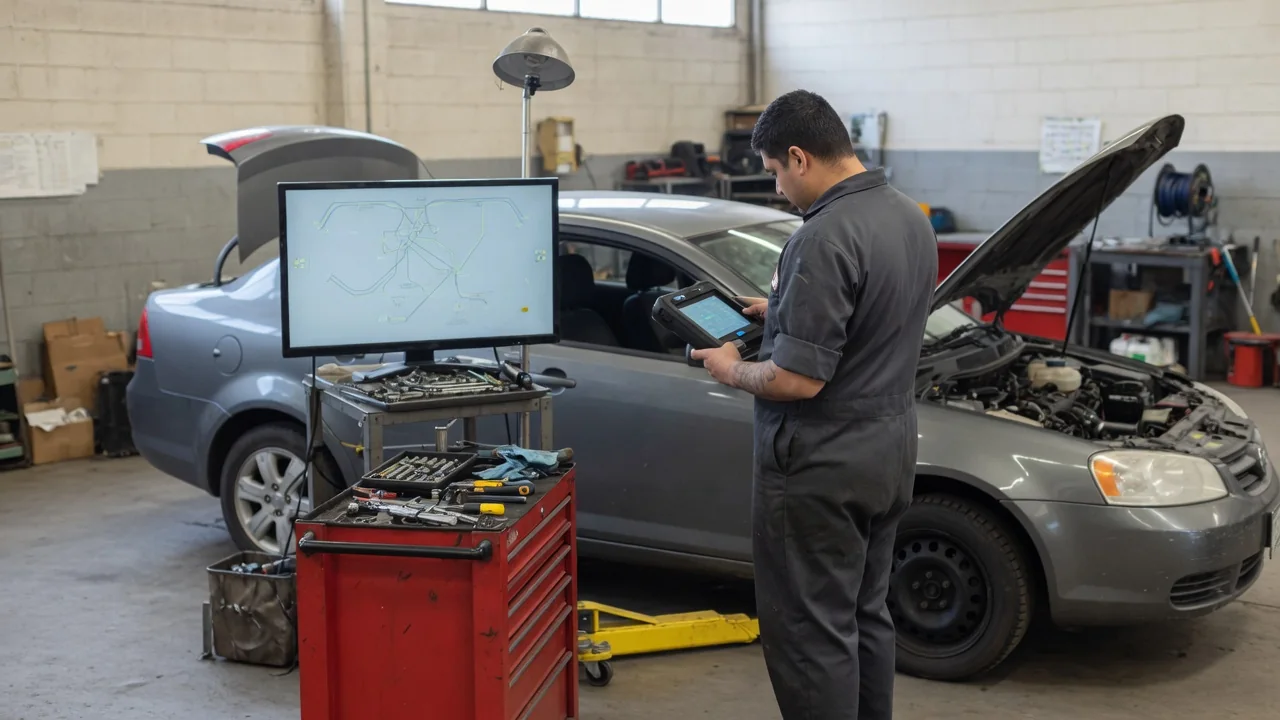
The P0600 code is a diagnostic trouble code that flags a problem on the vehicle data network rather than a single sensor reading. It is commonly described as a serial communication link malfunction, meaning control modules are not exchanging information as expected. The stored result is evidence to interpret, not proof a particular module failed. Confirm the manufacturer definition for the year, make, model, and powertrain first.
What P0600 Means on Your Vehicle
On many vehicles, P0600 is described as a serial communication link malfunction. That phrasing means one or more control modules did not complete expected data exchange over a communication link. Modules share information through those links so engine, transmission, body, and other systems can coordinate. The layout of the vehicle data network depends on the year, make, model, and powertrain, so the same code can refer to different buses or module groups from one vehicle to another.
Because of that variation, the code definition and the conditions that set it must be verified in vehicle-specific service information before the fault is interpreted. P0600 by itself does not identify a failed module, a damaged wire, a connector problem, or a particular network branch. It only reports that communication did not occur as the control strategy expected. A technician still has to determine which modules were involved, whether the loss was continuous or intermittent, and what physical or electrical condition interrupted the serial communication link.
Symptoms and When to Stop Driving
A module communication fault may turn on a warning lamp, store a message, or leave some functions unavailable. Some drivers notice hard starting, irregular engine behavior, or unexpected transmission operation when modules cannot share live data. Others see no obvious change while the diagnostic trouble code is stored. Because communication architecture differs by vehicle, none of these symptoms is guaranteed. An intermittent communication loss can come and go with vibration, temperature, or moisture, so the complaint at the moment of driving may not match what was captured in memory.
The P0600 code alone cannot establish whether continued driving is safe. If the vehicle stalls, loses propulsion, or develops impaired steering or braking, stop in a safe location and arrange assistance rather than trying to finish a trip. Those conditions can appear when modules that support powertrain or chassis control drop off the vehicle data network. A stored communication fault with no current drivability change is a different situation and still needs diagnosis, but it does not by itself prove an imminent failure or prove that a control module has already failed.
Possible Sources of the Communication Fault
Control modules need stable supply voltage and intact grounds to stay on the serial communication link. Low battery voltage, a poor ground, a blown fuse, or an interrupted power feed can make a healthy module look silent on the scan tool. Unstable voltage during cranking or after a deep discharge can also drop modules off the network long enough to set P0600. Before any module is condemned, power and ground integrity at the involved controllers deserves attention because communication cannot occur if a module is not powered as designed.
Damaged wiring, loose connectors, corrosion, and moisture are common physical reasons a communication circuit fails. Chafed harnesses, bent terminals, or water in a junction can interrupt the vehicle data network without destroying a module. An internal module failure remains possible, but it is only one of several explanations and requires testing rather than assumption. Recent electrical work, battery replacement, or added aftermarket equipment is useful history because it can disturb connectors or introduce extra loads, yet that history does not by itself prove the work caused the stored module communication fault.
Safe Observations to Record Before Service
Before a shop visit, write down warning messages, lamps, and any change in starting, shifting, or accessory operation, and note whether the problem appeared during cranking or after the vehicle was already running. Record recent battery discharge, jump-starting, water exposure, or electrical repairs, because those events often precede an intermittent communication loss. Save any scan results and the status of the diagnostic trouble code, including whether it is current or stored in history. Do not clear codes first; clearing erases freeze-frame and companion information that helps a technician reconstruct the event.
A basic code reader may not reach every control module on the vehicle data network, so a blank screen or a single P0600 result is not a complete picture. Owner inspection should stay limited to visible damage or moisture in readily accessible areas with the vehicle off and the ignition locked out. Look at obvious harness routing and connector boots without separating terminals. Connector disassembly, backprobing, and electrical measurements belong with a qualified technician who has the diagrams and the equipment to protect the serial communication link from accidental damage.
How a Technician Traces P0600
Professional diagnosis starts with the service information for that vehicle, including the published code definition, setting conditions, wiring diagrams, and the list of modules that share the affected communication link. A scan tool that can address the relevant controllers is then used to see which modules respond, which do not, and which companion codes are stored. Those responses establish direction: a silent module, a network-wide dropout, or a link that fails only under certain operating conditions. Without that vehicle-specific map, swapping parts is guesswork.
Battery condition and module power and ground are typically verified before any control module is condemned, because a controller that is not powered cannot talk. Technicians then evaluate the communication circuit with methods suited to that network, looking for opens, shorts, and loading that prevent serial data from reaching other modules. Intermittent faults may require monitoring during the conditions that originally set P0600, such as heat, moisture, or vibration. None of that work requires the owner to probe, jumper, or disconnect network wiring; those steps belong in a shop environment with the correct procedures.
Repair Decisions and Confirmation
Repair choices should follow confirmed findings, which may be a connector, a section of wiring, a power or ground fault, or a control module that has actually failed testing. The P0600 code alone does not justify replacing a module, because a silent controller is often the victim of supply or network problems rather than the root cause. If a module does need replacement, programming or configuration requirements must be checked for that specific vehicle; some controllers will not communicate correctly until they are coded to the rest of the network.
Confirmation is more than erasing the diagnostic trouble code. After the repair, a technician should verify that the involved modules communicate on the vehicle data network, rescan for returning faults, and confirm that the original symptoms are gone under safe operating conditions. Clearing P0600 or seeing temporary restoration after a battery reset does not prove the underlying communication fault is repaired. If the serial communication link remains unstable, the code or the drivability complaint can return once the same voltage, moisture, or mechanical condition reappears.