P0600 and P0607–P0610: PCM Communication, Performance and Output Codes
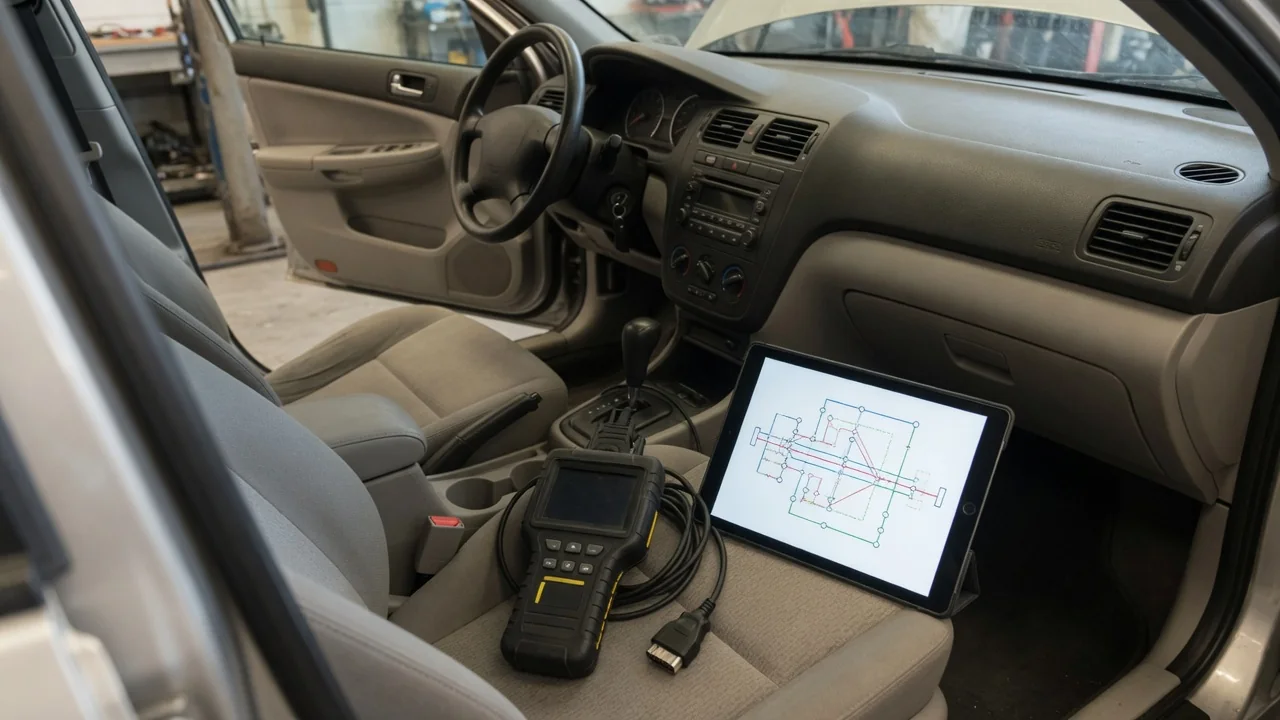
When a scan tool reports P0600, P0607, P0608, P0609, or P0610, the codes point to a serial communication link, control module performance, vehicle speed output, or vehicle options configuration rather than a single failed part. These manufacturer-dependent codes require confirmation of definition and procedure for the year, make, model, and reporting module. Wiring, network communication, module power supply, ground connections, and module programming all belong in the investigation.
P0600: Establish the Scope of the Communication Fault
P0600 is commonly described as a serial communication link concern, but that label is not a substitute for the vehicle-specific definition. Before interpreting any code in this group, confirm the official description and diagnostic procedure for the year, make, model, and the module that stored the fault. The code indicates a communication problem on a data path, not a named failed module and not a particular network architecture. Different platforms use different buses, gateways, and message sets, so treating P0600 as a universal network failure leads to the wrong path.
Warning lights, missing live data, and drivability complaints can accompany a serial communication link fault, yet their presence depends on which communication path is affected. One vehicle may show a check-engine lamp and lost cluster information; another may have no obvious warning if the interrupted messages do not drive a displayed function. A complete module scan, related communication codes, and the list of modules that still respond help locate the break. Modules that answer the scan tool, modules that do not, and companion network codes together map the fault more usefully than P0600 in isolation.
P0607: Investigate Control Module Performance
P0607 is typically associated with control module performance, meaning the reporting controller detected an internal processing or rationality concern under the vehicle's diagnostic criteria. That description is evidence to interpret, not proof that the powertrain control module needs replacement. Some vehicles illuminate a warning lamp, reduce power, stall, or become difficult to start; others may set the code with little obvious drivability change. Symptom lists cannot be assumed across platforms, so the diagnostic procedure for that controller, not a generic performance story, decides what the code actually measured.
Module power supply, ground connections, software status, and associated codes deserve evaluation before anyone condemns internal module electronics. Low or unstable voltage, a poor ground, incomplete module programming, or a related communication fault can produce a performance code without a failed processor. Useful history includes a discharged battery, a jump-start, water exposure, or recent electrical work, recorded as timing context rather than proven causation. Those events often coincide with P0607, yet coincidence is not diagnosis; freeze-frame data and the rest of the scan still have to show how the controller was operating when the code set.
P0608: Trace Vehicle Speed Output A
P0608 refers to control module vehicle speed output A, a designation that only becomes useful after vehicle documentation identifies what output A serves. On one application the circuit may feed a cluster, antilock module, or transmission controller; on another it may serve a different receiver. The code alone does not establish a failed wheel speed sensor, vehicle speed sensor, or control module. Output A is a generated or passed signal, so the fault may live in the source module, the wiring, a connector, or the device that is supposed to receive that speed information.
Speed-display or speed-dependent functions may misbehave only where the vehicle's circuit design actually uses that output. A wrong speedometer reading, inoperative cruise control, or a related transmission shift complaint can appear when those systems rely on vehicle speed output A, but dashboard oddities do not by themselves prove the circuit is at fault. Technicians use wiring information, scan data, and signal testing to evaluate the source module, the output circuit, and the receiving device. Comparing commanded or reported speed with what the downstream module actually sees separates a missing output from a display or sensor problem elsewhere.
P0609: Identify the Vehicle's Speed Output B Circuit
P0609 is the companion control module vehicle speed output B code, and the B designation requires vehicle-specific circuit identification just as output A does. Documentation, not the code number, identifies which wire, connector cavity, and receiving device belong to output B. Dashboard behavior alone cannot establish whether that designated output is working correctly, because a cluster may receive speed from a different path, a gateway, or another output. A working or failed speedometer therefore does not confirm or clear P0609 without matching the circuit that the manufacturer actually assigned to output B.
Related codes and the functions that actually fail help a technician identify the relevant receiving module and wiring path for vehicle speed output B. If an antilock, transmission, or body controller reports missing speed while the instrument cluster remains normal, the B circuit is more likely the shared or dedicated feed those modules use. Circuit loading, connector condition, and module output operation still require appropriate professional testing before parts are selected. A loaded circuit, a corroded pin, or an output that cannot drive the receiver can set P0609 without a defective sensor or a failed control module.
P0610: Verify Vehicle Options and Module Configuration
P0610 is described as a control module vehicle options error after its application to the vehicle is confirmed. The code generally means the controller sees a mismatch between expected vehicle options configuration and what it is reading, coding, or comparing internally. Configuration, coding, and replacement-module history are diagnostic leads, not proof that recent programming caused the fault. A newly installed controller, an interrupted flash, or an incomplete option setup can coincide with P0610, yet the same code can appear after a power loss or when installed equipment no longer matches the stored configuration.
Module identity, installed equipment, calibration, and configuration must be checked against manufacturer information rather than assumed from a parts catalog or a previous repair order. A controller that belongs to a different equipment package, or one that never received the correct calibration, can report a vehicle options error even though the hardware looks physically correct. Professional configuration verification, and any required module programming, belong with the applicable service information. Compatibility between modules is vehicle-specific and should not be asserted from the code; option settings should not be altered except as the manufacturer procedure directs.
Safe Observations and the Evidence Needed Before Repair
Before any codes are cleared, record all stored and pending faults, their status, available freeze-frame data, observed symptoms, and recent service history. That snapshot is the only way later testing can be compared with the conditions that set P0600, P0607, P0608, P0609, or P0610. Owner checks should stay limited to safe observations with the vehicle parked and switched off, such as visible harness damage, flooded carpets, or moisture in accessible areas. Connector probing and module disassembly are not owner tasks; they risk opening circuits, spreading corrosion, or creating new network communication faults.
Technicians assess module power supply and ground integrity under the conditions the diagnostic procedure specifies, because a single battery-voltage reading cannot rule out an intermittent supply problem. Voltage drop, load, and key-on versus cranking behavior can expose a supply that looks normal at rest. If stalling, severe power loss, or other symptoms make driving unsafe, stop safely and arrange assistance; a stored code by itself does not declare the vehicle safe to continue. Repair is confirmed through the applicable diagnostic procedure, a follow-up scan, and verification that affected communication, speed, and configuration functions operate correctly.