P0544, P0545 and P0546: Exhaust Gas Temperature Sensor Circuit Codes
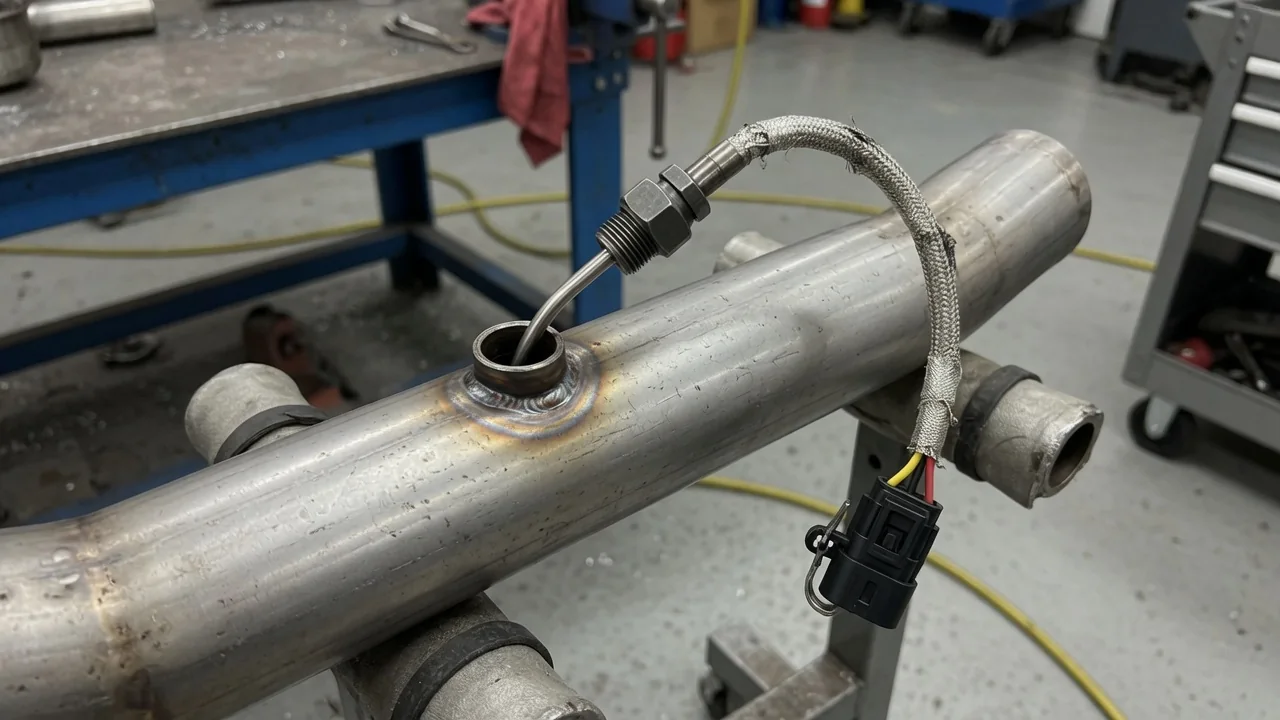
P0544, P0545, and P0546 commonly identify exhaust gas temperature sensor circuit faults at bank 1 sensor 1. A related P0547 code often points to a different sensor on the same bank. These faults can affect diesel particulate filter regeneration and power when the module lacks trustworthy temperature information. Confirm each definition in vehicle-specific service information; a circuit code is evidence to interpret, not proof the sensor failed.
What P0544 Means and Why Vehicle Details Matter
The P0544 code is commonly assigned to an exhaust gas temperature sensor circuit fault for bank 1 sensor 1. That assignment is not universal, so the applicable service information must confirm the definition, enable criteria, and which circuit the module is actually monitoring. Manufacturer-dependent codes require vehicle-specific confirmation because exhaust layouts, sensor counts, and control strategies differ. Treating a generic description as a final diagnosis can send inspection to the wrong harness, the wrong sensor, or a component that is not even installed on that vehicle.
Bank numbering typically distinguishes cylinder banks, and sensor numbering usually follows exhaust flow, but the exact location of bank 1 sensor 1 must come from the vehicle's exhaust layout and sensor location diagram. The P0544 code, like other EGT sensor circuit codes, reports a monitored electrical condition. It does not establish that the exhaust gas temperature sensor itself has failed. Open or shorted sensor wiring, damaged connectors, harness chafe near the exhaust, or a control-module input problem can set the same fault and must be considered before replacing the sensor.
Understanding the P0545 Low-Input Fault
A P0545 code is commonly assigned to bank 1 sensor 1 exhaust gas temperature sensor circuit low input. As with P0544, the wording, enable conditions, and voltage or signal thresholds belong to the vehicle's service information and should be confirmed before interpreting the result. Circuit low input means the control module saw an electrical signal below the expected range for that EGT sensor circuit. The P0545 fault is therefore a circuit observation, not a stand-alone statement about engine load, aftertreatment strategy, or any particular exhaust temperature value.
Low input does not establish that exhaust temperature is physically low. On many systems a shorted signal wire, a grounded circuit, a failed sensor element, or a connector that pulls the input toward a low voltage can produce the same P0545 reading. The applicable circuit design determines how those failures appear, because some EGT sensors are thermistors and others use different signal strategies. Without the correct wiring diagram, a low-input result can be mistaken for a cold exhaust stream when the actual problem is electrical.
Understanding the P0546 High-Input Fault
The P0546 code is commonly assigned to bank 1 sensor 1 exhaust gas temperature sensor circuit high input. Confirm that definition and the fault criteria for the specific vehicle before treating P0546 as a temperature event. Circuit high input means the monitored electrical signal rose above the expected range for that EGT sensor circuit. In practice, P0546 is often the counterpart to P0545 on the same bank 1 sensor 1 circuit, describing a different electrical extreme. The module is reporting signal range, not measured proof of exhaust overheating.
High input alone does not prove the exhaust is overheating. On applicable systems an open circuit, a failed sensor, or a connector that lets the input float high can produce an implausible signal that still stores P0546. Freeze-frame data and accompanying codes help separate an intermittent electrical fault from a temperature concern that needs further investigation. Note whether the P0546 code set at idle, during boost, after a cold start, or with other aftertreatment faults. Those recorded operating conditions show whether the circuit failed in a repeatable electrical pattern or during a thermal event.
Locating the Circuit Identified by P0547
A P0547 code commonly refers to the bank 1 sensor 2 exhaust gas temperature sensor circuit rather than bank 1 sensor 1. That distinction matters because P0544, P0545, and P0546 are frequently associated with the upstream sensor on bank 1, while P0547 points to a different station along the same bank. Vehicle-specific confirmation is still required before identifying the component, because numbering, sensor count, and circuit names are manufacturer-dependent. Using a P0547 definition copied from another platform can send diagnosis to the wrong EGT sensor circuit.
The vehicle's sensor location diagram is the reliable way to find the circuit identified by P0547. Do not apply bank 1 sensor 1 wiring, connector, or live-data guidance to sensor 2 simply because both codes mention exhaust gas temperature. Each EGT sensor circuit has its own path through the harness, its own enable criteria, and its own diagnostic procedure. Treat P0547 as a related identification code: confirm which sensor it names, then diagnose that circuit on its own rather than assuming a shared failure with P0544, P0545, or P0546.
Possible Effects on Regeneration, Power and Driving
A stored EGT sensor circuit fault may illuminate a warning light, command reduced engine power, or produce few noticeable symptoms, depending on the control strategy. Not every vehicle responds the same way. On diesel particulate filter-equipped vehicles, unreliable exhaust temperature information can restrict or interrupt regeneration because the module cannot confirm that the filter is in a safe thermal window. Regeneration may be delayed, aborted, or never commanded while the circuit fault remains. Power and aftertreatment behavior should be judged from the actual vehicle response, not from a generic code list.
A regeneration warning or power restriction needs prompt assessment rather than continued driving in the hope that the light will go out. If the vehicle shows severe power loss, unusual smoke, or an overheating warning, stop safely and follow the owner's manual. Clearing P0544, P0545, P0546, or a related P0547 code does not repair the underlying EGT sensor circuit fault, and attempting forced regeneration with unreliable temperature data does not restore circuit integrity. Regeneration decisions require appropriate professional assessment so the filter is not commanded into a thermal event the module cannot monitor.
Safe Observations and Professional Sensor Testing
Before clearing anything, record all codes, freeze-frame data, and symptoms, including whether the fault appeared after exhaust work, sensor replacement, or sensor wiring disturbance. Freeze-frame snapshots of load, temperature, and speed show the conditions under which the circuit failed. Owner inspection should stop at accessible wiring and connectors with the vehicle off and the exhaust fully cool. Do not reach near hot components or crawl under an unsupported vehicle. Visual connector damage, melted insulation, or a disconnected EGT sensor plug can be useful observations, but they are not a complete circuit test.
Professional testing compares live temperature data for plausibility, inspects connector condition, and checks circuit integrity with the correct wiring diagram and manufacturer specifications. Confirm the sensor technology before any resistance or electrical test; universal resistance values, improvised power application, and bypass methods are not appropriate. After a repair, verification should show plausible live temperature data and completed fault-monitor checks for the EGT sensor circuit. A warning light that goes out after a code clear does not, by itself, establish that P0544, P0545, or P0546 has been resolved.