P0423–P0429 and P0433–P0439 Catalyst Codes Explained
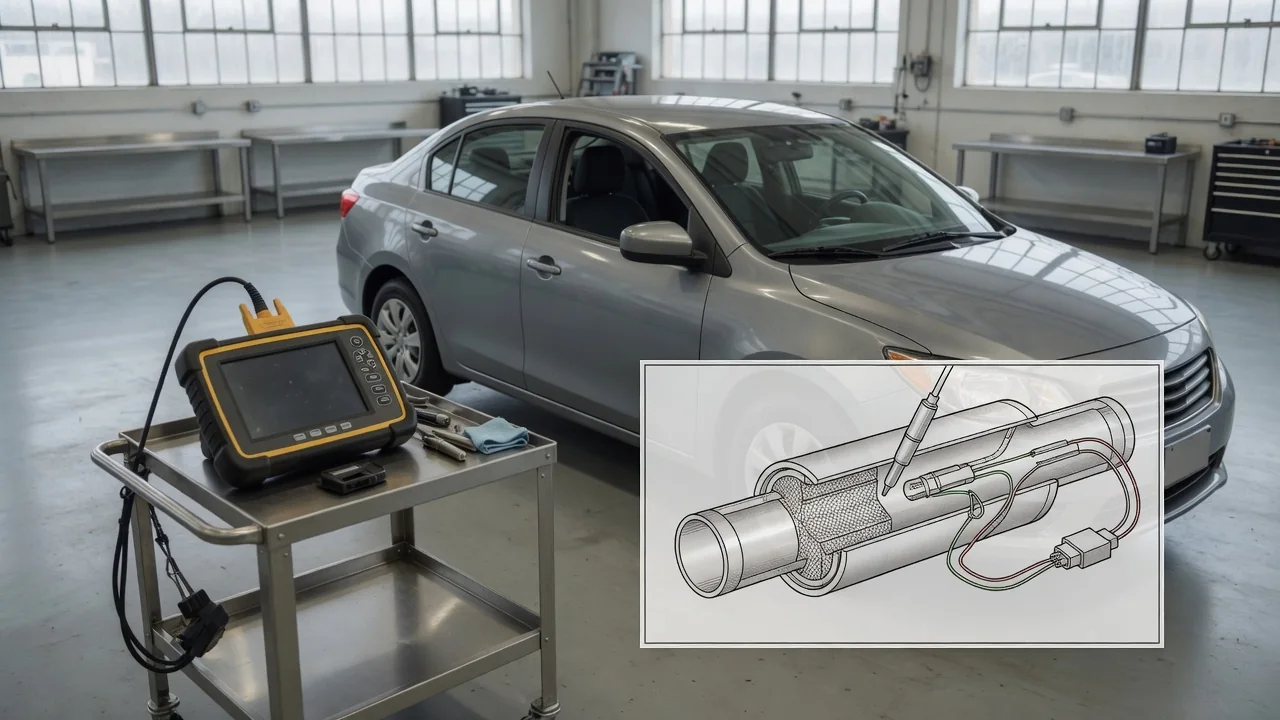
These diagnostic trouble codes cover catalyst temperature sensor circuit, range, low, high, and heater issues on bank 1 and bank 2. A stored code such as P0429, P0425, or P0433 is evidence of a monitored condition, not proof that a catalyst or sensor has failed. Confirm the exact description and the catalyst hardware fitted to the vehicle before interpreting any of these faults.
Confirm the code definition and catalyst system fitted to the vehicle
The first step is to verify the exact definition and diagnostic procedure for the vehicle's year, make, model, engine, and emissions configuration. Manufacturer-dependent descriptions can differ, so a P0429 code or a P0433 code must be read against that vehicle's service information. A stored code identifies a monitored condition. It does not establish which component needs replacement, and parts should not be ordered from the code number alone.
Bank 1 contains cylinder 1; bank 2 is the opposite bank on a V-type or opposed engine. Locating each bank and any numbered catalyst temperature sensor requires vehicle-specific information. Before component tests, establish whether the vehicle uses a dedicated temperature sensor, calculated catalyst temperature, or a heated catalyst system. That architecture decides which circuits, heater control paths, and temperature threshold monitors apply, and it prevents treating every P0425 or P0435 as the same hardware problem.
P0425–P0428: Bank 1 catalyst temperature sensor faults
On many vehicles, P0425 identifies the bank 1 catalyst temperature sensor circuit, P0426 range and performance, P0427 low circuit input, and P0428 high circuit input. Those descriptions still need vehicle-specific verification. A P0425 code, P0426 code, P0427, or P0428 code means the module saw an electrical or plausibility problem. Low and high circuit input describe the signal condition and do not independently establish actual catalyst temperature.
Possible causes include a failed sensor, damaged exhaust wiring, poor connections, and supply or ground faults, all requiring testing. Heat and corrosion around the converter can open or short the circuit without the catalyst being at fault. Range and performance diagnosis for a P0426 code needs operating conditions and signal plausibility checks before assigning a cause. Compare freeze-frame data with expected warm-up and load behavior rather than condemning the sensor from one snapshot.
P0435–P0438: Bank 2 catalyst temperature sensor faults
The bank 2 counterparts follow the same pattern: P0435 identifies the catalyst temperature sensor circuit, P0436 range and performance, P0437 low circuit input, and P0438 high circuit input, subject to vehicle-specific verification. A P0435 code, P0436 code, P0437, or P0438 should be confirmed against the engine and emissions configuration, because not every layout supports a bank 2 temperature monitor. Identify those components from service information rather than assuming a mirrored sensor.
Exhaust heat, connector damage, and circuit faults can distort the reported signal without proving sensor failure. Wiring that shares a harness with oxygen sensors or heater circuits may set related electrical codes that belong in the same diagnosis. Scan-tool temperature values for bank 2 may be unsupported, substituted, or calculated, so their source and validity must be established. If the displayed value is calculated, chasing a physical sensor that is not fitted will not correct the monitor.
P0429 and P0439: Catalyst heater control circuit codes
After confirming vehicle-specific meaning, P0429 is typically a bank 1 catalyst heater control circuit fault, and P0439 is the bank 2 counterpart. A P0429 code or P0439 code points to that control path, not automatically to catalyst efficiency. Catalyst heating on some designs brings the converter to operating temperature sooner and supports emissions readiness. Identify the heater architecture first, because some vehicles use a dedicated heated catalyst and others do not fit that hardware.
Possible fault areas include the power supply, exhaust wiring, connections, control components, and the heater assembly. None of those should be assumed compatible across models, and a heater control code alone does not establish catalyst failure. Powered circuit testing belongs with qualified technicians using the applicable procedure, because these circuits can carry substantial current beside a hot exhaust. Confirm commanded heater operation and circuit integrity before replacing a converter or heater element.
P0423, P0424, P0433, and P0434: Heated catalyst threshold codes
Standard descriptions treat P0423 as heated catalyst efficiency below threshold on bank 1 and P0433 as the same monitor on bank 2, with vehicle-specific verification required. P0424 and P0434 are commonly described as heated catalyst temperature below threshold for those banks. A P0423 code, P0424 code, P0433 code, or P0434 code is a monitor result, not a parts list. Investigation should cover enabling conditions, temperature information, and whether catalyst heating operated as commanded on the drive cycle that set the fault.
Related engine faults, exhaust leaks, measurement problems, and catalyst condition may need evaluation before replacement is recommended. An upstream misfire, mixture error, or leak ahead of the converter can keep temperature or efficiency from meeting the threshold even when the catalyst is intact. A temperature sensor circuit fault such as P0426 or P0436 can also make a below-threshold result look like a converter problem. Confirm that heating and sensing are valid before treating heated catalyst efficiency as a failed brick.
Symptoms and safe observations before arranging diagnosis
The most common driver-facing sign is a check-engine light. Emissions-test consequences can follow if the lamp is on or if emissions readiness monitors have not completed. Many drivers notice no change in operation, because a catalyst temperature sensor or heater control circuit fault can be electrical rather than a drivability problem. Rough running, reduced power, unusual exhaust odor, or excess heat can indicate accompanying issues without identifying the failed component.
Record when the warning appeared and any recent repairs, including exhaust, oxygen sensor, or wiring work that could disturb the circuit. Limit visual observations to accessible areas with the vehicle off and fully cooled. Do not touch hot exhaust parts or work beneath an unsupported vehicle. If a flashing warning light appears with rough running, smoke, or severe heat symptoms, stop safely and arrange assistance rather than continuing as a diagnostic shortcut.
What professional testing should establish before parts are replaced
Professional diagnosis should start with a complete code scan and preservation of freeze-frame data before faults are cleared. Related engine, fuel, oxygen sensor, and electrical codes belong in that snapshot because they can explain a catalyst temperature or heater control result. Circuit integrity, sensor signal plausibility, and commanded heater operation then need verification using manufacturer procedures. A single temperature reading or resistance measurement is not enough to condemn a sensor, especially when the circuit fails only under heat.
Intermittent P0428 or P0438 high circuit input, and intermittent low circuit input on P0427 or P0437, may appear only under the freeze-frame operating conditions. Those conditions should be reproduced rather than tested only at a cold shop temperature. After repair, confirmation requires the specified monitor procedure and emissions readiness checks; clearing a code alone does not verify the fix. If P0423, P0429, or a P0439 code returns, the enabling criteria and heater control circuit still need another pass before more parts are replaced.