P0355–P0361 and P0363: Ignition Circuit and Misfire Codes
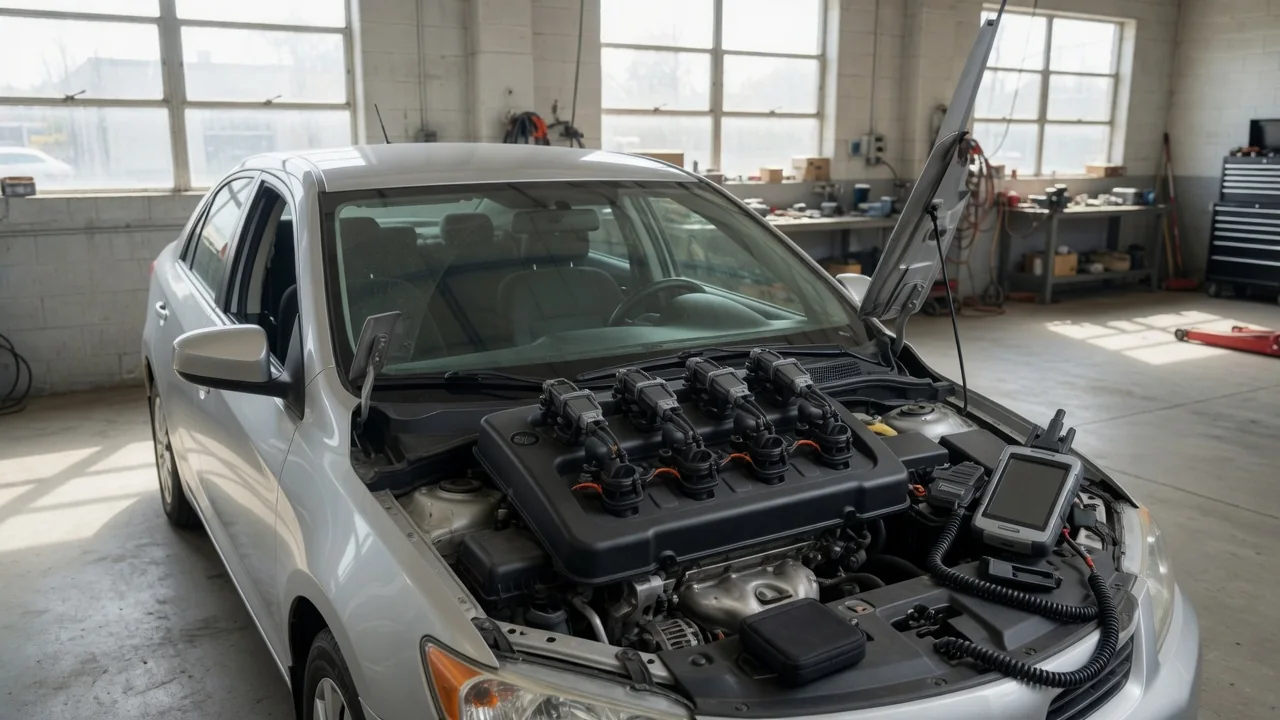
The P0355 code and its neighbors P0356, P0357, P0358, P0360, and P0361 report a monitored primary or secondary ignition circuit on a coil-on-plug engine, typically coils E through K. A P0363 code is different: the controller recorded misfire detection and disabled fueling on a cylinder. None of these codes, by themselves, prove a coil has failed. Confirm the exact description and cylinder assignment for the vehicle before acting on freeze-frame data or symptoms.
What P0355–P0361 Mean and How Coil Letters Identify Circuits
On many coil-on-plug ignition systems, the controller monitors primary and secondary ignition circuits and stores a lettered coil-circuit code when the expected signal is missing or out of range. In the standard numbering used for these faults, a P0355 code refers to ignition coil E, P0356 to coil F, P0357 to coil G, P0358 to coil H, P0359 to coil I, P0360 to coil J, and P0361 to coil K. Those letters label monitored circuits, not a guaranteed cylinder number you can assume from the code alone.
The coil letter only identifies which circuit the controller flagged. Vehicle service information for the year, make, model, and engine must confirm the exact code description, the cylinder that coil serves, and the physical location on the engine. A circuit code does not prove the coil itself failed. The same stored fault can originate in the coil, a coil connector, the wiring harness, a power supply, a ground, or the control circuit that drives the coil. Follow the vehicle-specific diagnostic procedure before replacing parts.
What P0363 Means When Misfire Detection Disables Fueling
A P0363 code, in the standard description, means misfire detection occurred and the controller disabled fueling to a cylinder. That fuel shutoff is a protective response, not a diagnosis of the original fault. After the controller sees a misfire that could send unburned fuel into the exhaust, it may stop injector delivery on the affected cylinder to limit catalyst damage. Confirm the vehicle-specific description and operating strategy, because manufacturers do not all apply the same disable criteria or cylinder-identification rules.
Because P0363 records what the controller did after it detected a misfire, it does not identify why the cylinder misfired. Companion codes matter. A P0355 code, P0356, P0357, P0358, P0360, or P0361 stored with P0363 can point diagnosis toward a coil-on-plug circuit, while a misfire code without an ignition-circuit fault may steer testing toward fuel delivery or a mechanical problem. Treat each stored code as a separate piece of evidence. Do not assume every code on the scan list shares one cause.
Symptoms and Warning Signs That Require Stopping
A coil-circuit fault or a misfire with fueling disabled can show up as a rough idle, engine shaking, hesitation, reduced power, or difficult starting. The malfunction indicator lamp may stay on steadily or flash. A flashing lamp is a stronger warning that misfire detection is active and unburned fuel may be reaching the catalytic converter. Intermittent problems complicate the picture: a P0358 code or similar circuit fault can remain stored after the engine already feels normal, so a smooth idle does not erase the need to read freeze-frame data.
Stop safely and arrange assistance if the warning lamp is flashing, the engine shakes severely, power drops substantially, or a strong raw-fuel smell is present. Continued driving during an active misfire can overheat and damage the catalytic converter, and a fuel shutoff on one cylinder still leaves the remaining cylinders working harder. The code number itself cannot establish whether the vehicle is safe to drive. Conditions captured when the fault set, plus how the engine behaves now, matter more than the label on the scan tool.
Possible Causes Behind Circuit Faults and Misfires
Circuit codes such as a P0357 code or a P0360 code can come from the coil, a damaged coil connector, chafed wiring in the harness, a loose or corroded pin, or a fault in the power supply or control circuit that feeds that coil. Moisture in the well, oil around the boot, or cracked ignition insulation can leak spark energy to ground and disturb the monitored signal. Visible oil or water is a useful clue, not proof. The controller still needs a confirmed circuit path before the coil is condemned.
When a P0363 code is stored, the diagnostic list widens because that fault follows misfire detection, not a single circuit failure. Ignition problems, fuel-delivery faults, and mechanical issues such as compression or valve problems all remain possible until companion codes and symptoms narrow the path. An ignition driver inside the engine controller can also fail, but that possibility requires directed testing of the driver output and related wiring. Replacing the controller from a stored code alone is not a diagnosis. Confirm power, ground, and control-circuit integrity first.
Safe Observations to Record Before Repairs
Before any clearing or parts swapping, record every stored and pending code, including a P0361 code or P0363 if present, and save available freeze-frame data. Note recent repairs, wet-weather exposure, and whether symptoms appeared during starting, idle, or acceleration. With the engine off and cool, inspect accessible coil connectors and nearby wiring-harness sections for obvious damage, a connector that is not fully seated, or oil or moisture around the coil. Those notes provide context. They do not prove which part failed.
Do not perform live ignition testing, unplug coils with the engine running, improvise a spark test, or probe primary and secondary ignition circuits. Coil-on-plug systems can deliver a high-voltage shock, and a running engine has moving belts, fans, and hot surfaces. Clearing codes before the freeze-frame snapshot is saved also erases the only record of the operating conditions that set the fault. Leave circuit probing and controlled testing to a technician with the correct procedure and insulated equipment.
How Professional Testing Identifies the Fault and Confirms the Repair
A technician starts with the vehicle-specific wiring diagram, cylinder layout, code-set criteria, and test procedure so the lettered circuit maps to the correct coil and cylinder. Professional checks then cover power supply, applicable grounds, coil-connector integrity, wiring continuity through the harness, and the control signal from the ignition driver. Suitable scan tools and meters, used with the published procedure, separate an open or shorted circuit from a coil that is simply not firing. Guessing from the code letter skips that mapping and can send work to the wrong cylinder.
When circuit tests do not explain a P0363 code or the remaining misfire, misfire counters, fuel-delivery checks, and mechanical tests become necessary. Injector operation, fuel pressure where specified by the procedure, and compression or relative-compression results can show a problem the ignition circuit never reported. After a repair, confirmation means the engine runs without the previous misfire or circuit fault through the same operating conditions captured in freeze-frame data, followed by a rescan. Clearing codes without that verification only hides the fault until it returns.